Zhen Zhang, Yun Zhang, Chaowei Han, Mei Yan, Guanfeng Ji and Wenshou Wang
{"title":"Efficient photo-oxidation of C(sp3)–H bonds on visible-light-responsive W-doped TiO2 nanocrystals promoted by the photochromic effect†","authors":"Zhen Zhang, Yun Zhang, Chaowei Han, Mei Yan, Guanfeng Ji and Wenshou Wang","doi":"10.1039/D5QI00131E","DOIUrl":null,"url":null,"abstract":"<p >Photocatalytic oxidation of C(sp<small><sup>3</sup></small>)–H bonds using semiconducting catalysts offers a sustainable and promising route for value-added chemical production under milder conditions. However, the photocatalytic performance of semiconductor-based photocatalysts is severely restricted by the limited active sites and low photoredox activity. Herein, we doped redox-active W<small><sup>6+</sup></small> ions into TiO<small><sub>2</sub></small> to produce W-doped TiO<small><sub>2</sub></small> nanocrystals with unique photochromic properties. W-doping effectively optimizes light harvesting, promotes charge carrier separation, and enriches the active sites for efficient photocatalytic oxidation of C(sp<small><sup>3</sup></small>)–H bonds. In particular, 10% W-doped TiO<small><sub>2</sub></small> nanocrystals demonstrate exceptional acetophenone production of 235 mmol g<small><sup>−1</sup></small> under 437 nm light irradiation, which is 16 times higher than that of pure TiO<small><sub>2</sub></small> nanocrystals. Furthermore, mechanistic analyses suggest that the photochromic effect-induced W<small><sup>5+</sup></small>–O<small><sub>vs</sub></small>–Ti<small><sup>3+</sup></small> (oxygen vacancies denoted by O<small><sub>vs</sub></small>) active sites in W-doped TiO<small><sub>2</sub></small> nanocrystals act as electron trapping centers to capture and store photogenerated electrons, promoting the photogenerated holes to activate C(sp<small><sup>3</sup></small>)–H bonds. Moreover, the O<small><sub>vs</sub></small> and stored photogenerated electrons on the active sites significantly enhance the adsorption and activation of O<small><sub>2</sub></small> to O<small><sub>2</sub></small>˙<small><sup>−</sup></small>. These O<small><sub>2</sub></small>˙<small><sup>−</sup></small> can directly react with benzylic C(sp<small><sup>3</sup></small>)˙ radicals upon light irradiation, generating acetophenone and thereby enhancing photocatalytic performance. This work showcases a feasible strategy to realize highly efficient ethylbenzene oxidation by designing photochromic photocatalysts.</p>","PeriodicalId":79,"journal":{"name":"Inorganic Chemistry Frontiers","volume":" 15","pages":" 4720-4730"},"PeriodicalIF":6.4000,"publicationDate":"2025-04-11","publicationTypes":"Journal Article","fieldsOfStudy":null,"isOpenAccess":false,"openAccessPdf":"","citationCount":"0","resultStr":null,"platform":"Semanticscholar","paperid":null,"PeriodicalName":"Inorganic Chemistry Frontiers","FirstCategoryId":"92","ListUrlMain":"https://pubs.rsc.org/en/content/articlelanding/2025/qi/d5qi00131e","RegionNum":1,"RegionCategory":"化学","ArticlePicture":[],"TitleCN":null,"AbstractTextCN":null,"PMCID":null,"EPubDate":"","PubModel":"","JCR":"Q1","JCRName":"CHEMISTRY, INORGANIC & NUCLEAR","Score":null,"Total":0}
引用次数: 0
Abstract
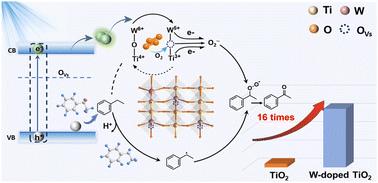
Photocatalytic oxidation of C(sp3)–H bonds using semiconducting catalysts offers a sustainable and promising route for value-added chemical production under milder conditions. However, the photocatalytic performance of semiconductor-based photocatalysts is severely restricted by the limited active sites and low photoredox activity. Herein, we doped redox-active W6+ ions into TiO2 to produce W-doped TiO2 nanocrystals with unique photochromic properties. W-doping effectively optimizes light harvesting, promotes charge carrier separation, and enriches the active sites for efficient photocatalytic oxidation of C(sp3)–H bonds. In particular, 10% W-doped TiO2 nanocrystals demonstrate exceptional acetophenone production of 235 mmol g−1 under 437 nm light irradiation, which is 16 times higher than that of pure TiO2 nanocrystals. Furthermore, mechanistic analyses suggest that the photochromic effect-induced W5+–Ovs–Ti3+ (oxygen vacancies denoted by Ovs) active sites in W-doped TiO2 nanocrystals act as electron trapping centers to capture and store photogenerated electrons, promoting the photogenerated holes to activate C(sp3)–H bonds. Moreover, the Ovs and stored photogenerated electrons on the active sites significantly enhance the adsorption and activation of O2 to O2˙−. These O2˙− can directly react with benzylic C(sp3)˙ radicals upon light irradiation, generating acetophenone and thereby enhancing photocatalytic performance. This work showcases a feasible strategy to realize highly efficient ethylbenzene oxidation by designing photochromic photocatalysts.




 京公网安备 11010802042870号
京ICP备2023020795号-1
京公网安备 11010802042870号
京ICP备2023020795号-1

 分享
分享
 求助内容:
求助内容: 应助结果提醒方式:
 扫码关注我们
