{"title":"Magnesium borohydride pyridine derivatives as electrolytes for all-solid-state batteries†","authors":"Jakob B. Grinderslev and Torben R. Jensen","doi":"10.1039/D5TA00239G","DOIUrl":null,"url":null,"abstract":"<p >All-solid-state batteries based on abundant elements may pave the way for safer and cheaper energy storage. Magnesium borohydride derivatives with neutral ligands are a new emerging class of solid-state Mg<small><sup>2+</sup></small> ionic conductors, and here we report the discovery of two new pyridine derivatives, Mg(BH<small><sub>4</sub></small>)<small><sub>2</sub></small>·<em>x</em>N(CH)<small><sub>5</sub></small> (<em>x</em> = 2 or 3). Magnesium tetrahydridoborate tripyridine, Mg(BH<small><sub>4</sub></small>)<small><sub>2</sub></small>·3N(CH)<small><sub>5</sub></small>, crystallizes in the monoclinic space group <em>C</em>2/<em>c</em> and is built from molecular units consisting of trigonal bipyramidal [Mg(N(CH)<small><sub>5</sub></small>)<small><sub>3</sub></small>(BH<small><sub>4</sub></small>)<small><sub>2</sub></small>] complexes, where the pyridine molecules are packed efficiently as a result of π–π stacking. Magnesium tetrahydridoborate dipyridine, Mg(BH<small><sub>4</sub></small>)<small><sub>2</sub></small>·2N(CH)<small><sub>5</sub></small>, crystallizes in the monoclinic space group <em>C</em>2/<em>c</em> and is built from tetrahedral [Mg(N(CH)<small><sub>5</sub></small>)<small><sub>2</sub></small>(BH<small><sub>4</sub></small>)<small><sub>2</sub></small>] complexes. The highest ionic conductivity is observed for Mg(BH<small><sub>4</sub></small>)<small><sub>2</sub></small>·3N(CH)<small><sub>5</sub></small> with <em>σ</em>(Mg<small><sup>2+</sup></small>) = 7.2 × 10<small><sup>−5</sup></small> S cm<small><sup>−1</sup></small> at 24 °C, increasing to (Mg<small><sup>2+</sup></small>) = 1.4 × 10<small><sup>−4</sup></small> S cm<small><sup>−1</sup></small> at 49 °C. The low activation energy of 0.25 eV shows promise for low temperature conductivity. A low electronic conductivity of <em>σ</em><small><sub>e</sub></small> = 2.5 × 10<small><sup>−10</sup></small> S cm<small><sup>−1</sup></small> was determined for Mg(BH<small><sub>4</sub></small>)<small><sub>2</sub></small>·3N(CH)<small><sub>5</sub></small> at 24 °C, providing a high ionic transport number of <em>t</em><small><sub>ion</sub></small> = 0.999997.</p>","PeriodicalId":82,"journal":{"name":"Journal of Materials Chemistry A","volume":" 21","pages":" 15810-15817"},"PeriodicalIF":9.5000,"publicationDate":"2025-04-10","publicationTypes":"Journal Article","fieldsOfStudy":null,"isOpenAccess":false,"openAccessPdf":"","citationCount":"0","resultStr":null,"platform":"Semanticscholar","paperid":null,"PeriodicalName":"Journal of Materials Chemistry A","FirstCategoryId":"88","ListUrlMain":"https://pubs.rsc.org/en/content/articlelanding/2025/ta/d5ta00239g","RegionNum":2,"RegionCategory":"材料科学","ArticlePicture":[],"TitleCN":null,"AbstractTextCN":null,"PMCID":null,"EPubDate":"","PubModel":"","JCR":"Q1","JCRName":"CHEMISTRY, PHYSICAL","Score":null,"Total":0}
引用次数: 0
Abstract
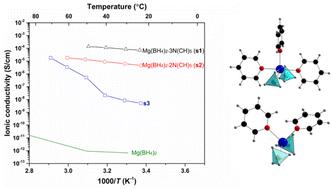
All-solid-state batteries based on abundant elements may pave the way for safer and cheaper energy storage. Magnesium borohydride derivatives with neutral ligands are a new emerging class of solid-state Mg2+ ionic conductors, and here we report the discovery of two new pyridine derivatives, Mg(BH4)2·xN(CH)5 (x = 2 or 3). Magnesium tetrahydridoborate tripyridine, Mg(BH4)2·3N(CH)5, crystallizes in the monoclinic space group C2/c and is built from molecular units consisting of trigonal bipyramidal [Mg(N(CH)5)3(BH4)2] complexes, where the pyridine molecules are packed efficiently as a result of π–π stacking. Magnesium tetrahydridoborate dipyridine, Mg(BH4)2·2N(CH)5, crystallizes in the monoclinic space group C2/c and is built from tetrahedral [Mg(N(CH)5)2(BH4)2] complexes. The highest ionic conductivity is observed for Mg(BH4)2·3N(CH)5 with σ(Mg2+) = 7.2 × 10⁻⁵ S cm−1 at 24 °C, increasing to (Mg2+) = 1.4 × 10⁻⁴ S cm−1 at 49 °C. The low activation energy of 0.25 eV shows promise for low temperature conductivity. A low electronic conductivity of σe = 2.5 × 10⁻¹⁰ S cm−1 was determined for Mg(BH4)2·3N(CH)5 at 24 °C, providing a high ionic transport number of tion = 0.999997.
期刊介绍:
The Journal of Materials Chemistry A, B & C covers a wide range of high-quality studies in the field of materials chemistry, with each section focusing on specific applications of the materials studied. Journal of Materials Chemistry A emphasizes applications in energy and sustainability, including topics such as artificial photosynthesis, batteries, and fuel cells. Journal of Materials Chemistry B focuses on applications in biology and medicine, while Journal of Materials Chemistry C covers applications in optical, magnetic, and electronic devices. Example topic areas within the scope of Journal of Materials Chemistry A include catalysis, green/sustainable materials, sensors, and water treatment, among others.




 京公网安备 11010802042870号
京ICP备2023020795号-1
京公网安备 11010802042870号
京ICP备2023020795号-1

 分享
分享
 求助内容:
求助内容: 应助结果提醒方式:
 扫码关注我们
