Lorena Hernández-García, Joheen Chakraborty, Paula Sánchez-Sáez, Claudio Ricci, Jorge Cuadra, Barry McKernan, K. E. Saavik Ford, Patricia Arévalo, Arne Rau, Riccardo Arcodia, Erin Kara, Zhu Liu, Andrea Merloni, Gabriele Bruni, Adelle Goodwin, Zaven Arzoumanian, Roberto J. Assef, Pietro Baldini, Amelia Bayo, Franz E. Bauer, Santiago Bernal, Murray Brightman, Gabriela Calistro Rivera, Keith Gendreau, David Homan, Mirko Krumpe, Paulina Lira, Mary Loli Martínez-Aldama, Mara Salvato, Belén Sotomayor
{"title":"Discovery of extreme quasi-periodic eruptions in a newly accreting massive black hole","authors":"Lorena Hernández-García, Joheen Chakraborty, Paula Sánchez-Sáez, Claudio Ricci, Jorge Cuadra, Barry McKernan, K. E. Saavik Ford, Patricia Arévalo, Arne Rau, Riccardo Arcodia, Erin Kara, Zhu Liu, Andrea Merloni, Gabriele Bruni, Adelle Goodwin, Zaven Arzoumanian, Roberto J. Assef, Pietro Baldini, Amelia Bayo, Franz E. Bauer, Santiago Bernal, Murray Brightman, Gabriela Calistro Rivera, Keith Gendreau, David Homan, Mirko Krumpe, Paulina Lira, Mary Loli Martínez-Aldama, Mara Salvato, Belén Sotomayor","doi":"10.1038/s41550-025-02523-9","DOIUrl":null,"url":null,"abstract":"Quasi-periodic eruptions (QPEs) are rapid, recurring X-ray bursts from supermassive black holes, believed to result from interactions between accretion disks and surrounding matter. The galaxy SDSS1335+0728, previously stable for two decades, exhibited an increase in optical brightness in December 2019, followed by persistent active galactic nucleus (AGN)-like variability for 5 yr, suggesting the activation of a ~106-M⊙ black hole. Since February 2024, X-ray emission has been detected, revealing extreme ~4.5-d QPEs with high fluxes and amplitudes, long timescales, large integrated energies and a ~25-d superperiod. Low-significance UV variations are reported, probably related to the long timescales and large radii from which the emission originates. This discovery broadens the possible formation channels for QPEs, suggesting that they are linked not solely to tidal disruption events but more generally to newly formed accretion flows, which we are witnessing in real time in a turn-on AGN candidate. In February 2024, rapid, recurring X-ray bursts (quasi-periodic eruptions) were detected from the black hole within galaxy SDSS1335+0728. Named Ansky, the event features day-and-a-half-long flares and extreme energy levels, challenging existing models.","PeriodicalId":18778,"journal":{"name":"Nature Astronomy","volume":"9 6","pages":"895-906"},"PeriodicalIF":14.3000,"publicationDate":"2025-04-11","publicationTypes":"Journal Article","fieldsOfStudy":null,"isOpenAccess":false,"openAccessPdf":"","citationCount":"0","resultStr":null,"platform":"Semanticscholar","paperid":null,"PeriodicalName":"Nature Astronomy","FirstCategoryId":"101","ListUrlMain":"https://www.nature.com/articles/s41550-025-02523-9","RegionNum":1,"RegionCategory":"物理与天体物理","ArticlePicture":[],"TitleCN":null,"AbstractTextCN":null,"PMCID":null,"EPubDate":"","PubModel":"","JCR":"Q1","JCRName":"ASTRONOMY & ASTROPHYSICS","Score":null,"Total":0}
引用次数: 0
Abstract
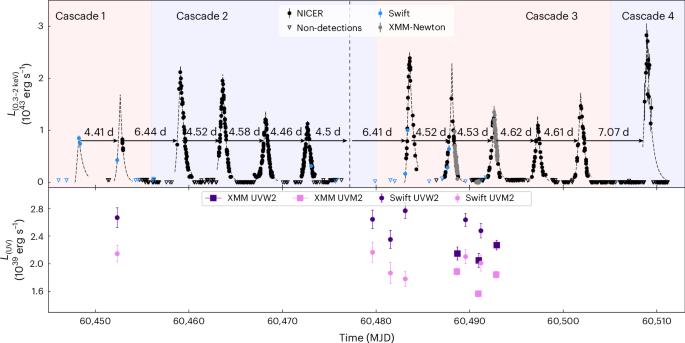
Quasi-periodic eruptions (QPEs) are rapid, recurring X-ray bursts from supermassive black holes, believed to result from interactions between accretion disks and surrounding matter. The galaxy SDSS1335+0728, previously stable for two decades, exhibited an increase in optical brightness in December 2019, followed by persistent active galactic nucleus (AGN)-like variability for 5 yr, suggesting the activation of a ~106-M⊙ black hole. Since February 2024, X-ray emission has been detected, revealing extreme ~4.5-d QPEs with high fluxes and amplitudes, long timescales, large integrated energies and a ~25-d superperiod. Low-significance UV variations are reported, probably related to the long timescales and large radii from which the emission originates. This discovery broadens the possible formation channels for QPEs, suggesting that they are linked not solely to tidal disruption events but more generally to newly formed accretion flows, which we are witnessing in real time in a turn-on AGN candidate. In February 2024, rapid, recurring X-ray bursts (quasi-periodic eruptions) were detected from the black hole within galaxy SDSS1335+0728. Named Ansky, the event features day-and-a-half-long flares and extreme energy levels, challenging existing models.
准周期喷发(qpe)是超大质量黑洞快速、反复出现的x射线爆发,据信是吸积盘与周围物质相互作用的结果。此前稳定了20年的星系SDSS1335+0728在2019年12月表现出光学亮度的增加,随后持续了5年的活动星系核(AGN)样变化,表明激活了一个~106 m⊙黑洞。自2024年2月以来,已经检测到x射线发射,揭示了具有高通量和振幅,长时间尺度,大集成能量和~25 d超周期的极端~4.5 d qpe。据报道,紫外线的低显著性变化可能与发射源的长时间尺度和大半径有关。这一发现拓宽了qpe的可能形成渠道,表明它们不仅与潮汐破坏事件有关,而且更普遍地与新形成的吸积流有关,这是我们在AGN候选者中实时目睹的。
Nature AstronomyPhysics and Astronomy-Astronomy and Astrophysics
CiteScore
19.50
自引率
2.80%
发文量
252
期刊介绍:
Nature Astronomy, the oldest science, has played a significant role in the history of Nature. Throughout the years, pioneering discoveries such as the first quasar, exoplanet, and understanding of spiral nebulae have been reported in the journal. With the introduction of Nature Astronomy, the field now receives expanded coverage, welcoming research in astronomy, astrophysics, and planetary science. The primary objective is to encourage closer collaboration among researchers in these related areas.
Similar to other journals under the Nature brand, Nature Astronomy boasts a devoted team of professional editors, ensuring fairness and rigorous peer-review processes. The journal maintains high standards in copy-editing and production, ensuring timely publication and editorial independence.
In addition to original research, Nature Astronomy publishes a wide range of content, including Comments, Reviews, News and Views, Features, and Correspondence. This diverse collection covers various disciplines within astronomy and includes contributions from a diverse range of voices.




 京公网安备 11010802042870号
京ICP备2023020795号-1
京公网安备 11010802042870号
京ICP备2023020795号-1

 分享
分享
 求助内容:
求助内容: 应助结果提醒方式:
 扫码关注我们
