Promotion or suppression of hydrogen evolution activity? The competition between sodium cations and quaternary ammonium ions at the metal/water interface†
Shilin Bo, Yang Xiang, Qiong Xiang, Li Li, Xun Huang and Zidong Wei
{"title":"Promotion or suppression of hydrogen evolution activity? The competition between sodium cations and quaternary ammonium ions at the metal/water interface†","authors":"Shilin Bo, Yang Xiang, Qiong Xiang, Li Li, Xun Huang and Zidong Wei","doi":"10.1039/D5SC01034A","DOIUrl":null,"url":null,"abstract":"<p >Quaternary ammonium salts (QASs) are frequently utilized to modulate the structure of the cathodic electric double layer in processes such as water electrolysis and hydrogenation reactions. However, literature reports have shown that QASs can both suppress and promote hydrogen evolution activity, yet the underlying mechanisms remain incompletely understood. In this study, we experimentally observed that the presence of QASs alone accelerates hydrogen evolution compared to NaOH solutions. Conversely, when the QAS is combined with Na<small><sup>+</sup></small> or H<small><sup>+</sup></small>, it inhibits hydrogen evolution. <em>Ab initio</em> molecular dynamics simulation and surface-enhanced infrared absorption spectroscopy results indicate that Na<small><sup>+</sup></small> ions disrupt the hydrogen bond network at the interface, leading to a disorder in the water chain arrangement. In contrast, QASs enhance the hydrogen bond network, thereby facilitating the hydrogen evolution reaction. However, coexistence of Na<small><sup>+</sup></small> and QASs leads to hydration competition, creating gaps in the hydrogen bond network near the surface and impeding hydrogen transport. These findings enhance our understanding of QASs in hydrogen evolution and guide future interface modulation strategies.</p>","PeriodicalId":9909,"journal":{"name":"Chemical Science","volume":" 20","pages":" 8922-8931"},"PeriodicalIF":7.4000,"publicationDate":"2025-04-11","publicationTypes":"Journal Article","fieldsOfStudy":null,"isOpenAccess":false,"openAccessPdf":"https://pubs.rsc.org/en/content/articlepdf/2025/sc/d5sc01034a?page=search","citationCount":"0","resultStr":null,"platform":"Semanticscholar","paperid":null,"PeriodicalName":"Chemical Science","FirstCategoryId":"92","ListUrlMain":"https://pubs.rsc.org/en/content/articlelanding/2025/sc/d5sc01034a","RegionNum":1,"RegionCategory":"化学","ArticlePicture":[],"TitleCN":null,"AbstractTextCN":null,"PMCID":null,"EPubDate":"","PubModel":"","JCR":"Q1","JCRName":"CHEMISTRY, MULTIDISCIPLINARY","Score":null,"Total":0}
引用次数: 0
Abstract
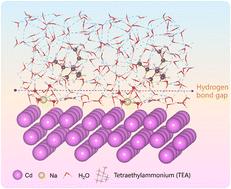
Quaternary ammonium salts (QASs) are frequently utilized to modulate the structure of the cathodic electric double layer in processes such as water electrolysis and hydrogenation reactions. However, literature reports have shown that QASs can both suppress and promote hydrogen evolution activity, yet the underlying mechanisms remain incompletely understood. In this study, we experimentally observed that the presence of QASs alone accelerates hydrogen evolution compared to NaOH solutions. Conversely, when the QAS is combined with Na+ or H+, it inhibits hydrogen evolution. Ab initio molecular dynamics simulation and surface-enhanced infrared absorption spectroscopy results indicate that Na+ ions disrupt the hydrogen bond network at the interface, leading to a disorder in the water chain arrangement. In contrast, QASs enhance the hydrogen bond network, thereby facilitating the hydrogen evolution reaction. However, coexistence of Na+ and QASs leads to hydration competition, creating gaps in the hydrogen bond network near the surface and impeding hydrogen transport. These findings enhance our understanding of QASs in hydrogen evolution and guide future interface modulation strategies.
期刊介绍:
Chemical Science is a journal that encompasses various disciplines within the chemical sciences. Its scope includes publishing ground-breaking research with significant implications for its respective field, as well as appealing to a wider audience in related areas. To be considered for publication, articles must showcase innovative and original advances in their field of study and be presented in a manner that is understandable to scientists from diverse backgrounds. However, the journal generally does not publish highly specialized research.





 京公网安备 11010802042870号
京ICP备2023020795号-1
京公网安备 11010802042870号
京ICP备2023020795号-1

 分享
分享
 求助内容:
求助内容: 应助结果提醒方式:
 扫码关注我们
