Byron J. Smith, Chunyu Zhao, Veronika Dubinkina, Xiaofan Jin, Liron Zahavi, Saar Shoer, Jacqueline Moltzau-Anderson, Eran Segal, Katherine S. Pollard
{"title":"Accurate estimation of intraspecific microbial gene content variation in metagenomic data with MIDAS v3 and StrainPGC","authors":"Byron J. Smith, Chunyu Zhao, Veronika Dubinkina, Xiaofan Jin, Liron Zahavi, Saar Shoer, Jacqueline Moltzau-Anderson, Eran Segal, Katherine S. Pollard","doi":"10.1101/gr.279543.124","DOIUrl":null,"url":null,"abstract":"Metagenomics has greatly expanded our understanding of the human gut microbiome by revealing a vast diversity of bacterial species within and across individuals. Even within a single species, different strains can have highly divergent gene content, affecting traits such as antibiotic resistance, metabolism, and virulence. Methods that harness metagenomic data to resolve strain-level differences in functional potential are crucial for understanding the causes and consequences of this intraspecific diversity. The enormous size of pangenome references, strain mixing within samples, and inconsistent sequencing depth present challenges for existing tools that analyze samples one at a time. To address this gap, we updated the MIDAS pangenome profiler, now released as version 3, and developed StrainPGC, an approach to strain-specific gene content estimation that combines strain tracking and correlations across multiple samples. We validate our integrated analysis using a complex synthetic community of strains from the human gut and find that StrainPGC outperforms existing approaches. Analyzing a large, publicly available metagenome collection from inflammatory bowel disease patients and healthy controls, we catalog the functional repertoires of thousands of strains across hundreds of species, capturing extensive diversity missing from reference databases. Finally, we apply StrainPGC to metagenomes from a clinical trial of fecal microbiota transplantation for the treatment of ulcerative colitis. We identify two <em>Escherichia coli</em> strains, from two different donors, that are both frequently transmitted to patients but have notable differences in functional potential. StrainPGC and MIDAS v3 together enable precise, intraspecific pangenomic investigations using large collections of metagenomic data without microbial isolation or de novo assembly.","PeriodicalId":12678,"journal":{"name":"Genome research","volume":"4 1","pages":""},"PeriodicalIF":5.5000,"publicationDate":"2025-04-10","publicationTypes":"Journal Article","fieldsOfStudy":null,"isOpenAccess":false,"openAccessPdf":"","citationCount":"0","resultStr":null,"platform":"Semanticscholar","paperid":null,"PeriodicalName":"Genome research","FirstCategoryId":"99","ListUrlMain":"https://doi.org/10.1101/gr.279543.124","RegionNum":2,"RegionCategory":"生物学","ArticlePicture":[],"TitleCN":null,"AbstractTextCN":null,"PMCID":null,"EPubDate":"","PubModel":"","JCR":"Q1","JCRName":"BIOCHEMISTRY & MOLECULAR BIOLOGY","Score":null,"Total":0}
引用次数: 0
Abstract
Metagenomics has greatly expanded our understanding of the human gut microbiome by revealing a vast diversity of bacterial species within and across individuals. Even within a single species, different strains can have highly divergent gene content, affecting traits such as antibiotic resistance, metabolism, and virulence. Methods that harness metagenomic data to resolve strain-level differences in functional potential are crucial for understanding the causes and consequences of this intraspecific diversity. The enormous size of pangenome references, strain mixing within samples, and inconsistent sequencing depth present challenges for existing tools that analyze samples one at a time. To address this gap, we updated the MIDAS pangenome profiler, now released as version 3, and developed StrainPGC, an approach to strain-specific gene content estimation that combines strain tracking and correlations across multiple samples. We validate our integrated analysis using a complex synthetic community of strains from the human gut and find that StrainPGC outperforms existing approaches. Analyzing a large, publicly available metagenome collection from inflammatory bowel disease patients and healthy controls, we catalog the functional repertoires of thousands of strains across hundreds of species, capturing extensive diversity missing from reference databases. Finally, we apply StrainPGC to metagenomes from a clinical trial of fecal microbiota transplantation for the treatment of ulcerative colitis. We identify two Escherichia coli strains, from two different donors, that are both frequently transmitted to patients but have notable differences in functional potential. StrainPGC and MIDAS v3 together enable precise, intraspecific pangenomic investigations using large collections of metagenomic data without microbial isolation or de novo assembly.
期刊介绍:
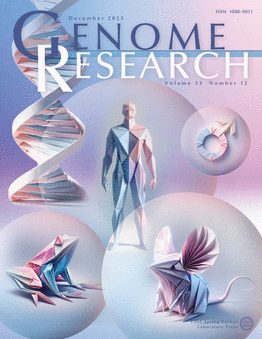
Launched in 1995, Genome Research is an international, continuously published, peer-reviewed journal that focuses on research that provides novel insights into the genome biology of all organisms, including advances in genomic medicine.
Among the topics considered by the journal are genome structure and function, comparative genomics, molecular evolution, genome-scale quantitative and population genetics, proteomics, epigenomics, and systems biology. The journal also features exciting gene discoveries and reports of cutting-edge computational biology and high-throughput methodologies.
New data in these areas are published as research papers, or methods and resource reports that provide novel information on technologies or tools that will be of interest to a broad readership. Complete data sets are presented electronically on the journal''s web site where appropriate. The journal also provides Reviews, Perspectives, and Insight/Outlook articles, which present commentary on the latest advances published both here and elsewhere, placing such progress in its broader biological context.




 京公网安备 11010802042870号
京ICP备2023020795号-1
京公网安备 11010802042870号
京ICP备2023020795号-1

 分享
分享
 求助内容:
求助内容: 应助结果提醒方式:
 扫码关注我们
