Efficient Production of 2,5-Furandicarboxylic Acid via Chemobiocatalytic Sequential Catalysis of Bread Waste in a One-Pot, Three-Step Process Manner in a Benign Reaction System
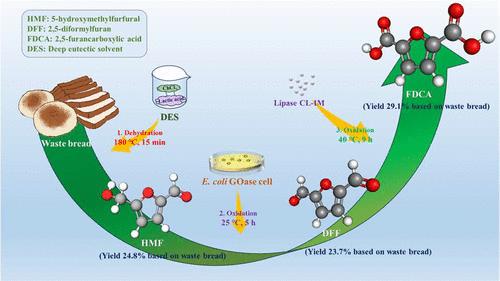
{"title":"Efficient Production of 2,5-Furandicarboxylic Acid via Chemobiocatalytic Sequential Catalysis of Bread Waste in a One-Pot, Three-Step Process Manner in a Benign Reaction System","authors":"Xinran Liu, Yucai He, Cuiluan Ma, Mingming Zheng","doi":"10.1021/acssuschemeng.5c00976","DOIUrl":null,"url":null,"abstract":"2,5-Furandicarboxylic acid (FDCA) is an essential biobased dibasic acid with a structure similar to that of the petroleum-based bulk chemical terephthalic acid. In this research, a highly effectual catalytic process was acquired to transform waste bread (WB) into FDCA in a one-pot, three-step approach. First, 5-hydroxymethylfurfural (24.8 wt % yield) was acquired from WB (40 g/L) in the deep eutectic solvent (DES) choline chloride:lactic acid (ChCl:LA)-H<sub>2</sub>O (ChCl:LA, 15 wt %) medium for 15 min at 180 °C. The WB-derived HMF was oxidized to 2,5-furandicarboxaldehyde (97.4% yield) using <i>Escherichia coli</i> pRSFDuet-GOase within 5 h. Afterward, WB-derived DFF was transformed to FDCA (0.291 g of FDCA per g of WB) using immobilized lipase powder CL (CL-IM) in <i>tert</i>-butanol:ethyl acetate (<i>t-</i>BuOH:EtOAc = 1:1, v/v) at 40 °C for 9 h. This chemobiological route from food waste to FDCA afforded a new idea for valorization of waste into valuable biobased chemicals in a green and effectual way.","PeriodicalId":25,"journal":{"name":"ACS Sustainable Chemistry & Engineering","volume":"66 1","pages":""},"PeriodicalIF":7.3000,"publicationDate":"2025-04-10","publicationTypes":"Journal Article","fieldsOfStudy":null,"isOpenAccess":false,"openAccessPdf":"","citationCount":"0","resultStr":null,"platform":"Semanticscholar","paperid":null,"PeriodicalName":"ACS Sustainable Chemistry & Engineering","FirstCategoryId":"92","ListUrlMain":"https://doi.org/10.1021/acssuschemeng.5c00976","RegionNum":1,"RegionCategory":"化学","ArticlePicture":[],"TitleCN":null,"AbstractTextCN":null,"PMCID":null,"EPubDate":"","PubModel":"","JCR":"Q1","JCRName":"CHEMISTRY, MULTIDISCIPLINARY","Score":null,"Total":0}
引用次数: 0
Abstract
2,5-Furandicarboxylic acid (FDCA) is an essential biobased dibasic acid with a structure similar to that of the petroleum-based bulk chemical terephthalic acid. In this research, a highly effectual catalytic process was acquired to transform waste bread (WB) into FDCA in a one-pot, three-step approach. First, 5-hydroxymethylfurfural (24.8 wt % yield) was acquired from WB (40 g/L) in the deep eutectic solvent (DES) choline chloride:lactic acid (ChCl:LA)-H2O (ChCl:LA, 15 wt %) medium for 15 min at 180 °C. The WB-derived HMF was oxidized to 2,5-furandicarboxaldehyde (97.4% yield) using Escherichia coli pRSFDuet-GOase within 5 h. Afterward, WB-derived DFF was transformed to FDCA (0.291 g of FDCA per g of WB) using immobilized lipase powder CL (CL-IM) in tert-butanol:ethyl acetate (t-BuOH:EtOAc = 1:1, v/v) at 40 °C for 9 h. This chemobiological route from food waste to FDCA afforded a new idea for valorization of waste into valuable biobased chemicals in a green and effectual way.
期刊介绍:
ACS Sustainable Chemistry & Engineering is a prestigious weekly peer-reviewed scientific journal published by the American Chemical Society. Dedicated to advancing the principles of green chemistry and green engineering, it covers a wide array of research topics including green chemistry, green engineering, biomass, alternative energy, and life cycle assessment.
The journal welcomes submissions in various formats, including Letters, Articles, Features, and Perspectives (Reviews), that address the challenges of sustainability in the chemical enterprise and contribute to the advancement of sustainable practices. Join us in shaping the future of sustainable chemistry and engineering.




 京公网安备 11010802042870号
京ICP备2023020795号-1
京公网安备 11010802042870号
京ICP备2023020795号-1

 分享
分享
 求助内容:
求助内容: 应助结果提醒方式:
 扫码关注我们
