{"title":"Hydrothermal Conversion of Forest-Based Biomass to Hydrogen","authors":"Marvellous Oluwaferanmi Faluyi, Sibel Irmak","doi":"10.1021/acssuschemeng.5c01301","DOIUrl":null,"url":null,"abstract":"The Northeastern United States is a heavily forested area with an increasing demand for energy because of its high population. The forests are promising resources for fulfilling this need. This research was designed to assess the utilization of various forest-based biomass (hardwoods, softwoods, and invasive plant species) for hydrogen production by hydrothermal gasification under mild gasification conditions (250 °C for 90 min). Total organic carbon, carbohydrate content, and lignin breakdown components of the biomass feeds were compared and linked to the overall gasification performance and hydrogen production yield for the forest-based biomass studied. The gasification of the biomass hydrolysates in the presence of a carbon-supported 10% Pt catalyst resulted in gas mixtures that were composed of more than 90% hydrogen. It was observed that mostly carbohydrate-derived compounds were consumed to produce gaseous products, while lignin-derived compounds in the biomass hydrolysates were not very reactive in the hydrothermal gasification reactions. Softwoods (eastern hemlock, spruce, and loblolly pine) produced more gaseous products than hardwoods studied (black walnut and soft maple). The average of the total gas mixture produced from hardwoods (385 ± 15 mL) was lower than that of softwoods (543 ± 25 mL). The gasification performance of invasive biomass, Japanese honeysuckle, and sumac were the same as softwoods, while autumn olive was between softwoods and hardwoods.","PeriodicalId":25,"journal":{"name":"ACS Sustainable Chemistry & Engineering","volume":"218 1","pages":""},"PeriodicalIF":7.3000,"publicationDate":"2025-04-10","publicationTypes":"Journal Article","fieldsOfStudy":null,"isOpenAccess":false,"openAccessPdf":"","citationCount":"0","resultStr":null,"platform":"Semanticscholar","paperid":null,"PeriodicalName":"ACS Sustainable Chemistry & Engineering","FirstCategoryId":"92","ListUrlMain":"https://doi.org/10.1021/acssuschemeng.5c01301","RegionNum":1,"RegionCategory":"化学","ArticlePicture":[],"TitleCN":null,"AbstractTextCN":null,"PMCID":null,"EPubDate":"","PubModel":"","JCR":"Q1","JCRName":"CHEMISTRY, MULTIDISCIPLINARY","Score":null,"Total":0}
引用次数: 0
Abstract
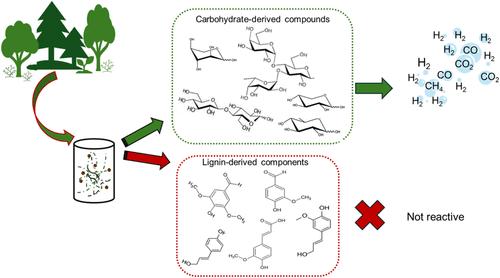
The Northeastern United States is a heavily forested area with an increasing demand for energy because of its high population. The forests are promising resources for fulfilling this need. This research was designed to assess the utilization of various forest-based biomass (hardwoods, softwoods, and invasive plant species) for hydrogen production by hydrothermal gasification under mild gasification conditions (250 °C for 90 min). Total organic carbon, carbohydrate content, and lignin breakdown components of the biomass feeds were compared and linked to the overall gasification performance and hydrogen production yield for the forest-based biomass studied. The gasification of the biomass hydrolysates in the presence of a carbon-supported 10% Pt catalyst resulted in gas mixtures that were composed of more than 90% hydrogen. It was observed that mostly carbohydrate-derived compounds were consumed to produce gaseous products, while lignin-derived compounds in the biomass hydrolysates were not very reactive in the hydrothermal gasification reactions. Softwoods (eastern hemlock, spruce, and loblolly pine) produced more gaseous products than hardwoods studied (black walnut and soft maple). The average of the total gas mixture produced from hardwoods (385 ± 15 mL) was lower than that of softwoods (543 ± 25 mL). The gasification performance of invasive biomass, Japanese honeysuckle, and sumac were the same as softwoods, while autumn olive was between softwoods and hardwoods.
期刊介绍:
ACS Sustainable Chemistry & Engineering is a prestigious weekly peer-reviewed scientific journal published by the American Chemical Society. Dedicated to advancing the principles of green chemistry and green engineering, it covers a wide array of research topics including green chemistry, green engineering, biomass, alternative energy, and life cycle assessment.
The journal welcomes submissions in various formats, including Letters, Articles, Features, and Perspectives (Reviews), that address the challenges of sustainability in the chemical enterprise and contribute to the advancement of sustainable practices. Join us in shaping the future of sustainable chemistry and engineering.



 京公网安备 11010802042870号
京ICP备2023020795号-1
京公网安备 11010802042870号
京ICP备2023020795号-1

 分享
分享
 求助内容:
求助内容: 应助结果提醒方式:
 扫码关注我们
