{"title":"Strategies to Improve the Sustainability of Silicone Polymers","authors":"Michael A. Brook, Yang Chen","doi":"10.1021/acs.macromol.5c00179","DOIUrl":null,"url":null,"abstract":"Silicones underpin an enormous range of simple and advanced technologies. Often, only small quantities of silicone are used to enable a technology such that, on a “per use” basis, one might suppose the environmental impact is low. However, silicone preparation processes have a very high carbon footprint, and billions of kg are produced each year. To provide context to the consideration of new strategies to improve silicone sustainability, we first outline traditional silicone chemistry and then describe strategies to improve the degree to which silicones are green, sustainable and circular. One strategy involves dilution of the silicone oil or elastomer by tethering organic entities, particularly natural products, that may provide new properties including facilitated degradation in nature at end-of-life. A greater focus is given to strategies that permit extensive reuse and repurposing of oils and elastomers (e.g., with thermoplastic elastomers), before the silicone undergoes recycling. Each reuse, repurposing or recycling step reduces the net carbon footprint. These mostly involve straightforward, high-yielding organic chemical processes that work efficiently in a silicone milieu. Silicones will eventually end up in the environment, where linear oils are known to rapidly degrade, particularly when compared to organic polymers. Alternative strategies that permit triggered or biological degradation of oils and, more importantly elastomers, are described, including enzymatic degradation and composting.","PeriodicalId":51,"journal":{"name":"Macromolecules","volume":"14 1","pages":""},"PeriodicalIF":5.2000,"publicationDate":"2025-04-11","publicationTypes":"Journal Article","fieldsOfStudy":null,"isOpenAccess":false,"openAccessPdf":"","citationCount":"0","resultStr":null,"platform":"Semanticscholar","paperid":null,"PeriodicalName":"Macromolecules","FirstCategoryId":"92","ListUrlMain":"https://doi.org/10.1021/acs.macromol.5c00179","RegionNum":1,"RegionCategory":"化学","ArticlePicture":[],"TitleCN":null,"AbstractTextCN":null,"PMCID":null,"EPubDate":"","PubModel":"","JCR":"Q1","JCRName":"POLYMER SCIENCE","Score":null,"Total":0}
引用次数: 0
Abstract
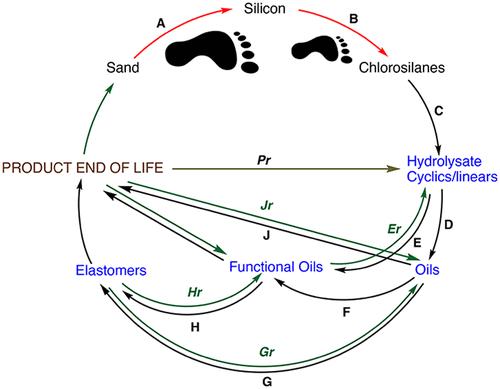
Silicones underpin an enormous range of simple and advanced technologies. Often, only small quantities of silicone are used to enable a technology such that, on a “per use” basis, one might suppose the environmental impact is low. However, silicone preparation processes have a very high carbon footprint, and billions of kg are produced each year. To provide context to the consideration of new strategies to improve silicone sustainability, we first outline traditional silicone chemistry and then describe strategies to improve the degree to which silicones are green, sustainable and circular. One strategy involves dilution of the silicone oil or elastomer by tethering organic entities, particularly natural products, that may provide new properties including facilitated degradation in nature at end-of-life. A greater focus is given to strategies that permit extensive reuse and repurposing of oils and elastomers (e.g., with thermoplastic elastomers), before the silicone undergoes recycling. Each reuse, repurposing or recycling step reduces the net carbon footprint. These mostly involve straightforward, high-yielding organic chemical processes that work efficiently in a silicone milieu. Silicones will eventually end up in the environment, where linear oils are known to rapidly degrade, particularly when compared to organic polymers. Alternative strategies that permit triggered or biological degradation of oils and, more importantly elastomers, are described, including enzymatic degradation and composting.
期刊介绍:
Macromolecules publishes original, fundamental, and impactful research on all aspects of polymer science. Topics of interest include synthesis (e.g., controlled polymerizations, polymerization catalysis, post polymerization modification, new monomer structures and polymer architectures, and polymerization mechanisms/kinetics analysis); phase behavior, thermodynamics, dynamic, and ordering/disordering phenomena (e.g., self-assembly, gelation, crystallization, solution/melt/solid-state characteristics); structure and properties (e.g., mechanical and rheological properties, surface/interfacial characteristics, electronic and transport properties); new state of the art characterization (e.g., spectroscopy, scattering, microscopy, rheology), simulation (e.g., Monte Carlo, molecular dynamics, multi-scale/coarse-grained modeling), and theoretical methods. Renewable/sustainable polymers, polymer networks, responsive polymers, electro-, magneto- and opto-active macromolecules, inorganic polymers, charge-transporting polymers (ion-containing, semiconducting, and conducting), nanostructured polymers, and polymer composites are also of interest. Typical papers published in Macromolecules showcase important and innovative concepts, experimental methods/observations, and theoretical/computational approaches that demonstrate a fundamental advance in the understanding of polymers.



 京公网安备 11010802042870号
京ICP备2023020795号-1
京公网安备 11010802042870号
京ICP备2023020795号-1

 分享
分享
 求助内容:
求助内容: 应助结果提醒方式:
 扫码关注我们
