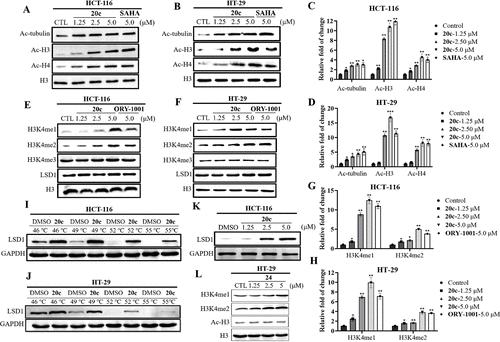
{"title":"Correction to “Discovery of Novel 5-Cyano-3-phenylindole-Based LSD1/HDAC Dual Inhibitors for Colorectal Cancer Treatment”","authors":"Hui-Juan Zhu, Hui-Min Zhou, Xiao-Xiao Zhou, Shi-Jie Li, Meng-Jie Zheng, Zhen Xu, Wen-Jing Dai, Yi-Bo Ban, Meng-Yao Zhang, Yi-Zhe Zhang, Jia-Rui Lu, Yong-Tao Xu, Sai-Qi Wang, Xiao-Jing Shi, Ying-Chao Duan","doi":"10.1021/acs.jmedchem.5c00900","DOIUrl":null,"url":null,"abstract":"In our study investigating the impact of target compound <b>20c</b> alongside positive control drugs (ORY-1001 and SAHA) on the expression levels of HDAC and LSD1 substrate proteins─specifically, Ac-tubulin, Ac-H3, Ac-H4, H3K4me1, H3K4me2, and H3K4me3─we conducted a series of experiments on different tumor cell lines, including HCT-116 and HT-29 cells. Regrettably, during the assembly of Figure 7 in the original manuscript, we inadvertently used an incorrect image for H3K4me1 and H3 in Figure 7E. Upon a recent and thorough review of the original manuscript and raw data, we identified this error and have now replaced the incorrect image with the correct one in the revised Figure 7. All authors have agreed to the change. The corrected figure still demonstrates that compound <b>20c</b> significantly upregulates the expression level of H3K4me1, and this correction do not alter the scientific conclusions of our study in any way. Figure 7. Compound <b>20c</b> simultaneously inhibited LSD1 and HDAC activities in HCT-116 and HT-29 cells. (A-D) Western blot analysis of the effects of compound <b>20c</b> on the expression levels of Ac-tubulin, Ac-H3, Ac-H4, and H3 in HCT-116 and HT-29 cells; (E–H) Western blot analysis of the effects of compound <b>20c</b> on the expression levels of H3K4me1, H3K4me2, H3K4me3, LSD1, and H3 in HCT-116 and HT-29 cells; (I, J) CETSA of LSD1 with <b>20c</b> at 5.0 μM in HCT-116 and HT-29 lysates for 6 h; (K) CETSA of LSD1 with <b>20c</b> at different concentrations (1.25, 2.5, and 5.0 μM) in HCT-116 lysates for 6 h; (L) Western blot analysis of the effects of compound <b>24</b> on the levels of H3K4me1, H3K4me2, and Ac-H3. We sincerely regret any confusion this may have caused and appreciate the readers’ understanding as we take the necessary steps to ensure the accuracy and integrity of our research. This article has not yet been cited by other publications.","PeriodicalId":46,"journal":{"name":"Journal of Medicinal Chemistry","volume":"108 1","pages":""},"PeriodicalIF":6.8000,"publicationDate":"2025-04-11","publicationTypes":"Journal Article","fieldsOfStudy":null,"isOpenAccess":false,"openAccessPdf":"","citationCount":"0","resultStr":null,"platform":"Semanticscholar","paperid":null,"PeriodicalName":"Journal of Medicinal Chemistry","FirstCategoryId":"3","ListUrlMain":"https://doi.org/10.1021/acs.jmedchem.5c00900","RegionNum":1,"RegionCategory":"医学","ArticlePicture":[],"TitleCN":null,"AbstractTextCN":null,"PMCID":null,"EPubDate":"","PubModel":"","JCR":"Q1","JCRName":"CHEMISTRY, MEDICINAL","Score":null,"Total":0}
引用次数: 0
Abstract
In our study investigating the impact of target compound 20c alongside positive control drugs (ORY-1001 and SAHA) on the expression levels of HDAC and LSD1 substrate proteins─specifically, Ac-tubulin, Ac-H3, Ac-H4, H3K4me1, H3K4me2, and H3K4me3─we conducted a series of experiments on different tumor cell lines, including HCT-116 and HT-29 cells. Regrettably, during the assembly of Figure 7 in the original manuscript, we inadvertently used an incorrect image for H3K4me1 and H3 in Figure 7E. Upon a recent and thorough review of the original manuscript and raw data, we identified this error and have now replaced the incorrect image with the correct one in the revised Figure 7. All authors have agreed to the change. The corrected figure still demonstrates that compound 20c significantly upregulates the expression level of H3K4me1, and this correction do not alter the scientific conclusions of our study in any way. Figure 7. Compound 20c simultaneously inhibited LSD1 and HDAC activities in HCT-116 and HT-29 cells. (A-D) Western blot analysis of the effects of compound 20c on the expression levels of Ac-tubulin, Ac-H3, Ac-H4, and H3 in HCT-116 and HT-29 cells; (E–H) Western blot analysis of the effects of compound 20c on the expression levels of H3K4me1, H3K4me2, H3K4me3, LSD1, and H3 in HCT-116 and HT-29 cells; (I, J) CETSA of LSD1 with 20c at 5.0 μM in HCT-116 and HT-29 lysates for 6 h; (K) CETSA of LSD1 with 20c at different concentrations (1.25, 2.5, and 5.0 μM) in HCT-116 lysates for 6 h; (L) Western blot analysis of the effects of compound 24 on the levels of H3K4me1, H3K4me2, and Ac-H3. We sincerely regret any confusion this may have caused and appreciate the readers’ understanding as we take the necessary steps to ensure the accuracy and integrity of our research. This article has not yet been cited by other publications.
期刊介绍:
The Journal of Medicinal Chemistry is a prestigious biweekly peer-reviewed publication that focuses on the multifaceted field of medicinal chemistry. Since its inception in 1959 as the Journal of Medicinal and Pharmaceutical Chemistry, it has evolved to become a cornerstone in the dissemination of research findings related to the design, synthesis, and development of therapeutic agents.
The Journal of Medicinal Chemistry is recognized for its significant impact in the scientific community, as evidenced by its 2022 impact factor of 7.3. This metric reflects the journal's influence and the importance of its content in shaping the future of drug discovery and development. The journal serves as a vital resource for chemists, pharmacologists, and other researchers interested in the molecular mechanisms of drug action and the optimization of therapeutic compounds.




 京公网安备 11010802042870号
京ICP备2023020795号-1
京公网安备 11010802042870号
京ICP备2023020795号-1

 分享
分享
 求助内容:
求助内容: 应助结果提醒方式:
 扫码关注我们
