{"title":"Solvent Effect on Bond Heterolytic Energy of Nickel Phenolate Complexes in Acetonitrile and Dimethyl Sulfoxide","authors":"Bin-Rui Mo, Jin-Dong Yang, Jin-Pei Cheng","doi":"10.1021/acs.jpclett.5c00645","DOIUrl":null,"url":null,"abstract":"Solvents can profoundly influence reaction outcomes and mechanisms through the solvation of the reaction components. Here, we determined the Ni–O bond heterolytic energy [Δ<i>G</i><sub>het</sub>(Ni–O)] of nickel phenolates using dimethyl sulfoxide (DMSO) and acetonitrile (MeCN) as solvents. The results showed that Δ<i>G</i><sub>het</sub>(Ni–O) in DMSO is larger than that in MeCN. This counterintuitive thermodynamics suggests that low-polarity MeCN can stabilize ionic species, generated from Ni–O bond heterolysis, more effectively than high-polarity DMSO, challenging the conventional notion of solvent polarity effects. Further experimental and theoretical studies elucidated the origin of this unique solvent effect, which cannot be observed in Pd–O systems. This work underscores the crucial role of solvents in modulating the stability of transition metal species, which can even reverse reaction thermodynamics.","PeriodicalId":62,"journal":{"name":"The Journal of Physical Chemistry Letters","volume":"66 1","pages":""},"PeriodicalIF":4.6000,"publicationDate":"2025-04-10","publicationTypes":"Journal Article","fieldsOfStudy":null,"isOpenAccess":false,"openAccessPdf":"","citationCount":"0","resultStr":null,"platform":"Semanticscholar","paperid":null,"PeriodicalName":"The Journal of Physical Chemistry Letters","FirstCategoryId":"1","ListUrlMain":"https://doi.org/10.1021/acs.jpclett.5c00645","RegionNum":2,"RegionCategory":"化学","ArticlePicture":[],"TitleCN":null,"AbstractTextCN":null,"PMCID":null,"EPubDate":"","PubModel":"","JCR":"Q2","JCRName":"CHEMISTRY, PHYSICAL","Score":null,"Total":0}
引用次数: 0
Abstract
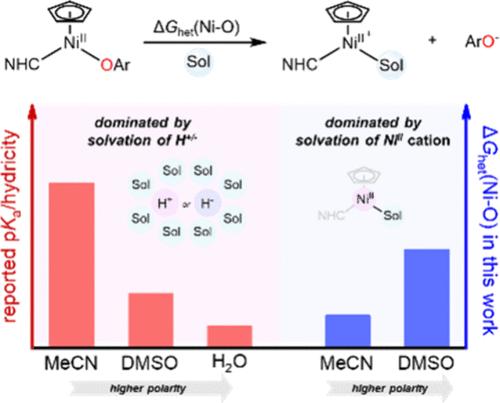
Solvents can profoundly influence reaction outcomes and mechanisms through the solvation of the reaction components. Here, we determined the Ni–O bond heterolytic energy [ΔGhet(Ni–O)] of nickel phenolates using dimethyl sulfoxide (DMSO) and acetonitrile (MeCN) as solvents. The results showed that ΔGhet(Ni–O) in DMSO is larger than that in MeCN. This counterintuitive thermodynamics suggests that low-polarity MeCN can stabilize ionic species, generated from Ni–O bond heterolysis, more effectively than high-polarity DMSO, challenging the conventional notion of solvent polarity effects. Further experimental and theoretical studies elucidated the origin of this unique solvent effect, which cannot be observed in Pd–O systems. This work underscores the crucial role of solvents in modulating the stability of transition metal species, which can even reverse reaction thermodynamics.
期刊介绍:
The Journal of Physical Chemistry (JPC) Letters is devoted to reporting new and original experimental and theoretical basic research of interest to physical chemists, biophysical chemists, chemical physicists, physicists, material scientists, and engineers. An important criterion for acceptance is that the paper reports a significant scientific advance and/or physical insight such that rapid publication is essential. Two issues of JPC Letters are published each month.



 京公网安备 11010802042870号
京ICP备2023020795号-1
京公网安备 11010802042870号
京ICP备2023020795号-1

 分享
分享
 求助内容:
求助内容: 应助结果提醒方式:
 扫码关注我们
