N-Iodosuccinimide-Promoted Synthesis of Indolo[3,2-c]quinolizines via Cascade Intramolecular C–N Bond Formation/Aromatization with 3-(1H-Indol-3-yl)-2-(pyridin-2-yl)propanoates
{"title":"N-Iodosuccinimide-Promoted Synthesis of Indolo[3,2-c]quinolizines via Cascade Intramolecular C–N Bond Formation/Aromatization with 3-(1H-Indol-3-yl)-2-(pyridin-2-yl)propanoates","authors":"Chen Chen, Xixiang Yang, Jiaxin Wang, Weiya Kong, Jianjun Chen, Xiaodong Tang","doi":"10.1021/acs.joc.4c03039","DOIUrl":null,"url":null,"abstract":"An NIS-promoted cascade of intramolecular C–N bond formation/aromatization with 3-(1<i>H</i>-indol-3-yl)-2-(pyridin-2-yl)propanoates is described for synthesizing a polycyclic indole skeleton, indolo[3,2-<i>c</i>]quinolizine, as well as 1,9-dihydropyrazolo[4’,3′:5,6]pyrido[2,3-<i>b</i>]indole. The advantages of this protocol include accessible starting materials, mild conditions, simple operation, and good yields. Indolo[3,2-<i>c</i>]quinolizines exhibited good fluorescence properties and effective staining for live cells, targeting lysosomes and mitochondria. Additionally, the products showed significant antiproliferative activity against tumor cells in the MTT assay.","PeriodicalId":57,"journal":{"name":"Journal of Organic Chemistry","volume":"74 1","pages":""},"PeriodicalIF":3.6000,"publicationDate":"2025-04-10","publicationTypes":"Journal Article","fieldsOfStudy":null,"isOpenAccess":false,"openAccessPdf":"","citationCount":"0","resultStr":null,"platform":"Semanticscholar","paperid":null,"PeriodicalName":"Journal of Organic Chemistry","FirstCategoryId":"1","ListUrlMain":"https://doi.org/10.1021/acs.joc.4c03039","RegionNum":2,"RegionCategory":"化学","ArticlePicture":[],"TitleCN":null,"AbstractTextCN":null,"PMCID":null,"EPubDate":"","PubModel":"","JCR":"Q1","JCRName":"CHEMISTRY, ORGANIC","Score":null,"Total":0}
引用次数: 0
Abstract
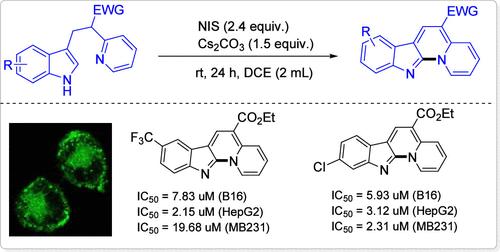
An NIS-promoted cascade of intramolecular C–N bond formation/aromatization with 3-(1H-indol-3-yl)-2-(pyridin-2-yl)propanoates is described for synthesizing a polycyclic indole skeleton, indolo[3,2-c]quinolizine, as well as 1,9-dihydropyrazolo[4’,3′:5,6]pyrido[2,3-b]indole. The advantages of this protocol include accessible starting materials, mild conditions, simple operation, and good yields. Indolo[3,2-c]quinolizines exhibited good fluorescence properties and effective staining for live cells, targeting lysosomes and mitochondria. Additionally, the products showed significant antiproliferative activity against tumor cells in the MTT assay.
期刊介绍:
Journal of Organic Chemistry welcomes original contributions of fundamental research in all branches of the theory and practice of organic chemistry. In selecting manuscripts for publication, the editors place emphasis on the quality and novelty of the work, as well as the breadth of interest to the organic chemistry community.



 京公网安备 11010802042870号
京ICP备2023020795号-1
京公网安备 11010802042870号
京ICP备2023020795号-1

 分享
分享
 求助内容:
求助内容: 应助结果提醒方式:
 扫码关注我们
