{"title":"Ferroelectric Rattling Enhances Thermoelectric Efficiency by Suppressing Thermal Transport in Metal Thio- and Selenophosphate Monolayers","authors":"Amir Ata Jalali, S. Shahab Naghavi","doi":"10.1021/acs.chemmater.5c00035","DOIUrl":null,"url":null,"abstract":"High-performance thermoelectric devices need materials with an optimal balance between low thermal conductivity and high electrical transport coefficients. Yet achieving such a balance is difficult. We address this challenge using M<sup>I</sup>M<sup>III</sup>P<sub>2</sub>Q<sub>6</sub> (M<sup>I</sup> = Ag, Cu; M<sup>III</sup> = Al, Ga, Sb, Bi, In, V, Sc, Cr; Q = S, Se) monolayers, which exploit ferroelectric and temperature-induced dynamical off-centering (i.e., emphanisis) instabilities to enhance thermoelectric efficiency. First-principles simulations show that above the Curie temperature, the rattling of coinage metal cations (Ag, Cu) suppresses lattice thermal conductivity in CuInP<sub>2</sub>S<sub>6</sub> down to the amorphous limit (0.19 W m<sup>–1</sup> K<sup>–1</sup>) without compromising the power factor. Even in nonferroelectric materials, rattling happens as emphanisis, causing ultralow lattice thermal transport between 0.07 and 0.3 W m<sup>–1</sup> K<sup>–1</sup> in AgBiP<sub>2</sub>Se<sub>6</sub>, AgInP<sub>2</sub>Se<sub>6</sub>, and AgGaP<sub>2</sub>Se<sub>6</sub>. The unprecedented glass-like lattice thermal conductivity in these monolayers, paired with the large electrical transport coefficients, yields predicted <i>zT</i> values surpassing two. These findings show that 2D M<sup>I</sup>M<sup>III</sup>P<sub>2</sub>Q<sub>6</sub> materials utilize ferroelectric instabilities to enhance their thermoelectric performance, unlocking an avenue for achieving a high figure of merit (<i>zT</i>) on the nanoscale.","PeriodicalId":33,"journal":{"name":"Chemistry of Materials","volume":"75 1","pages":""},"PeriodicalIF":7.0000,"publicationDate":"2025-04-11","publicationTypes":"Journal Article","fieldsOfStudy":null,"isOpenAccess":false,"openAccessPdf":"","citationCount":"0","resultStr":null,"platform":"Semanticscholar","paperid":null,"PeriodicalName":"Chemistry of Materials","FirstCategoryId":"88","ListUrlMain":"https://doi.org/10.1021/acs.chemmater.5c00035","RegionNum":2,"RegionCategory":"材料科学","ArticlePicture":[],"TitleCN":null,"AbstractTextCN":null,"PMCID":null,"EPubDate":"","PubModel":"","JCR":"Q2","JCRName":"CHEMISTRY, PHYSICAL","Score":null,"Total":0}
引用次数: 0
Abstract
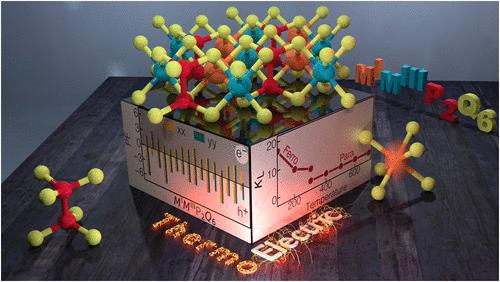
High-performance thermoelectric devices need materials with an optimal balance between low thermal conductivity and high electrical transport coefficients. Yet achieving such a balance is difficult. We address this challenge using MIMIIIP2Q6 (MI = Ag, Cu; MIII = Al, Ga, Sb, Bi, In, V, Sc, Cr; Q = S, Se) monolayers, which exploit ferroelectric and temperature-induced dynamical off-centering (i.e., emphanisis) instabilities to enhance thermoelectric efficiency. First-principles simulations show that above the Curie temperature, the rattling of coinage metal cations (Ag, Cu) suppresses lattice thermal conductivity in CuInP2S6 down to the amorphous limit (0.19 W m–1 K–1) without compromising the power factor. Even in nonferroelectric materials, rattling happens as emphanisis, causing ultralow lattice thermal transport between 0.07 and 0.3 W m–1 K–1 in AgBiP2Se6, AgInP2Se6, and AgGaP2Se6. The unprecedented glass-like lattice thermal conductivity in these monolayers, paired with the large electrical transport coefficients, yields predicted zT values surpassing two. These findings show that 2D MIMIIIP2Q6 materials utilize ferroelectric instabilities to enhance their thermoelectric performance, unlocking an avenue for achieving a high figure of merit (zT) on the nanoscale.
期刊介绍:
The journal Chemistry of Materials focuses on publishing original research at the intersection of materials science and chemistry. The studies published in the journal involve chemistry as a prominent component and explore topics such as the design, synthesis, characterization, processing, understanding, and application of functional or potentially functional materials. The journal covers various areas of interest, including inorganic and organic solid-state chemistry, nanomaterials, biomaterials, thin films and polymers, and composite/hybrid materials. The journal particularly seeks papers that highlight the creation or development of innovative materials with novel optical, electrical, magnetic, catalytic, or mechanical properties. It is essential that manuscripts on these topics have a primary focus on the chemistry of materials and represent a significant advancement compared to prior research. Before external reviews are sought, submitted manuscripts undergo a review process by a minimum of two editors to ensure their appropriateness for the journal and the presence of sufficient evidence of a significant advance that will be of broad interest to the materials chemistry community.



 京公网安备 11010802042870号
京ICP备2023020795号-1
京公网安备 11010802042870号
京ICP备2023020795号-1

 分享
分享
 求助内容:
求助内容: 应助结果提醒方式:
 扫码关注我们
