Shakkira Erimban, Matias H. Factorovich, Ignacio J. Bombau, John J. Karnes, Esteban D. Gadea, Johanna J. Schwartz, Valeria Molinero
{"title":"Ether Cleavage Decreases the Ion Exchange Capacity of Anion Exchange Membranes","authors":"Shakkira Erimban, Matias H. Factorovich, Ignacio J. Bombau, John J. Karnes, Esteban D. Gadea, Johanna J. Schwartz, Valeria Molinero","doi":"10.1021/acs.chemmater.5c00273","DOIUrl":null,"url":null,"abstract":"Anion exchange membranes (AEMs) are integral to fuel cells and water electrolysis systems but suffer from poor durability under alkaline conditions. Ether cleavage is an important failure pathway of poly(arylene ether)-based AEMs that compromises both mechanical stability and ion transport. While this degradation pathway is often studied in terms of polymer fragmentation, the role of newly formed hydrophilic groups has been largely overlooked. We show that polymer scission leads to reduced mechanical rigidity, while the introduction of hydrophilic groups partially mitigates this loss. Under alkaline conditions, phenoxide groups formed during ether cleavage neutralize the polymer cations, leading to a previously unreported loss of ion exchange capacity (IEC). This IEC loss mechanism exacerbates the reduction in ionic conductivity, emphasizing the severity of ether cleavage as a degradation pathway. Recognizing that ether cleavage introduces significant chemical changes beyond polymer fragmentation provides critical insights into its interplay with other degradation mechanisms, such as the direct reduction of cationic sites by E2 and S<sub>N</sub>2, and provides molecular-level interpretations for the concurrent effects of polymer scission and increased hydrophilicity on membrane performance.","PeriodicalId":33,"journal":{"name":"Chemistry of Materials","volume":"139 1","pages":""},"PeriodicalIF":7.0000,"publicationDate":"2025-04-11","publicationTypes":"Journal Article","fieldsOfStudy":null,"isOpenAccess":false,"openAccessPdf":"","citationCount":"0","resultStr":null,"platform":"Semanticscholar","paperid":null,"PeriodicalName":"Chemistry of Materials","FirstCategoryId":"88","ListUrlMain":"https://doi.org/10.1021/acs.chemmater.5c00273","RegionNum":2,"RegionCategory":"材料科学","ArticlePicture":[],"TitleCN":null,"AbstractTextCN":null,"PMCID":null,"EPubDate":"","PubModel":"","JCR":"Q2","JCRName":"CHEMISTRY, PHYSICAL","Score":null,"Total":0}
引用次数: 0
Abstract
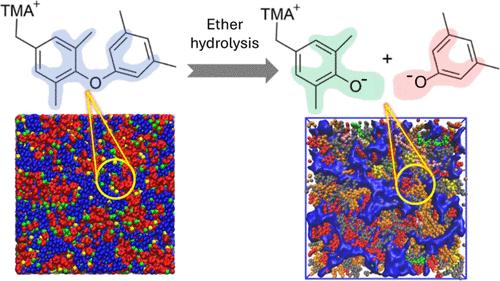
Anion exchange membranes (AEMs) are integral to fuel cells and water electrolysis systems but suffer from poor durability under alkaline conditions. Ether cleavage is an important failure pathway of poly(arylene ether)-based AEMs that compromises both mechanical stability and ion transport. While this degradation pathway is often studied in terms of polymer fragmentation, the role of newly formed hydrophilic groups has been largely overlooked. We show that polymer scission leads to reduced mechanical rigidity, while the introduction of hydrophilic groups partially mitigates this loss. Under alkaline conditions, phenoxide groups formed during ether cleavage neutralize the polymer cations, leading to a previously unreported loss of ion exchange capacity (IEC). This IEC loss mechanism exacerbates the reduction in ionic conductivity, emphasizing the severity of ether cleavage as a degradation pathway. Recognizing that ether cleavage introduces significant chemical changes beyond polymer fragmentation provides critical insights into its interplay with other degradation mechanisms, such as the direct reduction of cationic sites by E2 and SN2, and provides molecular-level interpretations for the concurrent effects of polymer scission and increased hydrophilicity on membrane performance.
期刊介绍:
The journal Chemistry of Materials focuses on publishing original research at the intersection of materials science and chemistry. The studies published in the journal involve chemistry as a prominent component and explore topics such as the design, synthesis, characterization, processing, understanding, and application of functional or potentially functional materials. The journal covers various areas of interest, including inorganic and organic solid-state chemistry, nanomaterials, biomaterials, thin films and polymers, and composite/hybrid materials. The journal particularly seeks papers that highlight the creation or development of innovative materials with novel optical, electrical, magnetic, catalytic, or mechanical properties. It is essential that manuscripts on these topics have a primary focus on the chemistry of materials and represent a significant advancement compared to prior research. Before external reviews are sought, submitted manuscripts undergo a review process by a minimum of two editors to ensure their appropriateness for the journal and the presence of sufficient evidence of a significant advance that will be of broad interest to the materials chemistry community.



 京公网安备 11010802042870号
京ICP备2023020795号-1
京公网安备 11010802042870号
京ICP备2023020795号-1

 分享
分享
 求助内容:
求助内容: 应助结果提醒方式:
 扫码关注我们
