{"title":"Novel Aryl Sulfonium Modification on Vancomycin to Tackle MRSA and VRE In Vitro and In Vivo through Dual Enhanced Cell-Wall and Membrane Inhibition","authors":"Yuanyuan Xie, Xiaowen Wang, Taopeng Chang, Zhifu Chen, Youhong Luo, Jingwen Zhang, Hui Wang, Jinhua Dong, Feifei Chen, Jinyong Zhang, Dongliang Guan","doi":"10.1021/acs.jmedchem.4c03028","DOIUrl":null,"url":null,"abstract":"Gram-positive superbugs resistant to methicillin and vancomycin pose a severe threat to global public health, urgently demanding novel therapeutic strategies. Herein, we rationally designed and synthesized vancomycin derivatives modified with diverse aryl sulfonium moieties to reactivate its antibacterial potency. By optimizing the sulfonium-based SAR, we got derivatives 2–3 orders of magnitude more active in vitro than vancomycin. Subsequently, preliminary toxicity evaluations for the optimal derivative, <b>7e</b>, indicated a favorable therapeutic index, while pharmacokinetic assays revealed its good properties, suggesting great drug-like potential. Notably, <b>7e</b> showed extremely potent in vivo protection efficacy by only a single-dose treatment in the challenging methicillin-resistant <i>Staphylococcus aureus</i> and VRE lethal sepsis mice models. Moreover, two independent and synergistic mechanisms of action were uncovered: membrane perturbation and enhanced cell wall biosynthesis inhibition. These findings revealed the unknown role of sulfonium strategy in vitro and in vivo and positioned <b>7e</b> as a promising candidate for future development.","PeriodicalId":46,"journal":{"name":"Journal of Medicinal Chemistry","volume":"19 1","pages":""},"PeriodicalIF":6.8000,"publicationDate":"2025-04-12","publicationTypes":"Journal Article","fieldsOfStudy":null,"isOpenAccess":false,"openAccessPdf":"","citationCount":"0","resultStr":null,"platform":"Semanticscholar","paperid":null,"PeriodicalName":"Journal of Medicinal Chemistry","FirstCategoryId":"3","ListUrlMain":"https://doi.org/10.1021/acs.jmedchem.4c03028","RegionNum":1,"RegionCategory":"医学","ArticlePicture":[],"TitleCN":null,"AbstractTextCN":null,"PMCID":null,"EPubDate":"","PubModel":"","JCR":"Q1","JCRName":"CHEMISTRY, MEDICINAL","Score":null,"Total":0}
引用次数: 0
Abstract
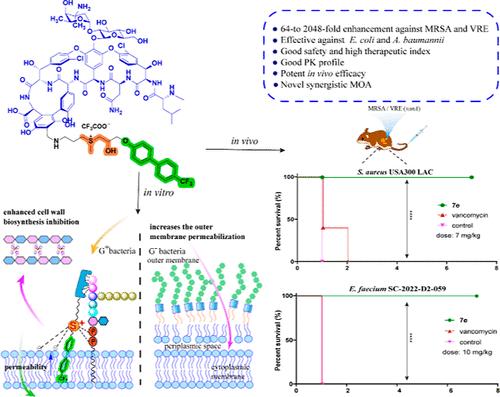
Gram-positive superbugs resistant to methicillin and vancomycin pose a severe threat to global public health, urgently demanding novel therapeutic strategies. Herein, we rationally designed and synthesized vancomycin derivatives modified with diverse aryl sulfonium moieties to reactivate its antibacterial potency. By optimizing the sulfonium-based SAR, we got derivatives 2–3 orders of magnitude more active in vitro than vancomycin. Subsequently, preliminary toxicity evaluations for the optimal derivative, 7e, indicated a favorable therapeutic index, while pharmacokinetic assays revealed its good properties, suggesting great drug-like potential. Notably, 7e showed extremely potent in vivo protection efficacy by only a single-dose treatment in the challenging methicillin-resistant Staphylococcus aureus and VRE lethal sepsis mice models. Moreover, two independent and synergistic mechanisms of action were uncovered: membrane perturbation and enhanced cell wall biosynthesis inhibition. These findings revealed the unknown role of sulfonium strategy in vitro and in vivo and positioned 7e as a promising candidate for future development.
期刊介绍:
The Journal of Medicinal Chemistry is a prestigious biweekly peer-reviewed publication that focuses on the multifaceted field of medicinal chemistry. Since its inception in 1959 as the Journal of Medicinal and Pharmaceutical Chemistry, it has evolved to become a cornerstone in the dissemination of research findings related to the design, synthesis, and development of therapeutic agents.
The Journal of Medicinal Chemistry is recognized for its significant impact in the scientific community, as evidenced by its 2022 impact factor of 7.3. This metric reflects the journal's influence and the importance of its content in shaping the future of drug discovery and development. The journal serves as a vital resource for chemists, pharmacologists, and other researchers interested in the molecular mechanisms of drug action and the optimization of therapeutic compounds.



 京公网安备 11010802042870号
京ICP备2023020795号-1
京公网安备 11010802042870号
京ICP备2023020795号-1

 分享
分享
 求助内容:
求助内容: 应助结果提醒方式:
 扫码关注我们
