Design and Synthesis of FR-β Targeting Chimeric Molecules for Reprogramming Tumor-Associated Macrophages Using 6-Substituted Pyrrolo[2,3-d]pyrimidines as Targeting Ligands
Lixiao Guo, Binghao Guo, Yuqing Wang, Yuwei Zheng, Shuo Sun, Mengqi Wu, Yingao Li, Deguang Jiang, Ruijuan Xing, Zenghui Sun, Yan Fu, Xin Li, Yining Zhang, Yi Liu, Lei Wang
{"title":"Design and Synthesis of FR-β Targeting Chimeric Molecules for Reprogramming Tumor-Associated Macrophages Using 6-Substituted Pyrrolo[2,3-d]pyrimidines as Targeting Ligands","authors":"Lixiao Guo, Binghao Guo, Yuqing Wang, Yuwei Zheng, Shuo Sun, Mengqi Wu, Yingao Li, Deguang Jiang, Ruijuan Xing, Zenghui Sun, Yan Fu, Xin Li, Yining Zhang, Yi Liu, Lei Wang","doi":"10.1021/acs.jmedchem.4c02995","DOIUrl":null,"url":null,"abstract":"Tumor-associated macrophages (TAMs) are highly plastic tumor-infiltrating immune cells. Their reprogramming has emerged as a pivotal strategy in antitumor immunotherapy. The TLR7/8 agonist, <b>IMDQ</b>, has significant potential for reprogramming macrophages but lacks target specificity. To address this challenge, we developed novel folate receptor beta (FR-β) targeting chimeric molecules using 6-substituted pyrrolo[2,3-<i>d</i>]pyrimidines as high-affinity ligands, which demonstrate superior FR-β targeting capability compared with classical folic acid. These molecules integrate the FR-β targeting moiety with <b>IMDQ</b>, marking the first application of this immunomodulator in targeted chimeric constructs. In <i>vitro</i> and in <i>vivo</i> studies demonstrated that our chimeric molecules selectively reprogrammed TAMs toward an immunostimulatory phenotype, reshaped the tumor microenvironment, and inhibited tumor progression without systemic toxicity. Given that TAM accumulation is prevalent across all solid tumors, our strategy of precisely targeting and reprogramming of TAMs is universally applicable to treating various types of cancers, a potent and effective strategy for antitumor immunotherapy.","PeriodicalId":46,"journal":{"name":"Journal of Medicinal Chemistry","volume":"183 1","pages":""},"PeriodicalIF":6.8000,"publicationDate":"2025-04-12","publicationTypes":"Journal Article","fieldsOfStudy":null,"isOpenAccess":false,"openAccessPdf":"","citationCount":"0","resultStr":null,"platform":"Semanticscholar","paperid":null,"PeriodicalName":"Journal of Medicinal Chemistry","FirstCategoryId":"3","ListUrlMain":"https://doi.org/10.1021/acs.jmedchem.4c02995","RegionNum":1,"RegionCategory":"医学","ArticlePicture":[],"TitleCN":null,"AbstractTextCN":null,"PMCID":null,"EPubDate":"","PubModel":"","JCR":"Q1","JCRName":"CHEMISTRY, MEDICINAL","Score":null,"Total":0}
引用次数: 0
Abstract
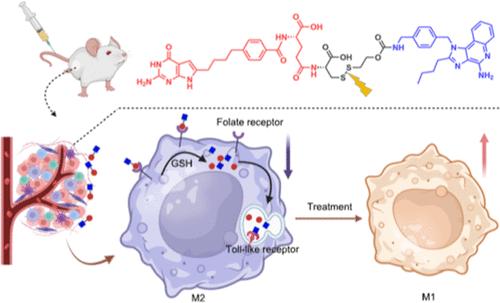
Tumor-associated macrophages (TAMs) are highly plastic tumor-infiltrating immune cells. Their reprogramming has emerged as a pivotal strategy in antitumor immunotherapy. The TLR7/8 agonist, IMDQ, has significant potential for reprogramming macrophages but lacks target specificity. To address this challenge, we developed novel folate receptor beta (FR-β) targeting chimeric molecules using 6-substituted pyrrolo[2,3-d]pyrimidines as high-affinity ligands, which demonstrate superior FR-β targeting capability compared with classical folic acid. These molecules integrate the FR-β targeting moiety with IMDQ, marking the first application of this immunomodulator in targeted chimeric constructs. In vitro and in vivo studies demonstrated that our chimeric molecules selectively reprogrammed TAMs toward an immunostimulatory phenotype, reshaped the tumor microenvironment, and inhibited tumor progression without systemic toxicity. Given that TAM accumulation is prevalent across all solid tumors, our strategy of precisely targeting and reprogramming of TAMs is universally applicable to treating various types of cancers, a potent and effective strategy for antitumor immunotherapy.
期刊介绍:
The Journal of Medicinal Chemistry is a prestigious biweekly peer-reviewed publication that focuses on the multifaceted field of medicinal chemistry. Since its inception in 1959 as the Journal of Medicinal and Pharmaceutical Chemistry, it has evolved to become a cornerstone in the dissemination of research findings related to the design, synthesis, and development of therapeutic agents.
The Journal of Medicinal Chemistry is recognized for its significant impact in the scientific community, as evidenced by its 2022 impact factor of 7.3. This metric reflects the journal's influence and the importance of its content in shaping the future of drug discovery and development. The journal serves as a vital resource for chemists, pharmacologists, and other researchers interested in the molecular mechanisms of drug action and the optimization of therapeutic compounds.



 京公网安备 11010802042870号
京ICP备2023020795号-1
京公网安备 11010802042870号
京ICP备2023020795号-1

 分享
分享
 求助内容:
求助内容: 应助结果提醒方式:
 扫码关注我们
