Xiaoyu Zhou, Kuanhong Cao, Shouqiang Huang, Haonan Wu, Zhen Cao, Hang Liu, Peng Chen, Dawei Su, Guoxiu Wang, Tianyi Wang, Chengyin Wang, Huan Pang
{"title":"Synergistic Conversion of Hydrogen Peroxide and Benzaldehyde in Air by Silver Single-Atom Modified Thiophene-Functionalized g-C3N4","authors":"Xiaoyu Zhou, Kuanhong Cao, Shouqiang Huang, Haonan Wu, Zhen Cao, Hang Liu, Peng Chen, Dawei Su, Guoxiu Wang, Tianyi Wang, Chengyin Wang, Huan Pang","doi":"10.1002/anie.202505532","DOIUrl":null,"url":null,"abstract":"<p>This study reports the synthesis of silver single-atom-loaded thiophene-conjugated carbon nitride (Ag@T─C<sub>3</sub>N<sub>4</sub>), a material with high carrier concentration and efficient carrier separation. Under visible light, Ag@T─C<sub>3</sub>N<sub>4</sub> catalyzes hydrogen peroxide (H<sub>2</sub>O<sub>2</sub>) production and benzyl alcohol oxidation to benzaldehyde, achieving production rates of 4729.82 µmol·g<sup>−1</sup>·h<sup>−1</sup> for H<sub>2</sub>O<sub>2</sub> and 19.71 mmol·g<sup>−1</sup>·h<sup>−1</sup> for benzaldehyde. The synergy between thiophene conjugation and silver atoms extends visible light absorption and accelerates the 2-electron oxygen reduction reaction (ORR), enhancing H<sub>2</sub>O<sub>2</sub> yield. Photogenerated holes oxidize benzyl alcohol to benzaldehyde, while the biphasic benzaldehyde-water system enables spontaneous product separation. In situ Raman spectroscopy, rotating disk electrode testing, EPR, GC-MS, and DFT calculations highlight the critical role of thiophene-silver synergy in optimizing reaction pathways, enhancing catalyst-intermediate interactions, and reducing Gibbs free energy, improving H<sub>2</sub>O<sub>2</sub> and benzaldehyde synthesis. This study provides new insights for designing carbon nitride-based photocatalysts and offers a strategy for co-producing value-added chemicals.</p>","PeriodicalId":125,"journal":{"name":"Angewandte Chemie International Edition","volume":"64 25","pages":""},"PeriodicalIF":16.9000,"publicationDate":"2025-04-11","publicationTypes":"Journal Article","fieldsOfStudy":null,"isOpenAccess":false,"openAccessPdf":"","citationCount":"0","resultStr":null,"platform":"Semanticscholar","paperid":null,"PeriodicalName":"Angewandte Chemie International Edition","FirstCategoryId":"92","ListUrlMain":"https://onlinelibrary.wiley.com/doi/10.1002/anie.202505532","RegionNum":1,"RegionCategory":"化学","ArticlePicture":[],"TitleCN":null,"AbstractTextCN":null,"PMCID":null,"EPubDate":"","PubModel":"","JCR":"Q1","JCRName":"CHEMISTRY, MULTIDISCIPLINARY","Score":null,"Total":0}
引用次数: 0
Abstract
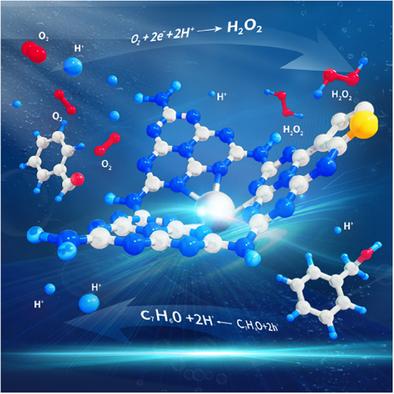
This study reports the synthesis of silver single-atom-loaded thiophene-conjugated carbon nitride (Ag@T─C3N4), a material with high carrier concentration and efficient carrier separation. Under visible light, Ag@T─C3N4 catalyzes hydrogen peroxide (H2O2) production and benzyl alcohol oxidation to benzaldehyde, achieving production rates of 4729.82 µmol·g−1·h−1 for H2O2 and 19.71 mmol·g−1·h−1 for benzaldehyde. The synergy between thiophene conjugation and silver atoms extends visible light absorption and accelerates the 2-electron oxygen reduction reaction (ORR), enhancing H2O2 yield. Photogenerated holes oxidize benzyl alcohol to benzaldehyde, while the biphasic benzaldehyde-water system enables spontaneous product separation. In situ Raman spectroscopy, rotating disk electrode testing, EPR, GC-MS, and DFT calculations highlight the critical role of thiophene-silver synergy in optimizing reaction pathways, enhancing catalyst-intermediate interactions, and reducing Gibbs free energy, improving H2O2 and benzaldehyde synthesis. This study provides new insights for designing carbon nitride-based photocatalysts and offers a strategy for co-producing value-added chemicals.
期刊介绍:
Angewandte Chemie, a journal of the German Chemical Society (GDCh), maintains a leading position among scholarly journals in general chemistry with an impressive Impact Factor of 16.6 (2022 Journal Citation Reports, Clarivate, 2023). Published weekly in a reader-friendly format, it features new articles almost every day. Established in 1887, Angewandte Chemie is a prominent chemistry journal, offering a dynamic blend of Review-type articles, Highlights, Communications, and Research Articles on a weekly basis, making it unique in the field.



 京公网安备 11010802042870号
京ICP备2023020795号-1
京公网安备 11010802042870号
京ICP备2023020795号-1

 分享
分享
 求助内容:
求助内容: 应助结果提醒方式:
 扫码关注我们
