{"title":"A High-Toughness NDI-Based Fluorescent Polyurea Based on Gradient Energy Dissipation","authors":"Pengcheng Li, Hongzhe Zhao, Zelin Liu, Yanqing Wang, Picheng Chen, Yuetao Liu, Fengchen Qiao, Li Ding, Chuanhui Gao","doi":"10.1021/acs.macromol.4c02637","DOIUrl":null,"url":null,"abstract":"1,5-Naphthalene diisocyanate (NDI) has garnered considerable attention in the design of functional materials due to its excellent photophysical properties and corrosion resistance. However, materials synthesized from NDI typically exhibit poor toughness, limiting their broader applications. To overcome these limitations, this study synthesized a polyurea material that combines both high toughness and fluorescence properties by constructing the polymer backbone through the rapid reaction of NDI with amines, followed by covalent cross-linking between hard domains. The material demonstrates a mechanical strength of 24.8 MPa and an ultrahigh toughness of 505.25 MJ/m<sup>3</sup>. Its exceptional toughness stems from a gradient energy dissipation mechanism, which is governed by the dissociation of strong and weak hydrogen bonds (with bond dissociation energies of 76.64 kJ/mol and 64.89 kJ/mol, respectively) and the decomposition of concentrated hard domains. Additionally, the naphthalene rings in NDI possess a planar rigid conjugated structure, and through covalent cross-linking among hard domains, the nonradiative transition is restricted, and the radiative transition is augmented, thereby enabling the material to exhibit intense and stable blue fluorescence under 365 nm UV lamps. The material can still fluoresce in the presence of a strong acid and a strong base, where the strong base enhances the fluorescence intensity, while the strong acid has the opposite effect. By modifying the form of the urea group surrounding the naphthalene ring, the acid–base effect influences the distribution of the electron cloud of the naphthalene ring and subsequently alters the fluorescence intensity. This study offers a novel concept for preparing NDI-based polyurea materials with high toughness and stable fluorescence properties.","PeriodicalId":51,"journal":{"name":"Macromolecules","volume":"25 1","pages":""},"PeriodicalIF":5.2000,"publicationDate":"2025-04-13","publicationTypes":"Journal Article","fieldsOfStudy":null,"isOpenAccess":false,"openAccessPdf":"","citationCount":"0","resultStr":null,"platform":"Semanticscholar","paperid":null,"PeriodicalName":"Macromolecules","FirstCategoryId":"92","ListUrlMain":"https://doi.org/10.1021/acs.macromol.4c02637","RegionNum":1,"RegionCategory":"化学","ArticlePicture":[],"TitleCN":null,"AbstractTextCN":null,"PMCID":null,"EPubDate":"","PubModel":"","JCR":"Q1","JCRName":"POLYMER SCIENCE","Score":null,"Total":0}
引用次数: 0
Abstract
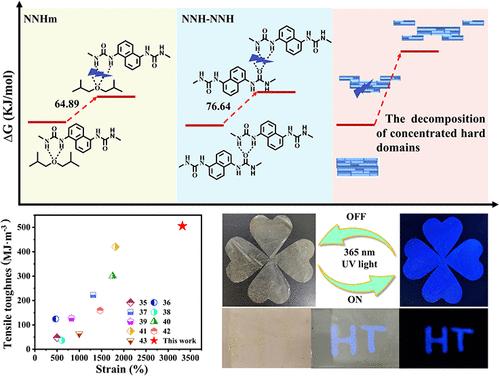
1,5-Naphthalene diisocyanate (NDI) has garnered considerable attention in the design of functional materials due to its excellent photophysical properties and corrosion resistance. However, materials synthesized from NDI typically exhibit poor toughness, limiting their broader applications. To overcome these limitations, this study synthesized a polyurea material that combines both high toughness and fluorescence properties by constructing the polymer backbone through the rapid reaction of NDI with amines, followed by covalent cross-linking between hard domains. The material demonstrates a mechanical strength of 24.8 MPa and an ultrahigh toughness of 505.25 MJ/m3. Its exceptional toughness stems from a gradient energy dissipation mechanism, which is governed by the dissociation of strong and weak hydrogen bonds (with bond dissociation energies of 76.64 kJ/mol and 64.89 kJ/mol, respectively) and the decomposition of concentrated hard domains. Additionally, the naphthalene rings in NDI possess a planar rigid conjugated structure, and through covalent cross-linking among hard domains, the nonradiative transition is restricted, and the radiative transition is augmented, thereby enabling the material to exhibit intense and stable blue fluorescence under 365 nm UV lamps. The material can still fluoresce in the presence of a strong acid and a strong base, where the strong base enhances the fluorescence intensity, while the strong acid has the opposite effect. By modifying the form of the urea group surrounding the naphthalene ring, the acid–base effect influences the distribution of the electron cloud of the naphthalene ring and subsequently alters the fluorescence intensity. This study offers a novel concept for preparing NDI-based polyurea materials with high toughness and stable fluorescence properties.
期刊介绍:
Macromolecules publishes original, fundamental, and impactful research on all aspects of polymer science. Topics of interest include synthesis (e.g., controlled polymerizations, polymerization catalysis, post polymerization modification, new monomer structures and polymer architectures, and polymerization mechanisms/kinetics analysis); phase behavior, thermodynamics, dynamic, and ordering/disordering phenomena (e.g., self-assembly, gelation, crystallization, solution/melt/solid-state characteristics); structure and properties (e.g., mechanical and rheological properties, surface/interfacial characteristics, electronic and transport properties); new state of the art characterization (e.g., spectroscopy, scattering, microscopy, rheology), simulation (e.g., Monte Carlo, molecular dynamics, multi-scale/coarse-grained modeling), and theoretical methods. Renewable/sustainable polymers, polymer networks, responsive polymers, electro-, magneto- and opto-active macromolecules, inorganic polymers, charge-transporting polymers (ion-containing, semiconducting, and conducting), nanostructured polymers, and polymer composites are also of interest. Typical papers published in Macromolecules showcase important and innovative concepts, experimental methods/observations, and theoretical/computational approaches that demonstrate a fundamental advance in the understanding of polymers.



 京公网安备 11010802042870号
京ICP备2023020795号-1
京公网安备 11010802042870号
京ICP备2023020795号-1

 分享
分享
 求助内容:
求助内容: 应助结果提醒方式:
 扫码关注我们
