Linyu Zhu, Cunhao Cui, Miloš Auersvald, Jing Zhang, Xun Kuang, Xintong Xiao, Yuhe Liao, Zhongyue Zhou*, Kevin M. Van Geem* and Fei Qi,
{"title":"Unveiling the Mechanism of Reductive Catalytic Fractionation via Online High-Resolution Mass Spectrometry: Insights into Lignin Valorization","authors":"Linyu Zhu, Cunhao Cui, Miloš Auersvald, Jing Zhang, Xun Kuang, Xintong Xiao, Yuhe Liao, Zhongyue Zhou*, Kevin M. Van Geem* and Fei Qi, ","doi":"10.1021/acssuschemeng.5c01160","DOIUrl":null,"url":null,"abstract":"<p >In the quest for sustainable energy and environmental preservation, reductive catalytic fractionation (RCF) of lignocellulosic biomass has emerged as a powerful approach to valorize lignin. However, the precise mechanism driving the RCF process remains elusive due to analytical challenges. This study unlocks the mechanism by investigating the Pd/C-catalyzed RCF of birch wood using online high-resolution mass spectrometry (HRMS) for the first molecular-level insights. Real-time evolutions of various monomers, dimers, and oligomers bridged the gap between large lignin fragments and small phenolic products, revealing the stepwise nature of RCF. The process starts with lignin extraction into the liquid phase from the middle lamella to the secondary wall of the cell wall, followed by rapid catalytic depolymerization of the extracted lignin fragments to yield phenolic monomers and dimers. Intriguingly, the evolution of sugar-derived compounds highlights the holocellulose degradation with prolonged reaction times, posing challenges to lignin-first strategies. These findings underscore the importance of fine-tuning RCF conditions to enhance conversion efficiency and minimize side reactions. Moreover, this work highlights the application of advanced HRMS techniques for gaining mechanistic and kinetic insights into liquid-phase reactions, paving the way for more efficient biomass valorization technologies.</p>","PeriodicalId":25,"journal":{"name":"ACS Sustainable Chemistry & Engineering","volume":"13 14","pages":"5434–5443 5434–5443"},"PeriodicalIF":7.3000,"publicationDate":"2025-03-31","publicationTypes":"Journal Article","fieldsOfStudy":null,"isOpenAccess":false,"openAccessPdf":"","citationCount":"0","resultStr":null,"platform":"Semanticscholar","paperid":null,"PeriodicalName":"ACS Sustainable Chemistry & Engineering","FirstCategoryId":"92","ListUrlMain":"https://pubs.acs.org/doi/10.1021/acssuschemeng.5c01160","RegionNum":1,"RegionCategory":"化学","ArticlePicture":[],"TitleCN":null,"AbstractTextCN":null,"PMCID":null,"EPubDate":"","PubModel":"","JCR":"Q1","JCRName":"CHEMISTRY, MULTIDISCIPLINARY","Score":null,"Total":0}
引用次数: 0
Abstract
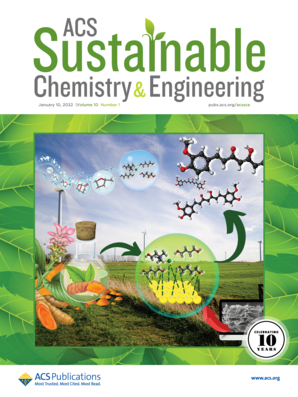
In the quest for sustainable energy and environmental preservation, reductive catalytic fractionation (RCF) of lignocellulosic biomass has emerged as a powerful approach to valorize lignin. However, the precise mechanism driving the RCF process remains elusive due to analytical challenges. This study unlocks the mechanism by investigating the Pd/C-catalyzed RCF of birch wood using online high-resolution mass spectrometry (HRMS) for the first molecular-level insights. Real-time evolutions of various monomers, dimers, and oligomers bridged the gap between large lignin fragments and small phenolic products, revealing the stepwise nature of RCF. The process starts with lignin extraction into the liquid phase from the middle lamella to the secondary wall of the cell wall, followed by rapid catalytic depolymerization of the extracted lignin fragments to yield phenolic monomers and dimers. Intriguingly, the evolution of sugar-derived compounds highlights the holocellulose degradation with prolonged reaction times, posing challenges to lignin-first strategies. These findings underscore the importance of fine-tuning RCF conditions to enhance conversion efficiency and minimize side reactions. Moreover, this work highlights the application of advanced HRMS techniques for gaining mechanistic and kinetic insights into liquid-phase reactions, paving the way for more efficient biomass valorization technologies.
期刊介绍:
ACS Sustainable Chemistry & Engineering is a prestigious weekly peer-reviewed scientific journal published by the American Chemical Society. Dedicated to advancing the principles of green chemistry and green engineering, it covers a wide array of research topics including green chemistry, green engineering, biomass, alternative energy, and life cycle assessment.
The journal welcomes submissions in various formats, including Letters, Articles, Features, and Perspectives (Reviews), that address the challenges of sustainability in the chemical enterprise and contribute to the advancement of sustainable practices. Join us in shaping the future of sustainable chemistry and engineering.




 京公网安备 11010802042870号
京ICP备2023020795号-1
京公网安备 11010802042870号
京ICP备2023020795号-1

 分享
分享
 求助内容:
求助内容: 应助结果提醒方式:
 扫码关注我们
