Chang Sun , Yuyan Liu , Zhaolei Liang , Qingqing Li , Yaping Du , Jin-Cheng Liu , Yahui Cheng , Feng Luo
{"title":"Activating PtRu with rare earth alloying for efficient electrocatalytic methanol oxidation reaction†","authors":"Chang Sun , Yuyan Liu , Zhaolei Liang , Qingqing Li , Yaping Du , Jin-Cheng Liu , Yahui Cheng , Feng Luo","doi":"10.1039/d4cy01514b","DOIUrl":null,"url":null,"abstract":"<div><div>The development of direct methanol fuel cells (DMFCs) is limited by the slow kinetics of anodic methanol oxidation (MOR), and Pt-based materials have been recognized as the most promising catalysts for MOR. Alloying Pt with other transition metals is an effective strategy for improving the catalytic performance of Pt-based catalysts. Rare earth (RE) metals are considered favorable elements for modulating catalytic activity owing to their unique electronic structures and electronegativity. In this work, a series of Pt–Ru–RE ternary alloys was synthesized <em>via</em> a potassium vapor reduction method, and the mass activity of the Pt<sub>2.7</sub>Ru<sub>0.3</sub>Sc alloy was observed to be 1.03 A mg<sub>pt</sub><sup>−1</sup>, which is almost four times that of Pt<sub>9</sub>Ru alloy (0.21 A mg<sub>pt</sub><sup>−1</sup>) and more than twice that of Pt<sub>3</sub>Sc alloy (0.42 A mg<sub>pt</sub><sup>−1</sup>). Moreover, the Pt<sub>2.7</sub>Ru<sub>0.3</sub>Sc alloy exhibited superior stability that could be activated repeatedly. Experiments and theoretical calculations revealed that Sc regulates the electronic structure of the Pt<sub>2.7</sub>Ru<sub>0.3</sub>Sc alloy and promotes the d-band center of superficial Pt downward, weakening the Pt–CO binding strength. Additionally, Ru was favorable for *OH adsorption, which was beneficial for the removal of the poisonous intermediate (*CO), and the synergistic effects enhanced the activity and stability of Pt<sub>2.7</sub>Ru<sub>0.3</sub>Sc alloy catalyst for MOR.</div></div>","PeriodicalId":66,"journal":{"name":"Catalysis Science & Technology","volume":"15 8","pages":"Pages 2473-2481"},"PeriodicalIF":4.2000,"publicationDate":"2025-02-21","publicationTypes":"Journal Article","fieldsOfStudy":null,"isOpenAccess":false,"openAccessPdf":"","citationCount":"0","resultStr":null,"platform":"Semanticscholar","paperid":null,"PeriodicalName":"Catalysis Science & Technology","FirstCategoryId":"92","ListUrlMain":"https://www.sciencedirect.com/org/science/article/pii/S2044475325001121","RegionNum":3,"RegionCategory":"化学","ArticlePicture":[],"TitleCN":null,"AbstractTextCN":null,"PMCID":null,"EPubDate":"2025/3/6 0:00:00","PubModel":"Epub","JCR":"Q2","JCRName":"CHEMISTRY, PHYSICAL","Score":null,"Total":0}
引用次数: 0
Abstract
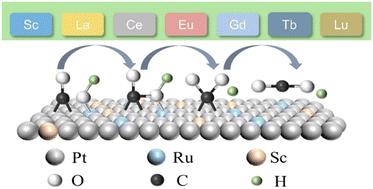
The development of direct methanol fuel cells (DMFCs) is limited by the slow kinetics of anodic methanol oxidation (MOR), and Pt-based materials have been recognized as the most promising catalysts for MOR. Alloying Pt with other transition metals is an effective strategy for improving the catalytic performance of Pt-based catalysts. Rare earth (RE) metals are considered favorable elements for modulating catalytic activity owing to their unique electronic structures and electronegativity. In this work, a series of Pt–Ru–RE ternary alloys was synthesized via a potassium vapor reduction method, and the mass activity of the Pt2.7Ru0.3Sc alloy was observed to be 1.03 A mgpt−1, which is almost four times that of Pt9Ru alloy (0.21 A mgpt−1) and more than twice that of Pt3Sc alloy (0.42 A mgpt−1). Moreover, the Pt2.7Ru0.3Sc alloy exhibited superior stability that could be activated repeatedly. Experiments and theoretical calculations revealed that Sc regulates the electronic structure of the Pt2.7Ru0.3Sc alloy and promotes the d-band center of superficial Pt downward, weakening the Pt–CO binding strength. Additionally, Ru was favorable for *OH adsorption, which was beneficial for the removal of the poisonous intermediate (*CO), and the synergistic effects enhanced the activity and stability of Pt2.7Ru0.3Sc alloy catalyst for MOR.
直接甲醇燃料电池(dmfc)的发展受到甲醇阳极氧化(MOR)缓慢动力学的限制,而pt基材料已被认为是最有前途的催化剂。将Pt与其他过渡金属合金化是提高Pt基催化剂催化性能的有效策略。稀土金属由于其独特的电子结构和电负性被认为是调节催化活性的有利元素。通过钾蒸气还原法制备了一系列Pt-Ru-RE三元合金,发现Pt2.7Ru0.3Sc合金的质量活度为1.03 a mgpt - 1,是Pt9Ru合金(0.21 a mgpt - 1)的近4倍,是Pt3Sc合金(0.42 a mgpt - 1)的2倍以上。此外,Pt2.7Ru0.3Sc合金具有良好的稳定性,可以反复活化。实验和理论计算表明,Sc调节了Pt2.7Ru0.3Sc合金的电子结构,促进了表面Pt的d带中心下移,减弱了Pt - co结合强度。此外,Ru有利于*OH的吸附,有利于有毒中间体(*CO)的去除,协同作用增强了Pt2.7Ru0.3Sc合金催化剂的MOR活性和稳定性。
期刊介绍:
A multidisciplinary journal focusing on cutting edge research across all fundamental science and technological aspects of catalysis.
Editor-in-chief: Bert Weckhuysen
Impact factor: 5.0
Time to first decision (peer reviewed only): 31 days



 京公网安备 11010802042870号
京ICP备2023020795号-1
京公网安备 11010802042870号
京ICP备2023020795号-1

 分享
分享
 求助内容:
求助内容: 应助结果提醒方式:
 扫码关注我们
