Jia Qin , Jingqi Liu , Linchao Xu , Yaping Zhou , Chenjing Jia , Xiangwei Kong , Jia Guan , Yongjie Ge , Jinjie Qian , Xiaofang Wang
{"title":"Design of a novel CuNi-MOF-based catalyst for efficient electrocatalytic conversion of nitrate to ammonia at low overpotential†","authors":"Jia Qin , Jingqi Liu , Linchao Xu , Yaping Zhou , Chenjing Jia , Xiangwei Kong , Jia Guan , Yongjie Ge , Jinjie Qian , Xiaofang Wang","doi":"10.1039/d5cy00055f","DOIUrl":null,"url":null,"abstract":"<div><div>The catalytic conversion of nitrate (NO<sub>3</sub><sup>−</sup>) to ammonia (NH<sub>3</sub>) has gained significant attention as a promising route for sustainable nitrogen recycling and ammonia production. However, the overall kinetic rate of the NO<sub>3</sub>RR is plagued by the complex proton-assisted multiple-electron transfer process. Herein, the CuNi-TBC-C catalyst was designed to optimize the kinetic rate of the NO<sub>3</sub>RR. Electrochemical evaluation, <em>in situ</em> FTIR spectra, and kinetic studies demonstrate that Ni enhances the catalytic activity and kinetic rate of Cu-based catalysts for the NO<sub>3</sub>RR by modulating the Cu d-orbital center, enhancing the adsorption energy of nitrate, and optimizing the reaction pathway. Thus, the CuNi-TBC-C catalyst efficiently converts NO<sub>3</sub><sup>−</sup> to NH<sub>3</sub> with a high faradaic efficiency (FE) of 94.68% and a high NH<sub>3</sub> yield rate of 214 μmol h<sup>−1</sup> cm<sup>−2</sup> in 1 M KOH and 0.1 M KNO<sub>3</sub> solution at −0.1 V <em>vs.</em> RHE. Furthermore, when applied as the cathode material in a novel Zn-nitrate battery, this highly efficient NO<sub>3</sub>RR electrocatalyst achieves a power density of 3.94 mW cm<sup>−2</sup> and an FE of 89.3% for NH<sub>3</sub> production.</div></div>","PeriodicalId":66,"journal":{"name":"Catalysis Science & Technology","volume":"15 8","pages":"Pages 2584-2594"},"PeriodicalIF":4.2000,"publicationDate":"2025-02-21","publicationTypes":"Journal Article","fieldsOfStudy":null,"isOpenAccess":false,"openAccessPdf":"","citationCount":"0","resultStr":null,"platform":"Semanticscholar","paperid":null,"PeriodicalName":"Catalysis Science & Technology","FirstCategoryId":"92","ListUrlMain":"https://www.sciencedirect.com/org/science/article/pii/S2044475325001182","RegionNum":3,"RegionCategory":"化学","ArticlePicture":[],"TitleCN":null,"AbstractTextCN":null,"PMCID":null,"EPubDate":"2025/3/4 0:00:00","PubModel":"Epub","JCR":"Q2","JCRName":"CHEMISTRY, PHYSICAL","Score":null,"Total":0}
引用次数: 0
Abstract
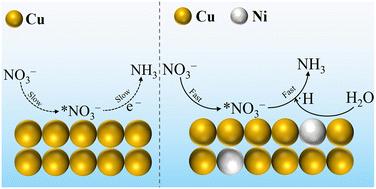
The catalytic conversion of nitrate (NO3−) to ammonia (NH3) has gained significant attention as a promising route for sustainable nitrogen recycling and ammonia production. However, the overall kinetic rate of the NO3RR is plagued by the complex proton-assisted multiple-electron transfer process. Herein, the CuNi-TBC-C catalyst was designed to optimize the kinetic rate of the NO3RR. Electrochemical evaluation, in situ FTIR spectra, and kinetic studies demonstrate that Ni enhances the catalytic activity and kinetic rate of Cu-based catalysts for the NO3RR by modulating the Cu d-orbital center, enhancing the adsorption energy of nitrate, and optimizing the reaction pathway. Thus, the CuNi-TBC-C catalyst efficiently converts NO3− to NH3 with a high faradaic efficiency (FE) of 94.68% and a high NH3 yield rate of 214 μmol h−1 cm−2 in 1 M KOH and 0.1 M KNO3 solution at −0.1 V vs. RHE. Furthermore, when applied as the cathode material in a novel Zn-nitrate battery, this highly efficient NO3RR electrocatalyst achieves a power density of 3.94 mW cm−2 and an FE of 89.3% for NH3 production.
期刊介绍:
A multidisciplinary journal focusing on cutting edge research across all fundamental science and technological aspects of catalysis.
Editor-in-chief: Bert Weckhuysen
Impact factor: 5.0
Time to first decision (peer reviewed only): 31 days




 京公网安备 11010802042870号
京ICP备2023020795号-1
京公网安备 11010802042870号
京ICP备2023020795号-1

 分享
分享
 求助内容:
求助内容: 应助结果提醒方式:
 扫码关注我们
