{"title":"Bio-oil derived polyesteramides as water-degradable replacements for polyethylene†","authors":"Yohei Yoshinaka , Stephen A. Miller","doi":"10.1039/d4gc05490c","DOIUrl":null,"url":null,"abstract":"<div><div>The seed oil from <em>Brassica carinata</em> is a promising source for biobased aviation fuel. Interestingly, the seeds contain considerable sinapic acid and erucic acid, both of which can be utilized for bioplastic synthesis. From the latter, we report herein the synthesis of biobased and water-degradable polyesteramides (PEAs) <em>via N</em>,<em>N</em>′-bis(2-hydroxyethyl)brassylamide (BHEBA). This diol was prepared from ethanolamine and brassylic acid, a C13 oxidation product of the C22 erucic acid, which makes up 42% of the fatty acids present in this non-GMO (non-genetically modified) Ethiopian mustard seed oil. After optimization of conditions, BHEBA was polymerized with aliphatic diacids to obtain the designed PEAs with high purified yields (77–88%) and good molecular weights (<em>M</em><sub>n</sub> = 7000–10 700 Da). The melting temperatures of these PEAs ranged from 130–139 °C, values comparable to those of several grades of polyethylene. Compared to shorter diacids, the brassylic acid incorporated into PEA structures improves hydrophobicity, and mechanical performance was not compromised after a daylong exposure to water. Furthermore, a 12-month PEA degradation study revealed significant hydrolytic degradation (at least 37% loss in <em>M</em><sub>n</sub>) under all the conditions studied: pH 2, pH 5, seawater, and deionized water. Their degradability was further evaluated under high-temperature conditions compared to several commercial plastics, establishing their superior degradability in seawater and deionized water. Chemical recyclability of PEA was demonstrated through facile aminolysis with ethanolamine to regenerate the BHEBA monomer in 84% yield. While further mechanical property improvement would be ideal, the results substantiate the high potential of brassylic acid-based polyesteramides to be eco-friendly replacements for some petroleum-derived commodity plastics, especially polyethylene.</div></div>","PeriodicalId":78,"journal":{"name":"Green Chemistry","volume":"27 16","pages":"Pages 4152-4164"},"PeriodicalIF":9.2000,"publicationDate":"2025-03-05","publicationTypes":"Journal Article","fieldsOfStudy":null,"isOpenAccess":false,"openAccessPdf":"","citationCount":"0","resultStr":null,"platform":"Semanticscholar","paperid":null,"PeriodicalName":"Green Chemistry","FirstCategoryId":"92","ListUrlMain":"https://www.sciencedirect.com/org/science/article/pii/S1463926225002249","RegionNum":1,"RegionCategory":"化学","ArticlePicture":[],"TitleCN":null,"AbstractTextCN":null,"PMCID":null,"EPubDate":"2025/2/5 0:00:00","PubModel":"Epub","JCR":"Q1","JCRName":"CHEMISTRY, MULTIDISCIPLINARY","Score":null,"Total":0}
引用次数: 0
Abstract
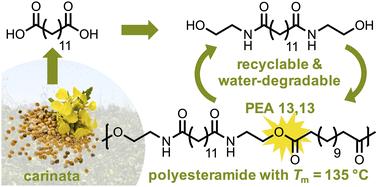
The seed oil from Brassica carinata is a promising source for biobased aviation fuel. Interestingly, the seeds contain considerable sinapic acid and erucic acid, both of which can be utilized for bioplastic synthesis. From the latter, we report herein the synthesis of biobased and water-degradable polyesteramides (PEAs) via N,N′-bis(2-hydroxyethyl)brassylamide (BHEBA). This diol was prepared from ethanolamine and brassylic acid, a C13 oxidation product of the C22 erucic acid, which makes up 42% of the fatty acids present in this non-GMO (non-genetically modified) Ethiopian mustard seed oil. After optimization of conditions, BHEBA was polymerized with aliphatic diacids to obtain the designed PEAs with high purified yields (77–88%) and good molecular weights (Mn = 7000–10 700 Da). The melting temperatures of these PEAs ranged from 130–139 °C, values comparable to those of several grades of polyethylene. Compared to shorter diacids, the brassylic acid incorporated into PEA structures improves hydrophobicity, and mechanical performance was not compromised after a daylong exposure to water. Furthermore, a 12-month PEA degradation study revealed significant hydrolytic degradation (at least 37% loss in Mn) under all the conditions studied: pH 2, pH 5, seawater, and deionized water. Their degradability was further evaluated under high-temperature conditions compared to several commercial plastics, establishing their superior degradability in seawater and deionized water. Chemical recyclability of PEA was demonstrated through facile aminolysis with ethanolamine to regenerate the BHEBA monomer in 84% yield. While further mechanical property improvement would be ideal, the results substantiate the high potential of brassylic acid-based polyesteramides to be eco-friendly replacements for some petroleum-derived commodity plastics, especially polyethylene.
期刊介绍:
Green Chemistry is a journal that provides a unique forum for the publication of innovative research on the development of alternative green and sustainable technologies. The scope of Green Chemistry is based on the definition proposed by Anastas and Warner (Green Chemistry: Theory and Practice, P T Anastas and J C Warner, Oxford University Press, Oxford, 1998), which defines green chemistry as the utilisation of a set of principles that reduces or eliminates the use or generation of hazardous substances in the design, manufacture and application of chemical products. Green Chemistry aims to reduce the environmental impact of the chemical enterprise by developing a technology base that is inherently non-toxic to living things and the environment. The journal welcomes submissions on all aspects of research relating to this endeavor and publishes original and significant cutting-edge research that is likely to be of wide general appeal. For a work to be published, it must present a significant advance in green chemistry, including a comparison with existing methods and a demonstration of advantages over those methods.



 京公网安备 11010802042870号
京ICP备2023020795号-1
京公网安备 11010802042870号
京ICP备2023020795号-1

 分享
分享
 求助内容:
求助内容: 应助结果提醒方式:
 扫码关注我们
