Yolanda Rusconi , Massimo Christian D'Alterio , Claudio De Rosa , Geoffrey W. Coates , Giovanni Talarico
{"title":"Disclosing multiple factors influencing enantioselective copolymerization of CO2 with meso-epoxides using β-diiminate Zn catalysts†","authors":"Yolanda Rusconi , Massimo Christian D'Alterio , Claudio De Rosa , Geoffrey W. Coates , Giovanni Talarico","doi":"10.1039/d5gc00523j","DOIUrl":null,"url":null,"abstract":"<div><div>The enantioselective ring-opening copolymerization (ROCOP) of cyclohexene oxide (CHO) and carbon dioxide (CO<sub>2</sub>) to produce isotactic poly(cyclohexene carbonate) (iPCHC) was systematically investigated using chiral <em>C</em><sub>1</sub>-symmetric zinc β-diiminate (BDI) catalysts. A combination of density functional theory (DFT), molecular steric descriptors (%<em>V</em><sub>Bur</sub>), and the activation strain model (ASM) was employed to elucidate the mechanistic pathways and factors governing enantioselectivity. We found that chiral monomeric BDI catalysts exhibit intrinsic enantioselective properties in <em>meso</em>-desymmetrization polymerization catalysis, which are significantly enhanced upon formation of dimeric complexes with <em>anti</em> and <em>syn</em> conformations. The predicted enantioselectivity, arising during the CHO ring-opening step, explains the experimental combination of selected stereocenters on the ligand and preferred stereochemistry of the polymer chain. This study identifies key factors influencing ROCOP enantioselectivity, including monomer deformation, ligand steric effects dictated by the number of chiral centers, and noncovalent interactions, all contributing additively to the observed selectivity. These insights provide a better understanding of the mechanistic origins of enantioselectivity in CHO/CO<sub>2</sub> ROCOP and offer guidance for the design of more efficient catalysts.</div></div>","PeriodicalId":78,"journal":{"name":"Green Chemistry","volume":"27 16","pages":"Pages 4196-4204"},"PeriodicalIF":9.2000,"publicationDate":"2025-03-05","publicationTypes":"Journal Article","fieldsOfStudy":null,"isOpenAccess":false,"openAccessPdf":"","citationCount":"0","resultStr":null,"platform":"Semanticscholar","paperid":null,"PeriodicalName":"Green Chemistry","FirstCategoryId":"92","ListUrlMain":"https://www.sciencedirect.com/org/science/article/pii/S146392622500216X","RegionNum":1,"RegionCategory":"化学","ArticlePicture":[],"TitleCN":null,"AbstractTextCN":null,"PMCID":null,"EPubDate":"2025/3/11 0:00:00","PubModel":"Epub","JCR":"Q1","JCRName":"CHEMISTRY, MULTIDISCIPLINARY","Score":null,"Total":0}
引用次数: 0
Abstract
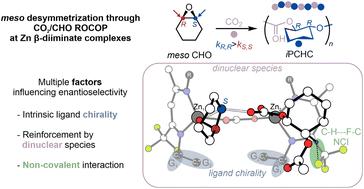
The enantioselective ring-opening copolymerization (ROCOP) of cyclohexene oxide (CHO) and carbon dioxide (CO2) to produce isotactic poly(cyclohexene carbonate) (iPCHC) was systematically investigated using chiral C1-symmetric zinc β-diiminate (BDI) catalysts. A combination of density functional theory (DFT), molecular steric descriptors (%VBur), and the activation strain model (ASM) was employed to elucidate the mechanistic pathways and factors governing enantioselectivity. We found that chiral monomeric BDI catalysts exhibit intrinsic enantioselective properties in meso-desymmetrization polymerization catalysis, which are significantly enhanced upon formation of dimeric complexes with anti and syn conformations. The predicted enantioselectivity, arising during the CHO ring-opening step, explains the experimental combination of selected stereocenters on the ligand and preferred stereochemistry of the polymer chain. This study identifies key factors influencing ROCOP enantioselectivity, including monomer deformation, ligand steric effects dictated by the number of chiral centers, and noncovalent interactions, all contributing additively to the observed selectivity. These insights provide a better understanding of the mechanistic origins of enantioselectivity in CHO/CO2 ROCOP and offer guidance for the design of more efficient catalysts.
期刊介绍:
Green Chemistry is a journal that provides a unique forum for the publication of innovative research on the development of alternative green and sustainable technologies. The scope of Green Chemistry is based on the definition proposed by Anastas and Warner (Green Chemistry: Theory and Practice, P T Anastas and J C Warner, Oxford University Press, Oxford, 1998), which defines green chemistry as the utilisation of a set of principles that reduces or eliminates the use or generation of hazardous substances in the design, manufacture and application of chemical products. Green Chemistry aims to reduce the environmental impact of the chemical enterprise by developing a technology base that is inherently non-toxic to living things and the environment. The journal welcomes submissions on all aspects of research relating to this endeavor and publishes original and significant cutting-edge research that is likely to be of wide general appeal. For a work to be published, it must present a significant advance in green chemistry, including a comparison with existing methods and a demonstration of advantages over those methods.



 京公网安备 11010802042870号
京ICP备2023020795号-1
京公网安备 11010802042870号
京ICP备2023020795号-1

 分享
分享
 求助内容:
求助内容: 应助结果提醒方式:
 扫码关注我们
