Yangyang Chen , Yu Liao , Lei Li , Yiding Ding , Ying Wu , Zhen Zhang , Sha Luo , Yiqiang Wu , Yan Qing
{"title":"Solvothermal-assisted defect engineering in hierarchically porous carbonized wood fibers for high-performance lithium–sulfur batteries†","authors":"Yangyang Chen , Yu Liao , Lei Li , Yiding Ding , Ying Wu , Zhen Zhang , Sha Luo , Yiqiang Wu , Yan Qing","doi":"10.1039/d5gc00414d","DOIUrl":null,"url":null,"abstract":"<div><div>The pursuit of carbon neutrality and reduced carbon dioxide emissions has necessitated the development of high-energy-density energy storage devices. To this end, Li–S batteries, with their exceptionally high energy density and theoretical specific capacity, have emerged as promising devices. However, the practical application of Li–S batteries is limited by the poor conductivity of sulfur and the notorious shuttle effect of lithium polysulfides (LPS). Herein, we present a scalable solvothermal-assisted carbonization strategy to engineer micro–mesoporous carbonized wood fibers (MMCWF) with precisely tailored structural defects and hierarchical porosity. Through a solvothermal treatment followed by carbonization, the WF are transformed into a nanostructured carbon material with a high specific surface area, abundant porosity, and one-dimensional hollow architecture. The as-assembled Li–S battery with sulfur-loaded MMCWF delivers an initial discharge capacity of 1389.6 mA h g<sup>−1</sup> at 0.1 C. The MMCWF/S cathode exhibits a high-rate capacity of 690.6 mA h g<sup>−1</sup> at 4.0 C, and after 800 cycles at 1.0 C, the capacity decay per cycle is only 0.05%. This innovative material design not only provides a new sulfur host for Li–S batteries but also paves the way for the development of future high-performance energy storage devices.</div></div>","PeriodicalId":78,"journal":{"name":"Green Chemistry","volume":"27 16","pages":"Pages 4235-4243"},"PeriodicalIF":9.2000,"publicationDate":"2025-03-05","publicationTypes":"Journal Article","fieldsOfStudy":null,"isOpenAccess":false,"openAccessPdf":"","citationCount":"0","resultStr":null,"platform":"Semanticscholar","paperid":null,"PeriodicalName":"Green Chemistry","FirstCategoryId":"92","ListUrlMain":"https://www.sciencedirect.com/org/science/article/pii/S1463926225002183","RegionNum":1,"RegionCategory":"化学","ArticlePicture":[],"TitleCN":null,"AbstractTextCN":null,"PMCID":null,"EPubDate":"2025/3/19 0:00:00","PubModel":"Epub","JCR":"Q1","JCRName":"CHEMISTRY, MULTIDISCIPLINARY","Score":null,"Total":0}
引用次数: 0
Abstract
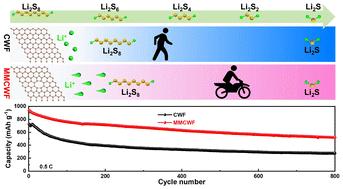
The pursuit of carbon neutrality and reduced carbon dioxide emissions has necessitated the development of high-energy-density energy storage devices. To this end, Li–S batteries, with their exceptionally high energy density and theoretical specific capacity, have emerged as promising devices. However, the practical application of Li–S batteries is limited by the poor conductivity of sulfur and the notorious shuttle effect of lithium polysulfides (LPS). Herein, we present a scalable solvothermal-assisted carbonization strategy to engineer micro–mesoporous carbonized wood fibers (MMCWF) with precisely tailored structural defects and hierarchical porosity. Through a solvothermal treatment followed by carbonization, the WF are transformed into a nanostructured carbon material with a high specific surface area, abundant porosity, and one-dimensional hollow architecture. The as-assembled Li–S battery with sulfur-loaded MMCWF delivers an initial discharge capacity of 1389.6 mA h g−1 at 0.1 C. The MMCWF/S cathode exhibits a high-rate capacity of 690.6 mA h g−1 at 4.0 C, and after 800 cycles at 1.0 C, the capacity decay per cycle is only 0.05%. This innovative material design not only provides a new sulfur host for Li–S batteries but also paves the way for the development of future high-performance energy storage devices.
追求碳中和和减少二氧化碳排放使得高能量密度储能装置的发展成为必要。为此,锂硫电池以其极高的能量密度和理论比容量,成为一种很有前途的设备。然而,锂硫电池的实际应用受到硫的导电性差和多硫化物锂(LPS)臭名昭著的穿梭效应的限制。在此,我们提出了一种可扩展的溶剂热辅助碳化策略来设计具有精确定制结构缺陷和分层孔隙度的微介孔碳化木纤维(MMCWF)。通过溶剂热处理和炭化,将WF转化为具有高比表面积、丰富孔隙度和一维中空结构的纳米结构碳材料。在0.1℃下,MMCWF/S阴极的初始放电容量为1389.6 mA h g−1,在4.0℃下,MMCWF/S阴极的高倍率容量为690.6 mA h g−1,在1.0℃下循环800次后,每个循环的容量衰减仅为0.05%。这种创新的材料设计不仅为Li-S电池提供了一种新的硫宿主,也为未来高性能储能设备的发展铺平了道路。
期刊介绍:
Green Chemistry is a journal that provides a unique forum for the publication of innovative research on the development of alternative green and sustainable technologies. The scope of Green Chemistry is based on the definition proposed by Anastas and Warner (Green Chemistry: Theory and Practice, P T Anastas and J C Warner, Oxford University Press, Oxford, 1998), which defines green chemistry as the utilisation of a set of principles that reduces or eliminates the use or generation of hazardous substances in the design, manufacture and application of chemical products. Green Chemistry aims to reduce the environmental impact of the chemical enterprise by developing a technology base that is inherently non-toxic to living things and the environment. The journal welcomes submissions on all aspects of research relating to this endeavor and publishes original and significant cutting-edge research that is likely to be of wide general appeal. For a work to be published, it must present a significant advance in green chemistry, including a comparison with existing methods and a demonstration of advantages over those methods.



 京公网安备 11010802042870号
京ICP备2023020795号-1
京公网安备 11010802042870号
京ICP备2023020795号-1

 分享
分享
 求助内容:
求助内容: 应助结果提醒方式:
 扫码关注我们
