{"title":"Water-assisted clean electro-preparation of Co3Fe7 in molten salts: its enhanced ferromagnetic properties and hydrogen evolution rate†","authors":"Shengxi Zhao , Kaiyu Xie , Ali Reza Kamali","doi":"10.1039/d4gc05961a","DOIUrl":null,"url":null,"abstract":"<div><div>A clean and efficient method for synthesizing intermetallic Co<sub>3</sub>Fe<sub>7</sub> is reported, based on water-assisted molten salt electrolysis employing the CoFe<sub>2</sub>O<sub>4</sub> electrode, fabricated through the thermo-mechanochemical treatment of iron and cobalt oxides. The electrolysis is conducted at a cell voltage of 1.5 V, achieving an energy consumption of 1.47 kW h kg<sup>−1</sup>. Upon formation, the synthesized Co<sub>3</sub>Fe<sub>7</sub> serves as an electrode for catalytic hydrogen production, demonstrating a current density of 91.7 mA cm<sup>−2</sup>. These performances are compared with those of electrolytic Fe (1.49 kW h kg<sup>−1</sup> and 96.4 mA cm<sup>−2</sup>) and electrolytic Co (1.30 kW h kg<sup>−1</sup> and 40.8 mA cm<sup>−2</sup>), both prepared under the same electrolysis potential but with different current–time profiles. The electrolytic Co<sub>3</sub>Fe<sub>7</sub> exhibits superior ferromagnetic properties, with saturation magnetization, remanent magnetization and coercivity values of 157.0 emu g<sup>−1</sup>, 4.3 emu g<sup>−1</sup> and 48.9 Oe, respectively, surpassing values reported in the literature for Fe–Co alloys. The findings suggest a sustainable approach for the green synthesis of Co<sub>3</sub>Fe<sub>7</sub> with enhanced ferromagnetic properties. Additionally, the electrolytic Fe and Co<sub>3</sub>Fe<sub>7</sub> show promise as electrode materials for molten salt hydrogen production.</div></div>","PeriodicalId":78,"journal":{"name":"Green Chemistry","volume":"27 16","pages":"Pages 4320-4329"},"PeriodicalIF":9.2000,"publicationDate":"2025-03-05","publicationTypes":"Journal Article","fieldsOfStudy":null,"isOpenAccess":false,"openAccessPdf":"","citationCount":"0","resultStr":null,"platform":"Semanticscholar","paperid":null,"PeriodicalName":"Green Chemistry","FirstCategoryId":"92","ListUrlMain":"https://www.sciencedirect.com/org/science/article/pii/S1463926225002201","RegionNum":1,"RegionCategory":"化学","ArticlePicture":[],"TitleCN":null,"AbstractTextCN":null,"PMCID":null,"EPubDate":"2025/3/11 0:00:00","PubModel":"Epub","JCR":"Q1","JCRName":"CHEMISTRY, MULTIDISCIPLINARY","Score":null,"Total":0}
引用次数: 0
Abstract
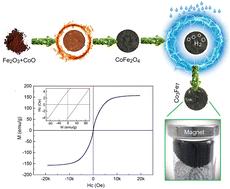
A clean and efficient method for synthesizing intermetallic Co3Fe7 is reported, based on water-assisted molten salt electrolysis employing the CoFe2O4 electrode, fabricated through the thermo-mechanochemical treatment of iron and cobalt oxides. The electrolysis is conducted at a cell voltage of 1.5 V, achieving an energy consumption of 1.47 kW h kg−1. Upon formation, the synthesized Co3Fe7 serves as an electrode for catalytic hydrogen production, demonstrating a current density of 91.7 mA cm−2. These performances are compared with those of electrolytic Fe (1.49 kW h kg−1 and 96.4 mA cm−2) and electrolytic Co (1.30 kW h kg−1 and 40.8 mA cm−2), both prepared under the same electrolysis potential but with different current–time profiles. The electrolytic Co3Fe7 exhibits superior ferromagnetic properties, with saturation magnetization, remanent magnetization and coercivity values of 157.0 emu g−1, 4.3 emu g−1 and 48.9 Oe, respectively, surpassing values reported in the literature for Fe–Co alloys. The findings suggest a sustainable approach for the green synthesis of Co3Fe7 with enhanced ferromagnetic properties. Additionally, the electrolytic Fe and Co3Fe7 show promise as electrode materials for molten salt hydrogen production.
本文报道了一种清洁高效的合成金属间化合物Co3Fe7的方法,该方法基于水辅助熔盐电解,采用CoFe2O4电极,通过对铁和钴氧化物进行热机械化学处理。电解在1.5 V的电池电压下进行,能耗为1.47 kW h kg−1。形成后,合成的Co3Fe7作为催化制氢的电极,显示出91.7 mA cm−2的电流密度。这些性能与电解Fe (1.49 kW h kg−1和96.4 mA cm−2)和电解Co (1.30 kW h kg−1和40.8 mA cm−2)的性能进行了比较,两者都是在相同的电解电位下制备的,但电流时间分布不同。电解后的Co3Fe7表现出优异的铁磁性能,饱和磁化强度、剩余磁化强度和矫顽力分别为157.0、4.3和48.9 ω,超过了Fe-Co合金的文献报道值。这一发现为绿色合成具有增强铁磁性的Co3Fe7提供了一种可持续的方法。此外,电解铁和Co3Fe7显示出作为熔盐制氢电极材料的前景。
期刊介绍:
Green Chemistry is a journal that provides a unique forum for the publication of innovative research on the development of alternative green and sustainable technologies. The scope of Green Chemistry is based on the definition proposed by Anastas and Warner (Green Chemistry: Theory and Practice, P T Anastas and J C Warner, Oxford University Press, Oxford, 1998), which defines green chemistry as the utilisation of a set of principles that reduces or eliminates the use or generation of hazardous substances in the design, manufacture and application of chemical products. Green Chemistry aims to reduce the environmental impact of the chemical enterprise by developing a technology base that is inherently non-toxic to living things and the environment. The journal welcomes submissions on all aspects of research relating to this endeavor and publishes original and significant cutting-edge research that is likely to be of wide general appeal. For a work to be published, it must present a significant advance in green chemistry, including a comparison with existing methods and a demonstration of advantages over those methods.



 京公网安备 11010802042870号
京ICP备2023020795号-1
京公网安备 11010802042870号
京ICP备2023020795号-1

 分享
分享
 求助内容:
求助内容: 应助结果提醒方式:
 扫码关注我们
