Tansu Abbasoglu , Xabier Lopez de Pariza , Gabriel Perli , Danila Merino , Phœbé Caillard-Humeau , Antoine Duval , Luc Avérous , Lourdes Irusta , Alba González , Haritz Sardon
{"title":"Sustainable and biobased self-blown polycarbonate foams: from synthesis to application†","authors":"Tansu Abbasoglu , Xabier Lopez de Pariza , Gabriel Perli , Danila Merino , Phœbé Caillard-Humeau , Antoine Duval , Luc Avérous , Lourdes Irusta , Alba González , Haritz Sardon","doi":"10.1039/d4gc06429a","DOIUrl":null,"url":null,"abstract":"<div><div>Escalating environmental concerns driven by the continuous demand for fossil-based materials have sparked growing interest in designing biobased polymeric materials for high-added-value applications. A novel series of self-blowing polycarbonate foams derived from various biobased polyols (<em>e.g.</em> cashew nutshell liquid, vegetable oil, and lignocellulose) is reported by leveraging thiol-triggered carbon dioxide release in a formulation composed of a thiol and 5- and 6-membered cyclic carbonates. The polyol architecture enabled a tunable open-cell morphology and properties, achieving up to 41 wt% biobased content, marking the first incorporation of biobased monomers in this type of foam. In this context, cashew nutshell-based foam featured good cyclic endurance at 70% compression and a high-water uptake capacity of 8 g g<sup>−1</sup>. As a forward-looking solution to address environmental challenges, this foam effectively supports the germination of different types of vegetable seeds (<em>e.g.</em> bok choy (<em>Brassica rapa chinensis</em>), lettuce (<em>Lactuca sativa</em>), and radish (<em>Raphanus sativus</em>)) in soilless environments, and its hydrolytic stability ensures reusability for subsequent seedling growth. This study lays the foundation for designing future environmentally friendly and renewable polymeric foams that are potentially recyclable with sustainable applications, <em>e.g.</em>, in hydroponics.</div></div>","PeriodicalId":78,"journal":{"name":"Green Chemistry","volume":"27 16","pages":"Pages 4341-4351"},"PeriodicalIF":9.2000,"publicationDate":"2025-03-05","publicationTypes":"Journal Article","fieldsOfStudy":null,"isOpenAccess":false,"openAccessPdf":"","citationCount":"0","resultStr":null,"platform":"Semanticscholar","paperid":null,"PeriodicalName":"Green Chemistry","FirstCategoryId":"92","ListUrlMain":"https://www.sciencedirect.com/org/science/article/pii/S1463926225002250","RegionNum":1,"RegionCategory":"化学","ArticlePicture":[],"TitleCN":null,"AbstractTextCN":null,"PMCID":null,"EPubDate":"2025/3/13 0:00:00","PubModel":"Epub","JCR":"Q1","JCRName":"CHEMISTRY, MULTIDISCIPLINARY","Score":null,"Total":0}
引用次数: 0
Abstract
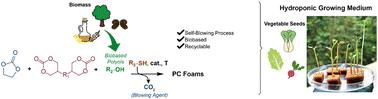
Escalating environmental concerns driven by the continuous demand for fossil-based materials have sparked growing interest in designing biobased polymeric materials for high-added-value applications. A novel series of self-blowing polycarbonate foams derived from various biobased polyols (e.g. cashew nutshell liquid, vegetable oil, and lignocellulose) is reported by leveraging thiol-triggered carbon dioxide release in a formulation composed of a thiol and 5- and 6-membered cyclic carbonates. The polyol architecture enabled a tunable open-cell morphology and properties, achieving up to 41 wt% biobased content, marking the first incorporation of biobased monomers in this type of foam. In this context, cashew nutshell-based foam featured good cyclic endurance at 70% compression and a high-water uptake capacity of 8 g g−1. As a forward-looking solution to address environmental challenges, this foam effectively supports the germination of different types of vegetable seeds (e.g. bok choy (Brassica rapa chinensis), lettuce (Lactuca sativa), and radish (Raphanus sativus)) in soilless environments, and its hydrolytic stability ensures reusability for subsequent seedling growth. This study lays the foundation for designing future environmentally friendly and renewable polymeric foams that are potentially recyclable with sustainable applications, e.g., in hydroponics.
期刊介绍:
Green Chemistry is a journal that provides a unique forum for the publication of innovative research on the development of alternative green and sustainable technologies. The scope of Green Chemistry is based on the definition proposed by Anastas and Warner (Green Chemistry: Theory and Practice, P T Anastas and J C Warner, Oxford University Press, Oxford, 1998), which defines green chemistry as the utilisation of a set of principles that reduces or eliminates the use or generation of hazardous substances in the design, manufacture and application of chemical products. Green Chemistry aims to reduce the environmental impact of the chemical enterprise by developing a technology base that is inherently non-toxic to living things and the environment. The journal welcomes submissions on all aspects of research relating to this endeavor and publishes original and significant cutting-edge research that is likely to be of wide general appeal. For a work to be published, it must present a significant advance in green chemistry, including a comparison with existing methods and a demonstration of advantages over those methods.



 京公网安备 11010802042870号
京ICP备2023020795号-1
京公网安备 11010802042870号
京ICP备2023020795号-1

 分享
分享
 求助内容:
求助内容: 应助结果提醒方式:
 扫码关注我们
