Ruggero Bonetto , Nuria Romero , Federica Sabuzi , Mattia Forchetta , Mirco Natali , Raffaella Signorini , Roger Bofill , Laia Francàs , Marcos Gil-Sepulcre , Olaf Rüdiger , Serena DeBeer , Jordi García-Antón , Karine Philippot , Pierluca Galloni , Andrea Sartorel , Xavier Sala
{"title":"KuQuinone-sensitized cobalt oxide nanoparticles for photoelectrocatalytic oxygen evolution with visible light†","authors":"Ruggero Bonetto , Nuria Romero , Federica Sabuzi , Mattia Forchetta , Mirco Natali , Raffaella Signorini , Roger Bofill , Laia Francàs , Marcos Gil-Sepulcre , Olaf Rüdiger , Serena DeBeer , Jordi García-Antón , Karine Philippot , Pierluca Galloni , Andrea Sartorel , Xavier Sala","doi":"10.1039/d4gc06606e","DOIUrl":null,"url":null,"abstract":"<div><div>Photocatalytic nanomaterials offer promising solutions for conducting chemical transformations under safe, green and sustainable conditions. In particular, the storage of solar energy into chemical bonds is an appealing but challenging goal in the field of artificial photosynthesis. Using water as the source of electrons and protons through the photodriven water oxidation (WO) reaction is at the core of this endeavour. In this work, we disclose photoactive hybrid nanomaterials designed through a dyadic approach. We exploit Co<sub>3</sub>O<sub>4</sub> nanoparticles (NPs) covalently functionalized with a fully organic pentacyclic polyquinoid KuQuinone (<strong>KuQ</strong>) dye, providing a rare example of a noble metal-free photocatalytic dyadic nanomaterial (hereafter denoted as ). NPs have been characterized by electron microscopy and optical and core-level spectroscopy studies. When cast onto a SnO<sub>2</sub> photoanode, they are active towards WO upon visible light irradiation (400–580 nm) with a faradaic efficiency for O<sub>2</sub> evolution of <em>ca.</em> 90%. This work provides a novel contribution to the rational design and mechanistic understanding of hybrid photocatalytic nanomaterials relevant for energy and sustainable synthesis applications.</div></div>","PeriodicalId":78,"journal":{"name":"Green Chemistry","volume":"27 16","pages":"Pages 4352-4368"},"PeriodicalIF":9.2000,"publicationDate":"2025-03-05","publicationTypes":"Journal Article","fieldsOfStudy":null,"isOpenAccess":false,"openAccessPdf":"","citationCount":"0","resultStr":null,"platform":"Semanticscholar","paperid":null,"PeriodicalName":"Green Chemistry","FirstCategoryId":"92","ListUrlMain":"https://www.sciencedirect.com/org/science/article/pii/S1463926225002134","RegionNum":1,"RegionCategory":"化学","ArticlePicture":[],"TitleCN":null,"AbstractTextCN":null,"PMCID":null,"EPubDate":"2025/3/18 0:00:00","PubModel":"Epub","JCR":"Q1","JCRName":"CHEMISTRY, MULTIDISCIPLINARY","Score":null,"Total":0}
引用次数: 0
Abstract
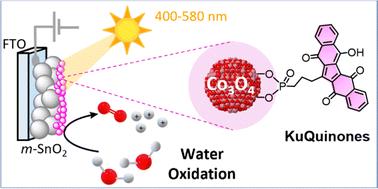
Photocatalytic nanomaterials offer promising solutions for conducting chemical transformations under safe, green and sustainable conditions. In particular, the storage of solar energy into chemical bonds is an appealing but challenging goal in the field of artificial photosynthesis. Using water as the source of electrons and protons through the photodriven water oxidation (WO) reaction is at the core of this endeavour. In this work, we disclose photoactive hybrid nanomaterials designed through a dyadic approach. We exploit Co3O4 nanoparticles (NPs) covalently functionalized with a fully organic pentacyclic polyquinoid KuQuinone (KuQ) dye, providing a rare example of a noble metal-free photocatalytic dyadic nanomaterial (hereafter denoted as ). NPs have been characterized by electron microscopy and optical and core-level spectroscopy studies. When cast onto a SnO2 photoanode, they are active towards WO upon visible light irradiation (400–580 nm) with a faradaic efficiency for O2 evolution of ca. 90%. This work provides a novel contribution to the rational design and mechanistic understanding of hybrid photocatalytic nanomaterials relevant for energy and sustainable synthesis applications.
期刊介绍:
Green Chemistry is a journal that provides a unique forum for the publication of innovative research on the development of alternative green and sustainable technologies. The scope of Green Chemistry is based on the definition proposed by Anastas and Warner (Green Chemistry: Theory and Practice, P T Anastas and J C Warner, Oxford University Press, Oxford, 1998), which defines green chemistry as the utilisation of a set of principles that reduces or eliminates the use or generation of hazardous substances in the design, manufacture and application of chemical products. Green Chemistry aims to reduce the environmental impact of the chemical enterprise by developing a technology base that is inherently non-toxic to living things and the environment. The journal welcomes submissions on all aspects of research relating to this endeavor and publishes original and significant cutting-edge research that is likely to be of wide general appeal. For a work to be published, it must present a significant advance in green chemistry, including a comparison with existing methods and a demonstration of advantages over those methods.



 京公网安备 11010802042870号
京ICP备2023020795号-1
京公网安备 11010802042870号
京ICP备2023020795号-1

 分享
分享
 求助内容:
求助内容: 应助结果提醒方式:
 扫码关注我们
