Sergio Alcalde , Raúl Porcar , Nuria Martín , Francisco G. Cirujano , Belén Altava , Eduardo García-Verdugo
{"title":"Shedding light on the path to multifunctional task-specific supported ionic liquids with enhanced catalyst stability and activity†","authors":"Sergio Alcalde , Raúl Porcar , Nuria Martín , Francisco G. Cirujano , Belén Altava , Eduardo García-Verdugo","doi":"10.1039/d4gc05170j","DOIUrl":null,"url":null,"abstract":"<div><div>This study introduces an approach to developing catalytic systems using multifunctional Task-Specific Support Ionic Liquid-like Phases (TS-SILLPs). These TS-SILLPs leverage the unique properties of ionic liquids (ILs) while addressing traditional challenges such as high production costs and environmental impact. A small-focused library of multifunctional SILLPs can be prepared by employing click chemistry and solid-phase synthesis. The use of thiolactone chemistry and thiol–alkene click reactions facilitates a straightforward method for the post-functionalization of supported ILs, allowing precise customization of their properties for specific catalytic applications. Specifically, in the 1,3-dipolar copper-catalyzed azide–alkyne cycloaddition (CuAAC) reactions, our findings show that these SILLPs can be tuned not only to provide the catalytic species and to stabilize them, enhancing catalyst activity and selectivity, but also to reduce metal leaching, thus providing a greener, more efficient synthesis. Moreover, the incorporation of Rose Bengal as a photosensitizer within the SILLP framework aids in the regeneration of active copper species, demonstrating high stability and reusability of the catalytic system.</div></div>","PeriodicalId":78,"journal":{"name":"Green Chemistry","volume":"27 16","pages":"Pages 4385-4394"},"PeriodicalIF":9.2000,"publicationDate":"2025-03-05","publicationTypes":"Journal Article","fieldsOfStudy":null,"isOpenAccess":false,"openAccessPdf":"","citationCount":"0","resultStr":null,"platform":"Semanticscholar","paperid":null,"PeriodicalName":"Green Chemistry","FirstCategoryId":"92","ListUrlMain":"https://www.sciencedirect.com/org/science/article/pii/S1463926225002043","RegionNum":1,"RegionCategory":"化学","ArticlePicture":[],"TitleCN":null,"AbstractTextCN":null,"PMCID":null,"EPubDate":"2025/3/18 0:00:00","PubModel":"Epub","JCR":"Q1","JCRName":"CHEMISTRY, MULTIDISCIPLINARY","Score":null,"Total":0}
引用次数: 0
Abstract
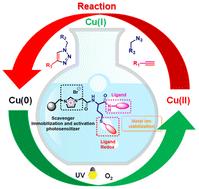
This study introduces an approach to developing catalytic systems using multifunctional Task-Specific Support Ionic Liquid-like Phases (TS-SILLPs). These TS-SILLPs leverage the unique properties of ionic liquids (ILs) while addressing traditional challenges such as high production costs and environmental impact. A small-focused library of multifunctional SILLPs can be prepared by employing click chemistry and solid-phase synthesis. The use of thiolactone chemistry and thiol–alkene click reactions facilitates a straightforward method for the post-functionalization of supported ILs, allowing precise customization of their properties for specific catalytic applications. Specifically, in the 1,3-dipolar copper-catalyzed azide–alkyne cycloaddition (CuAAC) reactions, our findings show that these SILLPs can be tuned not only to provide the catalytic species and to stabilize them, enhancing catalyst activity and selectivity, but also to reduce metal leaching, thus providing a greener, more efficient synthesis. Moreover, the incorporation of Rose Bengal as a photosensitizer within the SILLP framework aids in the regeneration of active copper species, demonstrating high stability and reusability of the catalytic system.
期刊介绍:
Green Chemistry is a journal that provides a unique forum for the publication of innovative research on the development of alternative green and sustainable technologies. The scope of Green Chemistry is based on the definition proposed by Anastas and Warner (Green Chemistry: Theory and Practice, P T Anastas and J C Warner, Oxford University Press, Oxford, 1998), which defines green chemistry as the utilisation of a set of principles that reduces or eliminates the use or generation of hazardous substances in the design, manufacture and application of chemical products. Green Chemistry aims to reduce the environmental impact of the chemical enterprise by developing a technology base that is inherently non-toxic to living things and the environment. The journal welcomes submissions on all aspects of research relating to this endeavor and publishes original and significant cutting-edge research that is likely to be of wide general appeal. For a work to be published, it must present a significant advance in green chemistry, including a comparison with existing methods and a demonstration of advantages over those methods.



 京公网安备 11010802042870号
京ICP备2023020795号-1
京公网安备 11010802042870号
京ICP备2023020795号-1

 分享
分享
 求助内容:
求助内容: 应助结果提醒方式:
 扫码关注我们
