Sergey I. Kostrovitsky, Dmitry A. Yakovlev, Benjamin R. Fosu, Sergey I. Dril, Konstantin V. Garanin
{"title":"A geological, geochemical and isotopic study of primary diamond deposits in the Siberian craton","authors":"Sergey I. Kostrovitsky, Dmitry A. Yakovlev, Benjamin R. Fosu, Sergey I. Dril, Konstantin V. Garanin","doi":"10.1007/s00710-024-00880-3","DOIUrl":null,"url":null,"abstract":"<div><p>We present an overview of published and newly obtained data, which provides general information about the diamond deposits, geochemical and isotopic of kimberlites from all primary diamond deposits of the Siberian craton (20 kimberlite pipes). These deposits are predominantly composed of pyroclastic kimberlites, typically forming as complex, multi-phase, and multi-channel intrusions. Age determinations, based on U-Pb dating of zircon and perovskite, place these deposits between 370 and 350 Ma. A discernible south-to-north gradation in diamond grade across the Siberian craton, particularly in the Yakutian Province correlates with variations in the chemical composition of the kimberlites. The richest diamondiferous deposits are predominantly high-Mg kimberlites. Strikingly, some of the largest deposits by size (such as Jubileynaya, Zarnitsa, and Mir) are Mg-Fe kimberlites and are noted for their lower proportions of high-quality diamonds. Pyroclastic kimberlites, which constitute most Siberian primary diamond deposits generally have higher diamond grades than coherent kimberlites.Apart from the Nakyn field, the distribution of incompatible elements within Siberian diamondiferous kimberlites appears to be independent of their MgO, total FeO, and TiO<sub>2</sub> content. The kimberlites exhibit ɛNd values ranging from + 1.9 to + 7.0 and initial <sup>87</sup>Sr/<sup>86</sup>Sr ratios (denoted as <sup>87</sup>Sr/<sup>86</sup>Sr<sub>i</sub>) from 0.702 to 0.706 (except for the Nakyn field deposits), suggesting a provenance from a slightly depleted mantle source, akin to the prevalent mantle. The kimberlites of the Nakyn field deposits differ from other Siberian diamond deposits by an abnormally low content of incompatible elements, higher <sup>87</sup>Sr/<sup>86</sup>Sr<sub>i</sub> (0.706 to 0.710), and low ɛNd (-3.1 to + 2; Kononova et al. 2005). It is assumed that the kimberlites of the Nakyn field were derived from a mantle source, with an intermediate composition between prevalent mantle and enriched mantle I.</p></div>","PeriodicalId":18547,"journal":{"name":"Mineralogy and Petrology","volume":"119 1","pages":"21 - 47"},"PeriodicalIF":1.1000,"publicationDate":"2025-01-18","publicationTypes":"Journal Article","fieldsOfStudy":null,"isOpenAccess":false,"openAccessPdf":"","citationCount":"0","resultStr":null,"platform":"Semanticscholar","paperid":null,"PeriodicalName":"Mineralogy and Petrology","FirstCategoryId":"89","ListUrlMain":"https://link.springer.com/article/10.1007/s00710-024-00880-3","RegionNum":4,"RegionCategory":"地球科学","ArticlePicture":[],"TitleCN":null,"AbstractTextCN":null,"PMCID":null,"EPubDate":"","PubModel":"","JCR":"Q3","JCRName":"GEOCHEMISTRY & GEOPHYSICS","Score":null,"Total":0}
引用次数: 0
Abstract
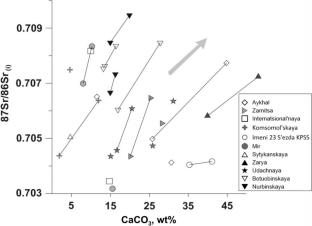
We present an overview of published and newly obtained data, which provides general information about the diamond deposits, geochemical and isotopic of kimberlites from all primary diamond deposits of the Siberian craton (20 kimberlite pipes). These deposits are predominantly composed of pyroclastic kimberlites, typically forming as complex, multi-phase, and multi-channel intrusions. Age determinations, based on U-Pb dating of zircon and perovskite, place these deposits between 370 and 350 Ma. A discernible south-to-north gradation in diamond grade across the Siberian craton, particularly in the Yakutian Province correlates with variations in the chemical composition of the kimberlites. The richest diamondiferous deposits are predominantly high-Mg kimberlites. Strikingly, some of the largest deposits by size (such as Jubileynaya, Zarnitsa, and Mir) are Mg-Fe kimberlites and are noted for their lower proportions of high-quality diamonds. Pyroclastic kimberlites, which constitute most Siberian primary diamond deposits generally have higher diamond grades than coherent kimberlites.Apart from the Nakyn field, the distribution of incompatible elements within Siberian diamondiferous kimberlites appears to be independent of their MgO, total FeO, and TiO2 content. The kimberlites exhibit ɛNd values ranging from + 1.9 to + 7.0 and initial 87Sr/86Sr ratios (denoted as 87Sr/86Sri) from 0.702 to 0.706 (except for the Nakyn field deposits), suggesting a provenance from a slightly depleted mantle source, akin to the prevalent mantle. The kimberlites of the Nakyn field deposits differ from other Siberian diamond deposits by an abnormally low content of incompatible elements, higher 87Sr/86Sri (0.706 to 0.710), and low ɛNd (-3.1 to + 2; Kononova et al. 2005). It is assumed that the kimberlites of the Nakyn field were derived from a mantle source, with an intermediate composition between prevalent mantle and enriched mantle I.
期刊介绍:
Mineralogy and Petrology welcomes manuscripts from the classical fields of mineralogy, igneous and metamorphic petrology, geochemistry, crystallography, as well as their applications in academic experimentation and research, materials science and engineering, for technology, industry, environment, or society. The journal strongly promotes cross-fertilization among Earth-scientific and applied materials-oriented disciplines. Purely descriptive manuscripts on regional topics will not be considered.
Mineralogy and Petrology was founded in 1872 by Gustav Tschermak as "Mineralogische und Petrographische Mittheilungen". It is one of Europe''s oldest geoscience journals. Former editors include outstanding names such as Gustav Tschermak, Friedrich Becke, Felix Machatschki, Josef Zemann, and Eugen F. Stumpfl.



 京公网安备 11010802042870号
京ICP备2023020795号-1
京公网安备 11010802042870号
京ICP备2023020795号-1

 分享
分享
 求助内容:
求助内容: 应助结果提醒方式:
 扫码关注我们
