Luke C. Doskey, Cole R. Scholtz, Nora R. Vail, Shalil Khanal, Amani L. Lee, Sai Giridhar Sarma Kandanur, Zachariah J. Hoell, Amelia M. Huehls, Mohamed R. Issa, Enis Kostallari, Sheng Cao, Joel M. Reid, Vijay H. Shah, Harmeet Malhi, William C. K. Pomerantz
{"title":"Efficacy and Toxicity Analysis of Selective BET Bromodomain Inhibitors in Models of Inflammatory Liver Disease","authors":"Luke C. Doskey, Cole R. Scholtz, Nora R. Vail, Shalil Khanal, Amani L. Lee, Sai Giridhar Sarma Kandanur, Zachariah J. Hoell, Amelia M. Huehls, Mohamed R. Issa, Enis Kostallari, Sheng Cao, Joel M. Reid, Vijay H. Shah, Harmeet Malhi, William C. K. Pomerantz","doi":"10.1021/acs.jmedchem.4c02555","DOIUrl":null,"url":null,"abstract":"BET bromodomain inhibitors demonstrate significant promise as anti-inflammatory agents. However, clinical data demonstrated that nonselective BET bromodomain inhibitors led to significant dose-limiting toxicity in clinical settings. Here, we use three orally bioavailable inhibitors, <b>1</b>–<b>3</b>, that are either BRD4-D1 selective or pan-D1-biased + BRD4-D2, for assessing their cellular and in vivo efficacy and safety profile compared to known BET inhibitors in two inflammatory disease models. Our results show that pan-D1-biased + BRD4-D2 inhibitor, <b>3</b>, is as efficacious as pan-BET inhibitor, I-BET151, in reducing inflammation in both models, whereas pan-D2 inhibitors are less effective. BRD4-D1 selective inhibitors are also efficacious; however, inhibitors with improved cellular engagement will be necessary to better assess their effects. Finally, BRD4-D1 selective inhibitors are better tolerated in a preclinical thrombocytopenia model than <b>3</b>, while gastrointestinal toxicity may be a BRD4-driven effect. These results highlight the importance of assessing specific BET bromodomain functions due to their diverse roles in disease models.","PeriodicalId":46,"journal":{"name":"Journal of Medicinal Chemistry","volume":"108 1","pages":""},"PeriodicalIF":6.8000,"publicationDate":"2025-04-14","publicationTypes":"Journal Article","fieldsOfStudy":null,"isOpenAccess":false,"openAccessPdf":"","citationCount":"0","resultStr":null,"platform":"Semanticscholar","paperid":null,"PeriodicalName":"Journal of Medicinal Chemistry","FirstCategoryId":"3","ListUrlMain":"https://doi.org/10.1021/acs.jmedchem.4c02555","RegionNum":1,"RegionCategory":"医学","ArticlePicture":[],"TitleCN":null,"AbstractTextCN":null,"PMCID":null,"EPubDate":"","PubModel":"","JCR":"Q1","JCRName":"CHEMISTRY, MEDICINAL","Score":null,"Total":0}
引用次数: 0
Abstract
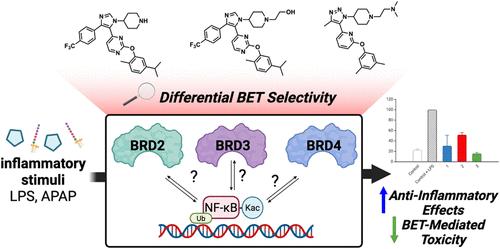
BET bromodomain inhibitors demonstrate significant promise as anti-inflammatory agents. However, clinical data demonstrated that nonselective BET bromodomain inhibitors led to significant dose-limiting toxicity in clinical settings. Here, we use three orally bioavailable inhibitors, 1–3, that are either BRD4-D1 selective or pan-D1-biased + BRD4-D2, for assessing their cellular and in vivo efficacy and safety profile compared to known BET inhibitors in two inflammatory disease models. Our results show that pan-D1-biased + BRD4-D2 inhibitor, 3, is as efficacious as pan-BET inhibitor, I-BET151, in reducing inflammation in both models, whereas pan-D2 inhibitors are less effective. BRD4-D1 selective inhibitors are also efficacious; however, inhibitors with improved cellular engagement will be necessary to better assess their effects. Finally, BRD4-D1 selective inhibitors are better tolerated in a preclinical thrombocytopenia model than 3, while gastrointestinal toxicity may be a BRD4-driven effect. These results highlight the importance of assessing specific BET bromodomain functions due to their diverse roles in disease models.
期刊介绍:
The Journal of Medicinal Chemistry is a prestigious biweekly peer-reviewed publication that focuses on the multifaceted field of medicinal chemistry. Since its inception in 1959 as the Journal of Medicinal and Pharmaceutical Chemistry, it has evolved to become a cornerstone in the dissemination of research findings related to the design, synthesis, and development of therapeutic agents.
The Journal of Medicinal Chemistry is recognized for its significant impact in the scientific community, as evidenced by its 2022 impact factor of 7.3. This metric reflects the journal's influence and the importance of its content in shaping the future of drug discovery and development. The journal serves as a vital resource for chemists, pharmacologists, and other researchers interested in the molecular mechanisms of drug action and the optimization of therapeutic compounds.




 京公网安备 11010802042870号
京ICP备2023020795号-1
京公网安备 11010802042870号
京ICP备2023020795号-1

 分享
分享
 求助内容:
求助内容: 应助结果提醒方式:
 扫码关注我们
