Mingliang Lin, Nishant Karadkhelkar, Yanjie Li, Lisa M. Eubanks, William H. Tepp, Sabine Pellett, Kim D. Janda
{"title":"Bifunctional Inhibition of Botulinum Neurotoxin A Protease: Unexpected Active Site Inhibition Enhances Covalent Targeting of an Allosteric Site","authors":"Mingliang Lin, Nishant Karadkhelkar, Yanjie Li, Lisa M. Eubanks, William H. Tepp, Sabine Pellett, Kim D. Janda","doi":"10.1021/acs.jmedchem.5c00417","DOIUrl":null,"url":null,"abstract":"Botulinum neurotoxin (BoNT) is the most toxic protein known to man and a Tier 1 bioterrorism agent. Among its serotypes, BoNT/A possesses the greatest potency and persistence, as such strategies to counteract it are highly coveted. Bifunctional molecules incorporating both metal chelation and a covalent warhead have shown great potential for blunting BoNT/A LC’s toxicity/longevity. To further explore this idea, new warheads as well as zinc metal-chelating scaffolds were prepared and examined. The structure–activity relationship and kinetic analyses of these inhibitors challenged the standard protease assay leading to a new screening platform implemented and validated. Reconnaissance studies from this new screening platform delineated an unprecedented structural flexibility associated with BoNT/A’s enzyme pocket, which can be induced by a small molecule for enhanced allosteric target inhibition of the protease. The culmination of these findings offers previously unrealized opportunities for neutralizing the BoNT/A protease and thus future <i>in vivo</i> applications.","PeriodicalId":46,"journal":{"name":"Journal of Medicinal Chemistry","volume":"27 1","pages":""},"PeriodicalIF":6.8000,"publicationDate":"2025-04-13","publicationTypes":"Journal Article","fieldsOfStudy":null,"isOpenAccess":false,"openAccessPdf":"","citationCount":"0","resultStr":null,"platform":"Semanticscholar","paperid":null,"PeriodicalName":"Journal of Medicinal Chemistry","FirstCategoryId":"3","ListUrlMain":"https://doi.org/10.1021/acs.jmedchem.5c00417","RegionNum":1,"RegionCategory":"医学","ArticlePicture":[],"TitleCN":null,"AbstractTextCN":null,"PMCID":null,"EPubDate":"","PubModel":"","JCR":"Q1","JCRName":"CHEMISTRY, MEDICINAL","Score":null,"Total":0}
引用次数: 0
Abstract
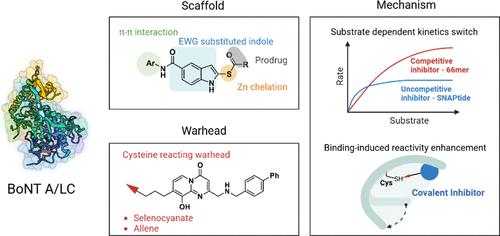
Botulinum neurotoxin (BoNT) is the most toxic protein known to man and a Tier 1 bioterrorism agent. Among its serotypes, BoNT/A possesses the greatest potency and persistence, as such strategies to counteract it are highly coveted. Bifunctional molecules incorporating both metal chelation and a covalent warhead have shown great potential for blunting BoNT/A LC’s toxicity/longevity. To further explore this idea, new warheads as well as zinc metal-chelating scaffolds were prepared and examined. The structure–activity relationship and kinetic analyses of these inhibitors challenged the standard protease assay leading to a new screening platform implemented and validated. Reconnaissance studies from this new screening platform delineated an unprecedented structural flexibility associated with BoNT/A’s enzyme pocket, which can be induced by a small molecule for enhanced allosteric target inhibition of the protease. The culmination of these findings offers previously unrealized opportunities for neutralizing the BoNT/A protease and thus future in vivo applications.
肉毒杆菌神经毒素(BoNT)是人类已知的毒性最强的蛋白质,也是一级生物恐怖主义制剂。在其血清型中,BoNT/A具有最大的效力和持久性,因为这种对抗它的策略是非常令人垂涎的。结合金属螯合和共价战斗部的双功能分子在降低BoNT/ a LC的毒性/寿命方面显示出巨大的潜力。为了进一步探索这一思路,制备并检验了新的弹头和锌金属螯合支架。这些抑制剂的结构-活性关系和动力学分析对标准蛋白酶测定提出了挑战,从而实现并验证了新的筛选平台。从这个新的筛选平台上进行的侦察研究描绘了与BoNT/A酶袋相关的前所未有的结构灵活性,这种灵活性可以通过小分子诱导来增强蛋白酶的变构靶抑制。这些发现的高潮为中和BoNT/A蛋白酶和未来的体内应用提供了以前未实现的机会。
期刊介绍:
The Journal of Medicinal Chemistry is a prestigious biweekly peer-reviewed publication that focuses on the multifaceted field of medicinal chemistry. Since its inception in 1959 as the Journal of Medicinal and Pharmaceutical Chemistry, it has evolved to become a cornerstone in the dissemination of research findings related to the design, synthesis, and development of therapeutic agents.
The Journal of Medicinal Chemistry is recognized for its significant impact in the scientific community, as evidenced by its 2022 impact factor of 7.3. This metric reflects the journal's influence and the importance of its content in shaping the future of drug discovery and development. The journal serves as a vital resource for chemists, pharmacologists, and other researchers interested in the molecular mechanisms of drug action and the optimization of therapeutic compounds.



 京公网安备 11010802042870号
京ICP备2023020795号-1
京公网安备 11010802042870号
京ICP备2023020795号-1

 分享
分享
 求助内容:
求助内容: 应助结果提醒方式:
 扫码关注我们
