Unveiling superior NH3 sensing performance: ultrafast response and enhanced recovery kinetics in Ti3C2Tx/ZnO nano-hybrid sensors with UV-induced Schottky junctions
Gowri Shonali Natarajamani, Veera Prabu Kannan and Sridharan Madanagurusamy
{"title":"Unveiling superior NH3 sensing performance: ultrafast response and enhanced recovery kinetics in Ti3C2Tx/ZnO nano-hybrid sensors with UV-induced Schottky junctions","authors":"Gowri Shonali Natarajamani, Veera Prabu Kannan and Sridharan Madanagurusamy","doi":"10.1039/D5NR00484E","DOIUrl":null,"url":null,"abstract":"<p >Achieving high sensitivity and rapid response/recovery times at ambient temperatures remains a significant challenge in gas sensing. Ti<small><sub>3</sub></small>C<small><sub>2</sub></small>T<small><sub><em>x</em></sub></small> MXenes have gained attention for their gas-sensing potential due to their high conductivity and active surface functional groups, but challenges such as limited sensitivity and slow response/recovery persist. In this study, we present an ultrafast, reversible Ti<small><sub>3</sub></small>C<small><sub>2</sub></small>T<small><sub><em>x</em></sub></small>/ZnO hybrid composite sensor for NH<small><sub>3</sub></small> detection at room temperature. We evaluated the sensor's performance under both ambient and UV illumination conditions. Under ambient conditions, the Ti<small><sub>3</sub></small>C<small><sub>2</sub></small>T<small><sub><em>x</em></sub></small>/ZnO sensor exhibited a 50-fold enhancement in sensitivity compared to pristine ZnO, with response and recovery times of 49 s and 39 s, respectively, at 10 ppm NH<small><sub>3</sub></small>. Under UV illumination, the optimized Ti<small><sub>3</sub></small>C<small><sub>2</sub></small>T<small><sub><em>x</em></sub></small>/ZnO configuration achieved a sensor response of 88 at 50 ppm NH<small><sub>3</sub></small>, with ultrafast response and recovery times of 10 s and 13 s, respectively, at 10 ppm NH<small><sub>3</sub></small>, and a limit of detection (LOD) of 0.1 ppm. These improvements are attributed to charge perturbation at the sensor surface facilitated by Ti<small><sub>3</sub></small>C<small><sub>2</sub></small>T<small><sub><em>x</em></sub></small>/ZnO interactions and the formation of a Schottky barrier at their interface, accelerating adsorption–desorption kinetics. The sensor also demonstrated excellent selectivity for NH<small><sub>3</sub></small> and high long-term stability and repeatability, making it highly suitable for environmental monitoring, industrial safety, and medical diagnostics.</p>","PeriodicalId":92,"journal":{"name":"Nanoscale","volume":" 19","pages":" 12473-12490"},"PeriodicalIF":5.1000,"publicationDate":"2025-04-14","publicationTypes":"Journal Article","fieldsOfStudy":null,"isOpenAccess":false,"openAccessPdf":"","citationCount":"0","resultStr":null,"platform":"Semanticscholar","paperid":null,"PeriodicalName":"Nanoscale","FirstCategoryId":"88","ListUrlMain":"https://pubs.rsc.org/en/content/articlelanding/2025/nr/d5nr00484e","RegionNum":3,"RegionCategory":"材料科学","ArticlePicture":[],"TitleCN":null,"AbstractTextCN":null,"PMCID":null,"EPubDate":"","PubModel":"","JCR":"Q1","JCRName":"CHEMISTRY, MULTIDISCIPLINARY","Score":null,"Total":0}
引用次数: 0
Abstract
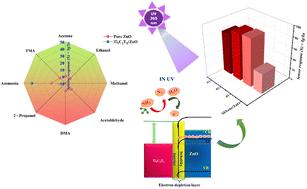
Achieving high sensitivity and rapid response/recovery times at ambient temperatures remains a significant challenge in gas sensing. Ti3C2Tx MXenes have gained attention for their gas-sensing potential due to their high conductivity and active surface functional groups, but challenges such as limited sensitivity and slow response/recovery persist. In this study, we present an ultrafast, reversible Ti3C2Tx/ZnO hybrid composite sensor for NH3 detection at room temperature. We evaluated the sensor's performance under both ambient and UV illumination conditions. Under ambient conditions, the Ti3C2Tx/ZnO sensor exhibited a 50-fold enhancement in sensitivity compared to pristine ZnO, with response and recovery times of 49 s and 39 s, respectively, at 10 ppm NH3. Under UV illumination, the optimized Ti3C2Tx/ZnO configuration achieved a sensor response of 88 at 50 ppm NH3, with ultrafast response and recovery times of 10 s and 13 s, respectively, at 10 ppm NH3, and a limit of detection (LOD) of 0.1 ppm. These improvements are attributed to charge perturbation at the sensor surface facilitated by Ti3C2Tx/ZnO interactions and the formation of a Schottky barrier at their interface, accelerating adsorption–desorption kinetics. The sensor also demonstrated excellent selectivity for NH3 and high long-term stability and repeatability, making it highly suitable for environmental monitoring, industrial safety, and medical diagnostics.
期刊介绍:
Nanoscale is a high-impact international journal, publishing high-quality research across nanoscience and nanotechnology. Nanoscale publishes a full mix of research articles on experimental and theoretical work, including reviews, communications, and full papers.Highly interdisciplinary, this journal appeals to scientists, researchers and professionals interested in nanoscience and nanotechnology, quantum materials and quantum technology, including the areas of physics, chemistry, biology, medicine, materials, energy/environment, information technology, detection science, healthcare and drug discovery, and electronics.



 京公网安备 11010802042870号
京ICP备2023020795号-1
京公网安备 11010802042870号
京ICP备2023020795号-1

 分享
分享
 求助内容:
求助内容: 应助结果提醒方式:
 扫码关注我们
