{"title":"Thermodynamic Origin of Li Underpotential and Overpotential Deposition on Current Collectors","authors":"J. Kian Pu, Venkatasubramanian Viswanathan","doi":"10.1021/acs.jpcc.5c01078","DOIUrl":null,"url":null,"abstract":"Advancing the electrification of transportation, anode-free lithium metal batteries represent a promising solution due to their superior specific energy. By eliminating the need for lithium metal foil on current collectors, this technology simplifies the manufacturing and handling processes. However, this configuration presents challenges, such as dendrite growth and reduced Coulombic efficiency. Understanding the mechanisms of Li nucleation and growth is critical for achieving uniform Li plating and improving battery performance. In this study, we conduct a detailed thermodynamic analysis of the initial Li deposition potential on homogeneous (Li), heterogeneous (Cu), and mixed homogeneous and heterogeneous (LiZn) substrates to understand the origin of underpotential deposition (UPD) and overpotential deposition (OPD). We simulated the open-circuit voltage of the Li overlayer formation. We found that underpotential deposition on Cu starts as high as 1.2 V but drops significantly to as low as −0.72 V due to repulsive interaction between Li adatoms. We showed that LiZn is a superior substrate for Li deposition because the Li overlayer can be formed at moderate positive potential from 0.17 to −0.07 V with a large underpotential deposition region. We attribute this performance to the synergistic effect of Li-alloy substrates: the adsorption energy is moderately stronger than in bulk Li, similar to heterogeneous substrates, while the larger lattice constant promotes attractive interactions between Li adatoms, similar to a homogeneous substrate. These results highlight the critical role of deposition concentration and substrate chemistry in tuning the deposition potential. Our findings provide a thermodynamic framework for evaluating current collectors and suggest that Li-alloy substrates with lattice constants larger than those of Li metals can enhance nucleation uniformity and suppress parasitic reactions. This work offers guidance for the rational design of next-generation current collectors and bridges a key gap between computational modeling and experimental strategies in an anode-free battery.","PeriodicalId":61,"journal":{"name":"The Journal of Physical Chemistry C","volume":"34 1","pages":""},"PeriodicalIF":3.2000,"publicationDate":"2025-04-14","publicationTypes":"Journal Article","fieldsOfStudy":null,"isOpenAccess":false,"openAccessPdf":"","citationCount":"0","resultStr":null,"platform":"Semanticscholar","paperid":null,"PeriodicalName":"The Journal of Physical Chemistry C","FirstCategoryId":"1","ListUrlMain":"https://doi.org/10.1021/acs.jpcc.5c01078","RegionNum":3,"RegionCategory":"化学","ArticlePicture":[],"TitleCN":null,"AbstractTextCN":null,"PMCID":null,"EPubDate":"","PubModel":"","JCR":"Q2","JCRName":"CHEMISTRY, PHYSICAL","Score":null,"Total":0}
引用次数: 0
Abstract
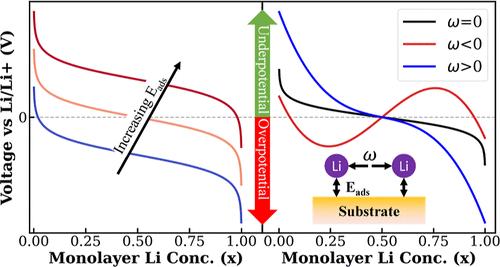
Advancing the electrification of transportation, anode-free lithium metal batteries represent a promising solution due to their superior specific energy. By eliminating the need for lithium metal foil on current collectors, this technology simplifies the manufacturing and handling processes. However, this configuration presents challenges, such as dendrite growth and reduced Coulombic efficiency. Understanding the mechanisms of Li nucleation and growth is critical for achieving uniform Li plating and improving battery performance. In this study, we conduct a detailed thermodynamic analysis of the initial Li deposition potential on homogeneous (Li), heterogeneous (Cu), and mixed homogeneous and heterogeneous (LiZn) substrates to understand the origin of underpotential deposition (UPD) and overpotential deposition (OPD). We simulated the open-circuit voltage of the Li overlayer formation. We found that underpotential deposition on Cu starts as high as 1.2 V but drops significantly to as low as −0.72 V due to repulsive interaction between Li adatoms. We showed that LiZn is a superior substrate for Li deposition because the Li overlayer can be formed at moderate positive potential from 0.17 to −0.07 V with a large underpotential deposition region. We attribute this performance to the synergistic effect of Li-alloy substrates: the adsorption energy is moderately stronger than in bulk Li, similar to heterogeneous substrates, while the larger lattice constant promotes attractive interactions between Li adatoms, similar to a homogeneous substrate. These results highlight the critical role of deposition concentration and substrate chemistry in tuning the deposition potential. Our findings provide a thermodynamic framework for evaluating current collectors and suggest that Li-alloy substrates with lattice constants larger than those of Li metals can enhance nucleation uniformity and suppress parasitic reactions. This work offers guidance for the rational design of next-generation current collectors and bridges a key gap between computational modeling and experimental strategies in an anode-free battery.
期刊介绍:
The Journal of Physical Chemistry A/B/C is devoted to reporting new and original experimental and theoretical basic research of interest to physical chemists, biophysical chemists, and chemical physicists.



 京公网安备 11010802042870号
京ICP备2023020795号-1
京公网安备 11010802042870号
京ICP备2023020795号-1

 分享
分享
 求助内容:
求助内容: 应助结果提醒方式:
 扫码关注我们
