Blue Thermally Activated Delayed Fluorescence Organic Electroluminescent Devices with Carriers Regulating Structure by Employing the Gadolinium(III) Complex as a Hole Trapper
{"title":"Blue Thermally Activated Delayed Fluorescence Organic Electroluminescent Devices with Carriers Regulating Structure by Employing the Gadolinium(III) Complex as a Hole Trapper","authors":"Guodong Sun, Yue Xu, Haoran Yang, Xiaoyang Xia, Jiuqi Wang, Liang Zhou, Quanguo Zhou","doi":"10.1021/acs.jpcc.5c01184","DOIUrl":null,"url":null,"abstract":"In this work, a series of high-performance organic light-emitting devices based on blue thermally activated delayed fluorescence material DBA-DI were designed and fabricated by utilizing the gadolinium(III) complex as a hole trapper. After optimizing the doping concentration of the blue emitter, the Gd complex was codoped into the emitting layer (EML). Due to the high-lying highest occupied molecular orbital level (HOMO) of the Gd complex, superfluous holes within EML were effectively captured, thus improving carrier balance and broadening the recombination zone. Experimental results demonstrated that the codoped devices obtained significantly elevated electroluminescent (EL) performance by regulating carrier distribution and suppressing exciton quenching. Compared with nonco-doped devices, codoped devices displayed higher external quantum efficiency (EQE) and brightness with increased ratios of nearly 20% and over 30%, respectively. Eventually, the optimal codoped double-EML device obtained the maximum EQE, brightness, current efficiency, and power efficiency as high as 15.82%, 12,170 cd m<sup>–2</sup>, 27.47 cd A<sup>–1</sup>, and 31.96 lm W<sup>–1</sup>, respectively. In addition, by further optimizing the thickness of the electron transport layer, a maximum EQE as high as 17.49% was realized.","PeriodicalId":61,"journal":{"name":"The Journal of Physical Chemistry C","volume":"24 1","pages":""},"PeriodicalIF":3.2000,"publicationDate":"2025-04-14","publicationTypes":"Journal Article","fieldsOfStudy":null,"isOpenAccess":false,"openAccessPdf":"","citationCount":"0","resultStr":null,"platform":"Semanticscholar","paperid":null,"PeriodicalName":"The Journal of Physical Chemistry C","FirstCategoryId":"1","ListUrlMain":"https://doi.org/10.1021/acs.jpcc.5c01184","RegionNum":3,"RegionCategory":"化学","ArticlePicture":[],"TitleCN":null,"AbstractTextCN":null,"PMCID":null,"EPubDate":"","PubModel":"","JCR":"Q2","JCRName":"CHEMISTRY, PHYSICAL","Score":null,"Total":0}
引用次数: 0
Abstract
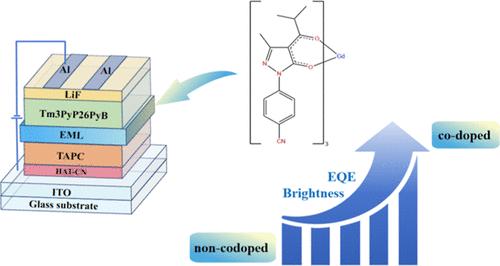
In this work, a series of high-performance organic light-emitting devices based on blue thermally activated delayed fluorescence material DBA-DI were designed and fabricated by utilizing the gadolinium(III) complex as a hole trapper. After optimizing the doping concentration of the blue emitter, the Gd complex was codoped into the emitting layer (EML). Due to the high-lying highest occupied molecular orbital level (HOMO) of the Gd complex, superfluous holes within EML were effectively captured, thus improving carrier balance and broadening the recombination zone. Experimental results demonstrated that the codoped devices obtained significantly elevated electroluminescent (EL) performance by regulating carrier distribution and suppressing exciton quenching. Compared with nonco-doped devices, codoped devices displayed higher external quantum efficiency (EQE) and brightness with increased ratios of nearly 20% and over 30%, respectively. Eventually, the optimal codoped double-EML device obtained the maximum EQE, brightness, current efficiency, and power efficiency as high as 15.82%, 12,170 cd m–2, 27.47 cd A–1, and 31.96 lm W–1, respectively. In addition, by further optimizing the thickness of the electron transport layer, a maximum EQE as high as 17.49% was realized.
本文以钆(III)配合物为捕孔剂,设计并制备了一系列基于蓝色热激活延迟荧光材料DBA-DI的高性能有机发光器件。在优化蓝色发射体掺杂浓度后,将Gd配合物共掺杂到发射层(EML)中。由于Gd配合物位于较高的最高已占据分子轨道能级(HOMO), EML内多余的空穴被有效捕获,从而改善载流子平衡,扩大重组区。实验结果表明,共掺杂器件通过调节载流子分布和抑制激子猝灭,显著提高了电致发光(EL)性能。与非共掺杂器件相比,共掺杂器件的外量子效率(EQE)和亮度分别提高了近20%和30%以上。最终,最优共掺杂双eml器件的EQE、亮度、电流效率和功率效率分别高达15.82%、12,170 cd m-2、27.47 cd A-1和31.96 lm W-1。此外,通过进一步优化电子传递层的厚度,实现了最高17.49%的EQE。
期刊介绍:
The Journal of Physical Chemistry A/B/C is devoted to reporting new and original experimental and theoretical basic research of interest to physical chemists, biophysical chemists, and chemical physicists.



 京公网安备 11010802042870号
京ICP备2023020795号-1
京公网安备 11010802042870号
京ICP备2023020795号-1

 分享
分享
 求助内容:
求助内容: 应助结果提醒方式:
 扫码关注我们
