{"title":"Probing Structural Distortions and Ionic Migration in CH3NH3PbI3: The Role of Intrinsic Defects","authors":"Pranjul Bhatt, Susmita Jana, Abhishek Tewari","doi":"10.1021/acs.jpcc.5c01844","DOIUrl":null,"url":null,"abstract":"Structural distortions play a decisive role in the stability and performance of organic–inorganic mixed halide perovskites. Therefore, understanding the role of inevitably present intrinsic defects in the structural distortions is essential for the defect engineering of halide perovskites. In this study, we present an in-depth analysis of the structural distortions induced by the presence of five intrinsic defects, namely, CH<sub>3</sub>NH<sub>3</sub> (MA), Pb and I vacancies, Pb interstitial, and Pb<sub>MA</sub> antisite in CH<sub>3</sub>NH<sub>3</sub>PbI<sub>3</sub>. Quantitative analysis of the octahedral distortions and MA molecular rotation showed that the Pb vacancy causes a maximum change in the isometric octahedral volume (∼14%) as well as MA molecule rotation (∼70°), while the asymmetric octahedral twisting and bond angle deviations are negligible. On the other hand, asymmetric octahedral distortions are highest in the I-vacant structure, where an average variation of ∼8° in the I–Pb–I bond angle was reported, and the effective coordination number of Pb drops to ∼5.2. Classical force-field based calculations revealed that the halide ion migration barrier varies proportionally with the isometric octahedral volume change and the MA molecule rotation, while the effect of asymmetric octahedral distortions was observed to be negligible. The total activation energy of halide vacancy diffusion increases by 0.3–1.1 eV due to the presence of intrinsic defects, where binding of the iodide vacancies with the intrinsic defects plays a dominating role. Inhibiting ionic migration through the interplay of defects is an effective strategy to suppress phase transitions and enhance the stability of perovskite-based devices, enabling their application in LEDs, photodetectors, and solar cells.","PeriodicalId":61,"journal":{"name":"The Journal of Physical Chemistry C","volume":"120 1","pages":""},"PeriodicalIF":3.2000,"publicationDate":"2025-04-13","publicationTypes":"Journal Article","fieldsOfStudy":null,"isOpenAccess":false,"openAccessPdf":"","citationCount":"0","resultStr":null,"platform":"Semanticscholar","paperid":null,"PeriodicalName":"The Journal of Physical Chemistry C","FirstCategoryId":"1","ListUrlMain":"https://doi.org/10.1021/acs.jpcc.5c01844","RegionNum":3,"RegionCategory":"化学","ArticlePicture":[],"TitleCN":null,"AbstractTextCN":null,"PMCID":null,"EPubDate":"","PubModel":"","JCR":"Q2","JCRName":"CHEMISTRY, PHYSICAL","Score":null,"Total":0}
引用次数: 0
Abstract
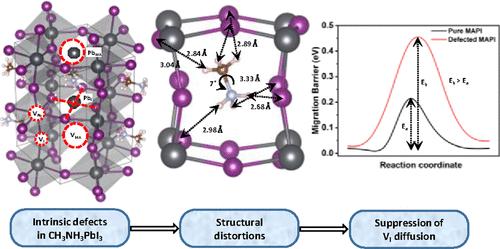
Structural distortions play a decisive role in the stability and performance of organic–inorganic mixed halide perovskites. Therefore, understanding the role of inevitably present intrinsic defects in the structural distortions is essential for the defect engineering of halide perovskites. In this study, we present an in-depth analysis of the structural distortions induced by the presence of five intrinsic defects, namely, CH3NH3 (MA), Pb and I vacancies, Pb interstitial, and PbMA antisite in CH3NH3PbI3. Quantitative analysis of the octahedral distortions and MA molecular rotation showed that the Pb vacancy causes a maximum change in the isometric octahedral volume (∼14%) as well as MA molecule rotation (∼70°), while the asymmetric octahedral twisting and bond angle deviations are negligible. On the other hand, asymmetric octahedral distortions are highest in the I-vacant structure, where an average variation of ∼8° in the I–Pb–I bond angle was reported, and the effective coordination number of Pb drops to ∼5.2. Classical force-field based calculations revealed that the halide ion migration barrier varies proportionally with the isometric octahedral volume change and the MA molecule rotation, while the effect of asymmetric octahedral distortions was observed to be negligible. The total activation energy of halide vacancy diffusion increases by 0.3–1.1 eV due to the presence of intrinsic defects, where binding of the iodide vacancies with the intrinsic defects plays a dominating role. Inhibiting ionic migration through the interplay of defects is an effective strategy to suppress phase transitions and enhance the stability of perovskite-based devices, enabling their application in LEDs, photodetectors, and solar cells.
期刊介绍:
The Journal of Physical Chemistry A/B/C is devoted to reporting new and original experimental and theoretical basic research of interest to physical chemists, biophysical chemists, and chemical physicists.



 京公网安备 11010802042870号
京ICP备2023020795号-1
京公网安备 11010802042870号
京ICP备2023020795号-1

 分享
分享
 求助内容:
求助内容: 应助结果提醒方式:
 扫码关注我们
