Dylan M. Snider, Mackenzie L. Coffin, Brian J. Armijo, Ryan Khetan, Mark W. Duchow, Anna Capasso, Devleena Samanta
{"title":"Conformationally Locked Peptide–DNA Nanostructures for CRISPR-Amplified Activity-Based Sensing","authors":"Dylan M. Snider, Mackenzie L. Coffin, Brian J. Armijo, Ryan Khetan, Mark W. Duchow, Anna Capasso, Devleena Samanta","doi":"10.1002/anie.202500649","DOIUrl":null,"url":null,"abstract":"<p>We introduce a new class of chemical probes for activity-based sensing of proteases, termed cleavable, locked initiator probes (CLIPs). CLIPs contain a protease-cleavable peptide linked between two programmable DNA strands—an “initiator” DNA and a shorter “blocking” DNA. These DNA sequences are designed to hybridize, creating a “locked” hairpin-like structure. Upon proteolytic cleavage, the initiator strand is released, triggering the activation of CRISPR-Cas12a enzymes and producing an amplified fluorescence response. CLIPs generate more than 20-fold turn-on signals at room temperature (25 °C), significantly outperforming commercial probes by yielding ∼40-fold lower limits of detection (LOD) at 100-fold lower concentrations. Their versatility enables the detection of various disease-relevant proteases—including the SARS-CoV-2 main protease, caspase-3, matrix metalloproteinase-7, and cathepsin B—simply by altering the peptide sequence. Importantly, CLIPs detect cathepsin B in four different colorectal cancer cell lines, highlighting their clinical potential. Taken together, the sensitivity (LOD: ∼88 pM), selectivity, and rapid assay time (down to 35 min), combined with the ability to operate in complex biological media with minimal sample preparation, position CLIPs as powerful chemical tools for activity-based sensing of functional enzymes.</p>","PeriodicalId":125,"journal":{"name":"Angewandte Chemie International Edition","volume":"64 25","pages":""},"PeriodicalIF":16.9000,"publicationDate":"2025-04-13","publicationTypes":"Journal Article","fieldsOfStudy":null,"isOpenAccess":false,"openAccessPdf":"https://onlinelibrary.wiley.com/doi/epdf/10.1002/anie.202500649","citationCount":"0","resultStr":null,"platform":"Semanticscholar","paperid":null,"PeriodicalName":"Angewandte Chemie International Edition","FirstCategoryId":"92","ListUrlMain":"https://onlinelibrary.wiley.com/doi/10.1002/anie.202500649","RegionNum":1,"RegionCategory":"化学","ArticlePicture":[],"TitleCN":null,"AbstractTextCN":null,"PMCID":null,"EPubDate":"","PubModel":"","JCR":"Q1","JCRName":"CHEMISTRY, MULTIDISCIPLINARY","Score":null,"Total":0}
引用次数: 0
Abstract
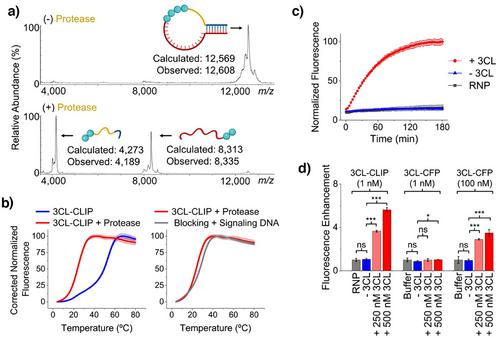
We introduce a new class of chemical probes for activity-based sensing of proteases, termed cleavable, locked initiator probes (CLIPs). CLIPs contain a protease-cleavable peptide linked between two programmable DNA strands—an “initiator” DNA and a shorter “blocking” DNA. These DNA sequences are designed to hybridize, creating a “locked” hairpin-like structure. Upon proteolytic cleavage, the initiator strand is released, triggering the activation of CRISPR-Cas12a enzymes and producing an amplified fluorescence response. CLIPs generate more than 20-fold turn-on signals at room temperature (25 °C), significantly outperforming commercial probes by yielding ∼40-fold lower limits of detection (LOD) at 100-fold lower concentrations. Their versatility enables the detection of various disease-relevant proteases—including the SARS-CoV-2 main protease, caspase-3, matrix metalloproteinase-7, and cathepsin B—simply by altering the peptide sequence. Importantly, CLIPs detect cathepsin B in four different colorectal cancer cell lines, highlighting their clinical potential. Taken together, the sensitivity (LOD: ∼88 pM), selectivity, and rapid assay time (down to 35 min), combined with the ability to operate in complex biological media with minimal sample preparation, position CLIPs as powerful chemical tools for activity-based sensing of functional enzymes.
期刊介绍:
Angewandte Chemie, a journal of the German Chemical Society (GDCh), maintains a leading position among scholarly journals in general chemistry with an impressive Impact Factor of 16.6 (2022 Journal Citation Reports, Clarivate, 2023). Published weekly in a reader-friendly format, it features new articles almost every day. Established in 1887, Angewandte Chemie is a prominent chemistry journal, offering a dynamic blend of Review-type articles, Highlights, Communications, and Research Articles on a weekly basis, making it unique in the field.



 京公网安备 11010802042870号
京ICP备2023020795号-1
京公网安备 11010802042870号
京ICP备2023020795号-1

 分享
分享
 求助内容:
求助内容: 应助结果提醒方式:
 扫码关注我们
