Xiao-Meng Huang, Zhi-Wen Ji, Xun-Lei Ding, Yan Chen, Wei Li, Jiao-Jiao Chen, Shao-Peng Xu and Lin-Lin Li
{"title":"Theoretical study of ammonia synthesis catalysed by trimetallic clusters with or without a sumanene support†","authors":"Xiao-Meng Huang, Zhi-Wen Ji, Xun-Lei Ding, Yan Chen, Wei Li, Jiao-Jiao Chen, Shao-Peng Xu and Lin-Lin Li","doi":"10.1039/D5CP00926J","DOIUrl":null,"url":null,"abstract":"<p >DFT calculations were utilized to explore the electrocatalytic nitrogen reduction reaction (NRR) mechanisms catalyzed by trimetallic clusters M<small><sub>3</sub></small> (M = Ti, Zr, V, and Nb), both unsupported and supported by bowl-shaped sumanene. The substrate enhanced N<small><sub>2</sub></small> adsorption and activation but hindered hydrogenation due to more negative adsorption energies. The substrate promoted hydrogenation of nitrogen, reducing the interference of the hydrogen evolution reaction (HER) and enhancing the NRR selectivity. Three fundamental and three mixed pathways were investigated, and the rate-determining step (RDS) was identified for each pathway. Through a consecutive pathway, V<small><sub>3</sub></small> exhibits the best catalytic performance with the free energy change of the RDS (Δ<em>G</em><small><sub>RDS</sub></small>) as 0.82 eV, while the optimal supported catalyst, Nb<small><sub>3</sub></small> supported on sumanene, has a Δ<em>G</em><small><sub>RDS</sub></small> of 1.43 eV. The introduction of the substrate generally increased Δ<em>G</em><small><sub>RDS</sub></small> by 0.3–0.8 eV. The substrate can effectively regulate the distance between metal atoms and reduce the change in geometric structures of M<small><sub>3</sub></small> clusters during the reaction process, thereby enhancing the structural stability of the active sites in the NRR process. The substrate can reduce the reactivity differences among catalysts with different metal types. This so-called blurring effect allows cheap metals to partially replace noble metals while maintaining catalyst performance. A linear correlation between charge changes on M<small><sub>3</sub></small> or M<small><sub>3</sub></small> together with the substrate and Δ<em>G</em> was observed, providing a potential method for optimizing the catalyst performance and designing new catalysts.</p>","PeriodicalId":99,"journal":{"name":"Physical Chemistry Chemical Physics","volume":" 19","pages":" 10259-10274"},"PeriodicalIF":2.9000,"publicationDate":"2025-04-14","publicationTypes":"Journal Article","fieldsOfStudy":null,"isOpenAccess":false,"openAccessPdf":"","citationCount":"0","resultStr":null,"platform":"Semanticscholar","paperid":null,"PeriodicalName":"Physical Chemistry Chemical Physics","FirstCategoryId":"92","ListUrlMain":"https://pubs.rsc.org/en/content/articlelanding/2025/cp/d5cp00926j","RegionNum":3,"RegionCategory":"化学","ArticlePicture":[],"TitleCN":null,"AbstractTextCN":null,"PMCID":null,"EPubDate":"","PubModel":"","JCR":"Q3","JCRName":"CHEMISTRY, PHYSICAL","Score":null,"Total":0}
引用次数: 0
Abstract
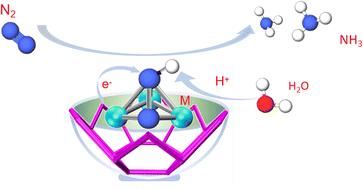
DFT calculations were utilized to explore the electrocatalytic nitrogen reduction reaction (NRR) mechanisms catalyzed by trimetallic clusters M3 (M = Ti, Zr, V, and Nb), both unsupported and supported by bowl-shaped sumanene. The substrate enhanced N2 adsorption and activation but hindered hydrogenation due to more negative adsorption energies. The substrate promoted hydrogenation of nitrogen, reducing the interference of the hydrogen evolution reaction (HER) and enhancing the NRR selectivity. Three fundamental and three mixed pathways were investigated, and the rate-determining step (RDS) was identified for each pathway. Through a consecutive pathway, V3 exhibits the best catalytic performance with the free energy change of the RDS (ΔGRDS) as 0.82 eV, while the optimal supported catalyst, Nb3 supported on sumanene, has a ΔGRDS of 1.43 eV. The introduction of the substrate generally increased ΔGRDS by 0.3–0.8 eV. The substrate can effectively regulate the distance between metal atoms and reduce the change in geometric structures of M3 clusters during the reaction process, thereby enhancing the structural stability of the active sites in the NRR process. The substrate can reduce the reactivity differences among catalysts with different metal types. This so-called blurring effect allows cheap metals to partially replace noble metals while maintaining catalyst performance. A linear correlation between charge changes on M3 or M3 together with the substrate and ΔG was observed, providing a potential method for optimizing the catalyst performance and designing new catalysts.
期刊介绍:
Physical Chemistry Chemical Physics (PCCP) is an international journal co-owned by 19 physical chemistry and physics societies from around the world. This journal publishes original, cutting-edge research in physical chemistry, chemical physics and biophysical chemistry. To be suitable for publication in PCCP, articles must include significant innovation and/or insight into physical chemistry; this is the most important criterion that reviewers and Editors will judge against when evaluating submissions.
The journal has a broad scope and welcomes contributions spanning experiment, theory, computation and data science. Topical coverage includes spectroscopy, dynamics, kinetics, statistical mechanics, thermodynamics, electrochemistry, catalysis, surface science, quantum mechanics, quantum computing and machine learning. Interdisciplinary research areas such as polymers and soft matter, materials, nanoscience, energy, surfaces/interfaces, and biophysical chemistry are welcomed if they demonstrate significant innovation and/or insight into physical chemistry. Joined experimental/theoretical studies are particularly appreciated when complementary and based on up-to-date approaches.




 京公网安备 11010802042870号
京ICP备2023020795号-1
京公网安备 11010802042870号
京ICP备2023020795号-1

 分享
分享
 求助内容:
求助内容: 应助结果提醒方式:
 扫码关注我们
