{"title":"Application of DeepONet to predict transient drop motion of the control rod in real-time","authors":"Dae-Guen Lim , Gil-Yong Lee , Yong-Hwa Park","doi":"10.1016/j.net.2025.103620","DOIUrl":null,"url":null,"abstract":"<div><div>This paper proposes a surrogate model using a deep operator neural network (DeepONet) to predict transient drop motion of CR in real-time. The DeepONet model is trained using synthetic data obtained from the experimentally verified flexible multibody dynamic model, which considers large deformation, fluid-structure interaction, and friction. In the DeepONet architecture, the branch network processes the deformation profile of the fuel assembly (FA), while the trunk network handles the three actuator strokes as structural parameters along with time, enabling the model to predict the displacement and velocity of the CR. The accuracy of DeepONet is evaluated by calculating the mean absolute error of the normalized output, and the model's efficiency is assessed by comparing the computational time of the flexible multibody dynamics model with that of the DeepONet. Validation results demonstrate strong agreement between the DeepONet predictions and those of the flexible multibody dynamics model, achieving 99.39 % accuracy for displacement and 98.72 % accuracy for velocity under various FA deformations. Furthermore, the DeepONet provides a computational speedup of over 1500 times, with average prediction times of 321.4 ms. The proposed surrogate model offers a reliable solution for predicting CR drop motion with high accuracy and computational efficiency, enhancing nuclear reactor safety.</div></div>","PeriodicalId":19272,"journal":{"name":"Nuclear Engineering and Technology","volume":"57 9","pages":"Article 103620"},"PeriodicalIF":2.6000,"publicationDate":"2025-09-01","publicationTypes":"Journal Article","fieldsOfStudy":null,"isOpenAccess":false,"openAccessPdf":"","citationCount":"0","resultStr":null,"platform":"Semanticscholar","paperid":null,"PeriodicalName":"Nuclear Engineering and Technology","FirstCategoryId":"5","ListUrlMain":"https://www.sciencedirect.com/science/article/pii/S1738573325001883","RegionNum":3,"RegionCategory":"工程技术","ArticlePicture":[],"TitleCN":null,"AbstractTextCN":null,"PMCID":null,"EPubDate":"2025/4/4 0:00:00","PubModel":"Epub","JCR":"Q1","JCRName":"NUCLEAR SCIENCE & TECHNOLOGY","Score":null,"Total":0}
引用次数: 0
Abstract
This paper proposes a surrogate model using a deep operator neural network (DeepONet) to predict transient drop motion of CR in real-time. The DeepONet model is trained using synthetic data obtained from the experimentally verified flexible multibody dynamic model, which considers large deformation, fluid-structure interaction, and friction. In the DeepONet architecture, the branch network processes the deformation profile of the fuel assembly (FA), while the trunk network handles the three actuator strokes as structural parameters along with time, enabling the model to predict the displacement and velocity of the CR. The accuracy of DeepONet is evaluated by calculating the mean absolute error of the normalized output, and the model's efficiency is assessed by comparing the computational time of the flexible multibody dynamics model with that of the DeepONet. Validation results demonstrate strong agreement between the DeepONet predictions and those of the flexible multibody dynamics model, achieving 99.39 % accuracy for displacement and 98.72 % accuracy for velocity under various FA deformations. Furthermore, the DeepONet provides a computational speedup of over 1500 times, with average prediction times of 321.4 ms. The proposed surrogate model offers a reliable solution for predicting CR drop motion with high accuracy and computational efficiency, enhancing nuclear reactor safety.
期刊介绍:
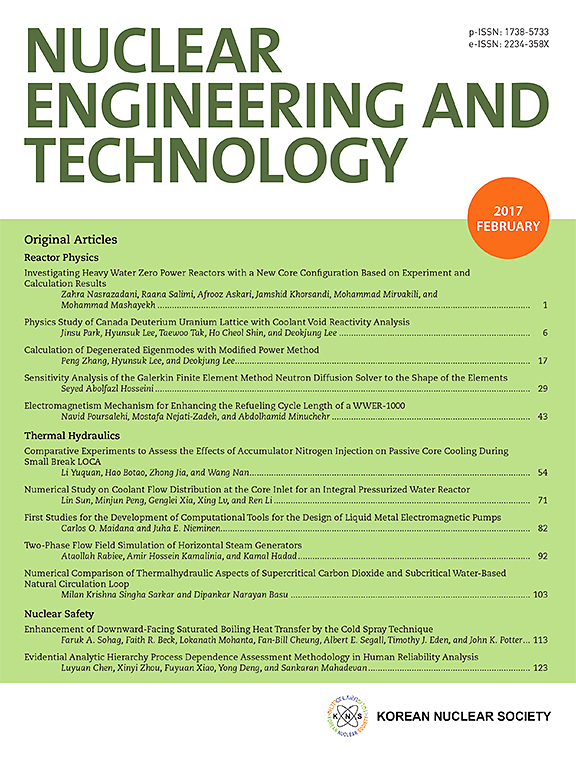
Nuclear Engineering and Technology (NET), an international journal of the Korean Nuclear Society (KNS), publishes peer-reviewed papers on original research, ideas and developments in all areas of the field of nuclear science and technology. NET bimonthly publishes original articles, reviews, and technical notes. The journal is listed in the Science Citation Index Expanded (SCIE) of Thomson Reuters.
NET covers all fields for peaceful utilization of nuclear energy and radiation as follows:
1) Reactor Physics
2) Thermal Hydraulics
3) Nuclear Safety
4) Nuclear I&C
5) Nuclear Physics, Fusion, and Laser Technology
6) Nuclear Fuel Cycle and Radioactive Waste Management
7) Nuclear Fuel and Reactor Materials
8) Radiation Application
9) Radiation Protection
10) Nuclear Structural Analysis and Plant Management & Maintenance
11) Nuclear Policy, Economics, and Human Resource Development



 京公网安备 11010802042870号
京ICP备2023020795号-1
京公网安备 11010802042870号
京ICP备2023020795号-1

 分享
分享
 求助内容:
求助内容: 应助结果提醒方式:
 扫码关注我们
