Fanny Faure, Margot Zambon, Yen Vo-Hoang, Patricia Licznar-Fajardo, Jean-Denis Docquier, Suzanne Peyrottes and Laurent Gavara
{"title":"Functionalization at the C3 position of the cephalosporin pharmacophore by palladium-catalyzed cross-coupling reactions†","authors":"Fanny Faure, Margot Zambon, Yen Vo-Hoang, Patricia Licznar-Fajardo, Jean-Denis Docquier, Suzanne Peyrottes and Laurent Gavara","doi":"10.1039/D5NJ00243E","DOIUrl":null,"url":null,"abstract":"<p >Herein, we describe a new methodology for selective cephalosporin functionalization at the C3 position. First, an optimization study of the reaction conditions was performed and allowed favourable parameters for the Suzuki–Miyaura coupling reaction to be defined. Then, the scope of the reaction was evaluated using various boronic acids, and the reaction demonstrated a good functional-group tolerance profile. Finally, the formation of some side-products was also investigated, and the main limitations of the reaction were defined.</p>","PeriodicalId":95,"journal":{"name":"New Journal of Chemistry","volume":" 16","pages":" 6512-6516"},"PeriodicalIF":2.5000,"publicationDate":"2025-03-24","publicationTypes":"Journal Article","fieldsOfStudy":null,"isOpenAccess":false,"openAccessPdf":"https://pubs.rsc.org/en/content/articlepdf/2025/nj/d5nj00243e?page=search","citationCount":"0","resultStr":null,"platform":"Semanticscholar","paperid":null,"PeriodicalName":"New Journal of Chemistry","FirstCategoryId":"92","ListUrlMain":"https://pubs.rsc.org/en/content/articlelanding/2025/nj/d5nj00243e","RegionNum":3,"RegionCategory":"化学","ArticlePicture":[],"TitleCN":null,"AbstractTextCN":null,"PMCID":null,"EPubDate":"","PubModel":"","JCR":"Q2","JCRName":"CHEMISTRY, MULTIDISCIPLINARY","Score":null,"Total":0}
引用次数: 0
Abstract
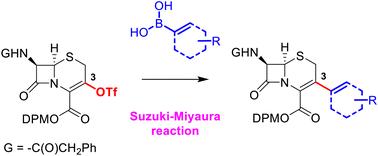
Herein, we describe a new methodology for selective cephalosporin functionalization at the C3 position. First, an optimization study of the reaction conditions was performed and allowed favourable parameters for the Suzuki–Miyaura coupling reaction to be defined. Then, the scope of the reaction was evaluated using various boronic acids, and the reaction demonstrated a good functional-group tolerance profile. Finally, the formation of some side-products was also investigated, and the main limitations of the reaction were defined.



 京公网安备 11010802042870号
京ICP备2023020795号-1
京公网安备 11010802042870号
京ICP备2023020795号-1

 分享
分享
 求助内容:
求助内容: 应助结果提醒方式:
 扫码关注我们
