Xin Zhou, Limin Liu, Xiaoliang Zhou, Jingjie Li, Weilin Guo and Yang Tang
{"title":"The performance of Cu3P/TiO2 nanotubes as a novel photoelectrocatalyst for water electrolysis in an alkaline medium†","authors":"Xin Zhou, Limin Liu, Xiaoliang Zhou, Jingjie Li, Weilin Guo and Yang Tang","doi":"10.1039/D5NJ00120J","DOIUrl":null,"url":null,"abstract":"<p >Hydrogen is an ideal clean energy source, and electrolysis of water is one of the carbon free hydrogen production technologies. However, the kinetics of the oxygen evolution reaction (OER) at the anode is sluggish, making the enhancement of reaction efficiency crucial for the advancement of water electrolysis-based hydrogen production technology. In this study, titanium sheets were oxidized into TiO<small><sub>2</sub></small> nanotubes (TiO<small><sub>2</sub></small> NTs) by anodic oxidation, and then Cu(OH)<small><sub>2</sub></small> hydrotalcite (Cu(OH)<small><sub>2</sub></small>/TiO<small><sub>2</sub></small> NTs) was loaded onto the nanotubes by a hydrothermal method. Subsequently, a self-supporting Cu<small><sub>3</sub></small>P supported TiO<small><sub>2</sub></small> nanotube (Cu<small><sub>3</sub></small>P/TiO<small><sub>2</sub></small> NT) electrode was prepared by phosphating treatment under a N<small><sub>2</sub></small> atmosphere. The Cu<small><sub>3</sub></small>P formed a P–N heterojunction with TiO<small><sub>2</sub></small>, demonstrating excellent catalytic activity under visible light and electrical excitation. When Cu<small><sub>3</sub></small>P/TiO<small><sub>2</sub></small>-NT was used as an OER working electrode in a 1.0 M KOH solution at room temperature and under xenon lamp irradiation, the overpotential was 145 mV at a current density of 10 mA cm<small><sup>−2</sup></small>, which was 446 mV lower than under dark conditions. Cu<small><sub>3</sub></small>P/TiO<small><sub>2</sub></small>-NTs can operate stably for 22 hours at a current density of 20 mA cm<small><sup>−2</sup></small> without significant performance degradation. As a HER working electrode, the overpotential at a current density of 10 mV cm<small><sup>−2</sup></small> is 73 mV, which is 518 mV lower than under dark conditions. The efficient and stable OER catalytic performance is primarily attributed to the unique nanostructure and stable electrode architecture. The self-supporting non-precious metal catalyst developed in this work effectively had enhanced the reaction kinetics of the anode in water electrolysis.</p>","PeriodicalId":95,"journal":{"name":"New Journal of Chemistry","volume":" 16","pages":" 6793-6799"},"PeriodicalIF":2.5000,"publicationDate":"2025-03-22","publicationTypes":"Journal Article","fieldsOfStudy":null,"isOpenAccess":false,"openAccessPdf":"","citationCount":"0","resultStr":null,"platform":"Semanticscholar","paperid":null,"PeriodicalName":"New Journal of Chemistry","FirstCategoryId":"92","ListUrlMain":"https://pubs.rsc.org/en/content/articlelanding/2025/nj/d5nj00120j","RegionNum":3,"RegionCategory":"化学","ArticlePicture":[],"TitleCN":null,"AbstractTextCN":null,"PMCID":null,"EPubDate":"","PubModel":"","JCR":"Q2","JCRName":"CHEMISTRY, MULTIDISCIPLINARY","Score":null,"Total":0}
引用次数: 0
Abstract
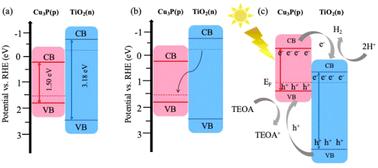
Hydrogen is an ideal clean energy source, and electrolysis of water is one of the carbon free hydrogen production technologies. However, the kinetics of the oxygen evolution reaction (OER) at the anode is sluggish, making the enhancement of reaction efficiency crucial for the advancement of water electrolysis-based hydrogen production technology. In this study, titanium sheets were oxidized into TiO2 nanotubes (TiO2 NTs) by anodic oxidation, and then Cu(OH)2 hydrotalcite (Cu(OH)2/TiO2 NTs) was loaded onto the nanotubes by a hydrothermal method. Subsequently, a self-supporting Cu3P supported TiO2 nanotube (Cu3P/TiO2 NT) electrode was prepared by phosphating treatment under a N2 atmosphere. The Cu3P formed a P–N heterojunction with TiO2, demonstrating excellent catalytic activity under visible light and electrical excitation. When Cu3P/TiO2-NT was used as an OER working electrode in a 1.0 M KOH solution at room temperature and under xenon lamp irradiation, the overpotential was 145 mV at a current density of 10 mA cm−2, which was 446 mV lower than under dark conditions. Cu3P/TiO2-NTs can operate stably for 22 hours at a current density of 20 mA cm−2 without significant performance degradation. As a HER working electrode, the overpotential at a current density of 10 mV cm−2 is 73 mV, which is 518 mV lower than under dark conditions. The efficient and stable OER catalytic performance is primarily attributed to the unique nanostructure and stable electrode architecture. The self-supporting non-precious metal catalyst developed in this work effectively had enhanced the reaction kinetics of the anode in water electrolysis.




 京公网安备 11010802042870号
京ICP备2023020795号-1
京公网安备 11010802042870号
京ICP备2023020795号-1

 分享
分享
 求助内容:
求助内容: 应助结果提醒方式:
 扫码关注我们
