Zhen Li, Guizhang Guo, Chengzhi Xue, Zhaocheng Wang and Libo Yu
{"title":"NaYF4:Yb3+/Er3+ nanorod/TiO2 mesoporous films for enhanced dye sensitized solar cells†","authors":"Zhen Li, Guizhang Guo, Chengzhi Xue, Zhaocheng Wang and Libo Yu","doi":"10.1039/D5NJ00223K","DOIUrl":null,"url":null,"abstract":"<p >We synthesized NaYF<small><sub>4</sub></small>:Yb<small><sup>3+</sup></small>/Er<small><sup>3+</sup></small> nanorods (NRs) through a hydrothermal process. Scanning electron microscopy (SEM) and transmission electron microscopy (TEM) analyses revealed that these nanorods are composed of smaller NaYF<small><sub>4</sub></small>:Yb<small><sup>3+</sup></small>/Er<small><sup>3+</sup></small> nanocrystals. Subsequent annealing treatments caused these nanocrystals to fuse into larger structures. We incorporated the NaYF<small><sub>4</sub></small>:Yb<small><sup>3+</sup></small>/Er<small><sup>3+</sup></small> NRs into a mesoporous TiO<small><sub>2</sub></small> film to create NaYF<small><sub>4</sub></small>:Yb<small><sup>3+</sup></small>/Er<small><sup>3+</sup></small> NR/TiO<small><sub>2</sub></small> photoanodes for application in dye-sensitized solar cells (DSSCs). Our investigation focused on how variations in the structure and doping concentration of NaYF<small><sub>4</sub></small>:Yb<small><sup>3+</sup></small>/Er<small><sup>3+</sup></small> NRs within the TiO<small><sub>2</sub></small> matrix affected the photovoltaic performance of the DSSCs. Notably, the photoanode that incorporated 1.0 wt% NaYF<small><sub>4</sub></small>:Yb<small><sup>3+</sup></small>/Er<small><sup>3+</sup></small> NRs, annealed at 500 °C, exhibited superior photovoltaic performance, achieving a short-circuit current density (<em>J</em><small><sub>sc</sub></small>) of 10.60 mA cm<small><sup>−2</sup></small> and a power conversion efficiency (PCE) of 6.20%. This represents a 31.35% increase in <em>J</em><small><sub>sc</sub></small> and a remarkable 95.58% improvement in the PCE compared to the reference TiO<small><sub>2</sub></small>-based DSSC, which had a <em>J</em><small><sub>sc</sub></small> of 8.07 mA cm<small><sup>−2</sup></small> and a PCE of 3.17%. The enhancements in photovoltaic performance can be attributed to the upconversion properties of NaYF<small><sub>4</sub></small>:Yb<small><sup>3+</sup></small>/Er<small><sup>3+</sup></small> NRs and their ability to facilitate charge separation, which ultimately improves the efficiency of the solar cells.</p>","PeriodicalId":95,"journal":{"name":"New Journal of Chemistry","volume":" 16","pages":" 6810-6817"},"PeriodicalIF":2.5000,"publicationDate":"2025-03-24","publicationTypes":"Journal Article","fieldsOfStudy":null,"isOpenAccess":false,"openAccessPdf":"","citationCount":"0","resultStr":null,"platform":"Semanticscholar","paperid":null,"PeriodicalName":"New Journal of Chemistry","FirstCategoryId":"92","ListUrlMain":"https://pubs.rsc.org/en/content/articlelanding/2025/nj/d5nj00223k","RegionNum":3,"RegionCategory":"化学","ArticlePicture":[],"TitleCN":null,"AbstractTextCN":null,"PMCID":null,"EPubDate":"","PubModel":"","JCR":"Q2","JCRName":"CHEMISTRY, MULTIDISCIPLINARY","Score":null,"Total":0}
引用次数: 0
Abstract
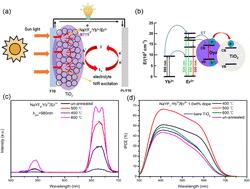
We synthesized NaYF4:Yb3+/Er3+ nanorods (NRs) through a hydrothermal process. Scanning electron microscopy (SEM) and transmission electron microscopy (TEM) analyses revealed that these nanorods are composed of smaller NaYF4:Yb3+/Er3+ nanocrystals. Subsequent annealing treatments caused these nanocrystals to fuse into larger structures. We incorporated the NaYF4:Yb3+/Er3+ NRs into a mesoporous TiO2 film to create NaYF4:Yb3+/Er3+ NR/TiO2 photoanodes for application in dye-sensitized solar cells (DSSCs). Our investigation focused on how variations in the structure and doping concentration of NaYF4:Yb3+/Er3+ NRs within the TiO2 matrix affected the photovoltaic performance of the DSSCs. Notably, the photoanode that incorporated 1.0 wt% NaYF4:Yb3+/Er3+ NRs, annealed at 500 °C, exhibited superior photovoltaic performance, achieving a short-circuit current density (Jsc) of 10.60 mA cm−2 and a power conversion efficiency (PCE) of 6.20%. This represents a 31.35% increase in Jsc and a remarkable 95.58% improvement in the PCE compared to the reference TiO2-based DSSC, which had a Jsc of 8.07 mA cm−2 and a PCE of 3.17%. The enhancements in photovoltaic performance can be attributed to the upconversion properties of NaYF4:Yb3+/Er3+ NRs and their ability to facilitate charge separation, which ultimately improves the efficiency of the solar cells.
采用水热法合成了NaYF4:Yb3+/Er3+纳米棒。扫描电镜(SEM)和透射电镜(TEM)分析表明,这些纳米棒是由较小的NaYF4:Yb3+/Er3+纳米晶体组成的。随后的退火处理使这些纳米晶体融合成更大的结构。我们将NaYF4:Yb3+/Er3+ NR加入到介孔TiO2薄膜中,制备了用于染料敏化太阳能电池(DSSCs)的NaYF4:Yb3+/Er3+ NR/TiO2光阳极。我们的研究重点是TiO2基质中NaYF4:Yb3+/Er3+ NRs的结构和掺杂浓度的变化如何影响DSSCs的光伏性能。值得注意的是,在500℃退火下,加入1.0 wt% NaYF4:Yb3+/Er3+ NRs的光阳极表现出优异的光伏性能,短路电流密度(Jsc)为10.60 mA cm−2,功率转换效率(PCE)为6.20%。与Jsc为8.07 mA cm - 2, PCE为3.17%的参考tio2基DSSC相比,Jsc增加了31.35%,PCE显著提高了95.58%。光伏性能的增强可归因于NaYF4:Yb3+/Er3+ NRs的上转换特性及其促进电荷分离的能力,从而最终提高了太阳能电池的效率。



 京公网安备 11010802042870号
京ICP备2023020795号-1
京公网安备 11010802042870号
京ICP备2023020795号-1

 分享
分享
 求助内容:
求助内容: 应助结果提醒方式:
 扫码关注我们
