Bernhard von Boehn, Francesca Genuzio, Tevfik O. Menteş, Andrea Locatelli, Ronald Imbihl
{"title":"Ammonia Oxidation with O2 and NO on a VOx/Rh(111) Catalyst: A Comparison","authors":"Bernhard von Boehn, Francesca Genuzio, Tevfik O. Menteş, Andrea Locatelli, Ronald Imbihl","doi":"10.1021/acs.jpcc.5c00524","DOIUrl":null,"url":null,"abstract":"We have studied catalytic ammonia oxidation with NO and O<sub>2</sub> on a VO<sub><i>x</i></sub>/Rh(111) catalyst at θ<sub>V</sub> < 0.5 monolayer equivalents (MLE) with photoemission electron microscopy (PEEM) at 10<sup>–4</sup> mbar and with spectroscopic photoemission and low-energy electron microscopy (SPELEEM) in the 10<sup>–6</sup> mbar range. With O<sub>2</sub> as oxidant, VO<sub><i>x</i></sub> condenses into islands of macroscopic size, <i>i</i>.<i>e</i>., of diameters ranging from tens to several hundreds of microns. With NO a hole pattern in the VO<sub><i>x</i></sub> layer develops under reaction conditions. In the NH<sub>3</sub> + O<sub>2</sub> reaction microspot-LEED (μLEED) identifies a (√3 × √3)-moiré pattern inside the VO<sub><i>x</i></sub> islands and on the surrounding metal surface. In NH<sub>3</sub> oxidation with NO reaction microspot X-ray photoelectron spectroscopy (μXPS) shows the presence of nitrogen species on the bare metal surface, as well as on the VO<sub><i>x</i></sub> layer. With NO as reactant, the interface region between the VO<sub><i>x</i></sub> covered and bare metal surface areas is strongly broadened with about 100 μm width as compared to ≈30 μm width with O<sub>2</sub> as oxidant. Our data suggest that in ammonia oxidation over VO<sub><i>x</i></sub>/Rh(111), oxidation with NO is less effective than oxidation with O<sub>2</sub>.","PeriodicalId":61,"journal":{"name":"The Journal of Physical Chemistry C","volume":"7 1","pages":""},"PeriodicalIF":3.2000,"publicationDate":"2025-04-14","publicationTypes":"Journal Article","fieldsOfStudy":null,"isOpenAccess":false,"openAccessPdf":"","citationCount":"0","resultStr":null,"platform":"Semanticscholar","paperid":null,"PeriodicalName":"The Journal of Physical Chemistry C","FirstCategoryId":"1","ListUrlMain":"https://doi.org/10.1021/acs.jpcc.5c00524","RegionNum":3,"RegionCategory":"化学","ArticlePicture":[],"TitleCN":null,"AbstractTextCN":null,"PMCID":null,"EPubDate":"","PubModel":"","JCR":"Q2","JCRName":"CHEMISTRY, PHYSICAL","Score":null,"Total":0}
引用次数: 0
Abstract
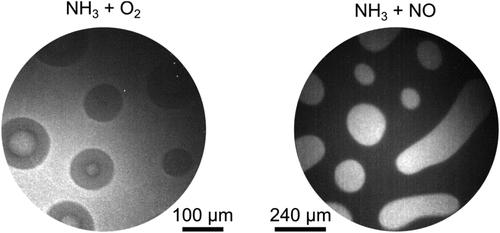
We have studied catalytic ammonia oxidation with NO and O2 on a VOx/Rh(111) catalyst at θV < 0.5 monolayer equivalents (MLE) with photoemission electron microscopy (PEEM) at 10–4 mbar and with spectroscopic photoemission and low-energy electron microscopy (SPELEEM) in the 10–6 mbar range. With O2 as oxidant, VOx condenses into islands of macroscopic size, i.e., of diameters ranging from tens to several hundreds of microns. With NO a hole pattern in the VOx layer develops under reaction conditions. In the NH3 + O2 reaction microspot-LEED (μLEED) identifies a (√3 × √3)-moiré pattern inside the VOx islands and on the surrounding metal surface. In NH3 oxidation with NO reaction microspot X-ray photoelectron spectroscopy (μXPS) shows the presence of nitrogen species on the bare metal surface, as well as on the VOx layer. With NO as reactant, the interface region between the VOx covered and bare metal surface areas is strongly broadened with about 100 μm width as compared to ≈30 μm width with O2 as oxidant. Our data suggest that in ammonia oxidation over VOx/Rh(111), oxidation with NO is less effective than oxidation with O2.
期刊介绍:
The Journal of Physical Chemistry A/B/C is devoted to reporting new and original experimental and theoretical basic research of interest to physical chemists, biophysical chemists, and chemical physicists.



 京公网安备 11010802042870号
京ICP备2023020795号-1
京公网安备 11010802042870号
京ICP备2023020795号-1

 分享
分享
 求助内容:
求助内容: 应助结果提醒方式:
 扫码关注我们
