Glucagon-like peptide-1 receptor agonists are known to delay gastric emptying; however, the association between glucagon-like peptide-1 receptor agonist use and peri-operative pulmonary aspiration risk is not known. This systematic review and meta-analysis aimed to summarise the evidence on whether glucagon-like peptide-1 receptor agonist exposure is associated with pulmonary aspiration or increased residual gastric content in fasted patients undergoing procedures requiring anaesthesia or sedation.
We searched six databases for studies assessing peri-operative pulmonary aspiration or residual gastric contents in fasted patients or volunteers who were using any form of glucagon-like peptide-1 receptor agonist. Pooled odds ratios were estimated for each outcome using random effects meta-analysis. Certainty of evidence for each outcome was assessed using the GRADE framework.
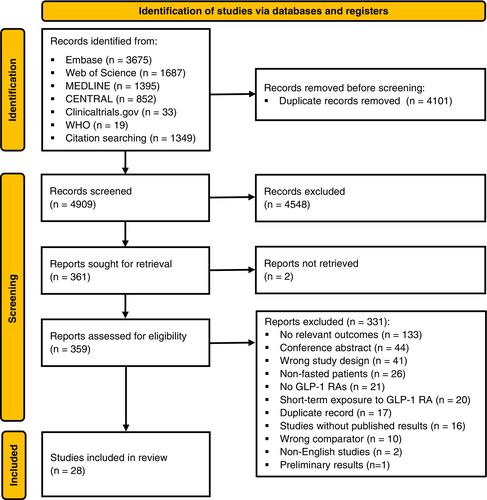
Of 9010 screened studies, 28 observational studies were included. In a meta-analysis of nine studies involving 185,414 patients and 471 cases of pulmonary aspiration, glucagon-like peptide-1 receptor agonist exposure was not associated with pulmonary aspiration (OR 1.04, 95%CI 0.87–1.25, low certainty of evidence). In a meta-analysis of 18 studies involving 165,522 patients and 3831 cases of residual gastric contents, glucagon-like peptide-1 receptor agonist exposure was associated with an increased risk of residual gastric contents despite appropriate fasting (odds ratio 5.96, 95%CI 3.96–8.98, low certainty of evidence). In a meta-analysis of five studies involving 1706 patients and 208 cases of residual gastric contents, withholding at least one dose of glucagon-like peptide-1 receptor agonist before a procedure was associated with lower odds of residual gastric contents (odds ratio 0.51, 95%CI 0.33–0.81, very low certainty of evidence).
Patients using glucagon-like peptide-1 receptor agonists are at increased risk of presenting for anaesthesia with residual gastric contents, though the available evidence does not indicate that this translates to an increased risk of pulmonary aspiration.





 京公网安备 11010802042870号
京ICP备2023020795号-1
京公网安备 11010802042870号
京ICP备2023020795号-1

 分享
分享
 求助内容:
求助内容: 应助结果提醒方式:
 扫码关注我们
