Pengyan Wu, Zhengjie Zhang, Yan Hu, Yan Li, Tong Zhu, Yanxi Liu, Haitao Cui and Haijun Cui
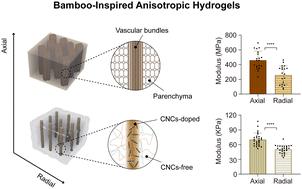
{"title":"Bamboo-inspired anisotropic hydrogels with enhanced mechanical properties via cellulose nanocrystal-reinforced heterostructures†","authors":"Pengyan Wu, Zhengjie Zhang, Yan Hu, Yan Li, Tong Zhu, Yanxi Liu, Haitao Cui and Haijun Cui","doi":"10.1039/D4NR05310A","DOIUrl":null,"url":null,"abstract":"<p >Mimicking anisotropic materials is challenging due to their complex structural and mechanical properties. In this study, we developed biomimetic hydrogels that replicate the anisotropic characteristics of bamboo by incorporating cellulose nanocrystals (CNCs) into polyethylene glycol diacrylate (PEGDA) hydrogels. The inclusion of CNCs significantly enhanced the mechanical strength, with a 0.5% CNCs concentration increasing the modulus by 1.9 times, from 110 kPa to 208 kPa. By utilizing CNCs-doped regions to mimic the vascular bundles of bamboo and the undoped regions to represent the parenchyma tissue, we created biomimetic anisotropic hydrogels. These hydrogels displayed pronounced anisotropy, with the axial modulus exceeding the radial modulus, successfully demonstrating the creation of anisotropic materials. This method was also successfully applied to polyacrylic acid (PAA) hydrogels, further highlighting its versatility. These anisotropic biomimetic hydrogels exhibit distinct mechanical sensing properties in different directions, with the axial direction being 1.36 times more sensitive than the radial direction. This generalizable approach offers valuable insights for developing other anisotropic materials.</p>","PeriodicalId":92,"journal":{"name":"Nanoscale","volume":" 18","pages":" 11658-11667"},"PeriodicalIF":5.1000,"publicationDate":"2025-04-15","publicationTypes":"Journal Article","fieldsOfStudy":null,"isOpenAccess":false,"openAccessPdf":"","citationCount":"0","resultStr":null,"platform":"Semanticscholar","paperid":null,"PeriodicalName":"Nanoscale","FirstCategoryId":"88","ListUrlMain":"https://pubs.rsc.org/en/content/articlelanding/2025/nr/d4nr05310a","RegionNum":3,"RegionCategory":"材料科学","ArticlePicture":[],"TitleCN":null,"AbstractTextCN":null,"PMCID":null,"EPubDate":"","PubModel":"","JCR":"Q1","JCRName":"CHEMISTRY, MULTIDISCIPLINARY","Score":null,"Total":0}
引用次数: 0
Abstract
Mimicking anisotropic materials is challenging due to their complex structural and mechanical properties. In this study, we developed biomimetic hydrogels that replicate the anisotropic characteristics of bamboo by incorporating cellulose nanocrystals (CNCs) into polyethylene glycol diacrylate (PEGDA) hydrogels. The inclusion of CNCs significantly enhanced the mechanical strength, with a 0.5% CNCs concentration increasing the modulus by 1.9 times, from 110 kPa to 208 kPa. By utilizing CNCs-doped regions to mimic the vascular bundles of bamboo and the undoped regions to represent the parenchyma tissue, we created biomimetic anisotropic hydrogels. These hydrogels displayed pronounced anisotropy, with the axial modulus exceeding the radial modulus, successfully demonstrating the creation of anisotropic materials. This method was also successfully applied to polyacrylic acid (PAA) hydrogels, further highlighting its versatility. These anisotropic biomimetic hydrogels exhibit distinct mechanical sensing properties in different directions, with the axial direction being 1.36 times more sensitive than the radial direction. This generalizable approach offers valuable insights for developing other anisotropic materials.
期刊介绍:
Nanoscale is a high-impact international journal, publishing high-quality research across nanoscience and nanotechnology. Nanoscale publishes a full mix of research articles on experimental and theoretical work, including reviews, communications, and full papers.Highly interdisciplinary, this journal appeals to scientists, researchers and professionals interested in nanoscience and nanotechnology, quantum materials and quantum technology, including the areas of physics, chemistry, biology, medicine, materials, energy/environment, information technology, detection science, healthcare and drug discovery, and electronics.



 京公网安备 11010802042870号
京ICP备2023020795号-1
京公网安备 11010802042870号
京ICP备2023020795号-1

 分享
分享
 求助内容:
求助内容: 应助结果提醒方式:
 扫码关注我们
