Engineering nitrogen-doped porous carbon positive electrodes for high-performance sodium-ion capacitors: the critical role of porosity, structure and surface functionalities†
Ademola Adeniji, Adrian Beda, Philippe Fioux and Camelia Matei Ghimbeu
{"title":"Engineering nitrogen-doped porous carbon positive electrodes for high-performance sodium-ion capacitors: the critical role of porosity, structure and surface functionalities†","authors":"Ademola Adeniji, Adrian Beda, Philippe Fioux and Camelia Matei Ghimbeu","doi":"10.1039/D5TA01075F","DOIUrl":null,"url":null,"abstract":"<p >Sodium-ion capacitors are increasingly gaining momentum thanks to their high energy and power densities. However, there is still a lack of understanding of porous carbon positive electrode properties that affect their electrochemical performance. To address this challenge, carbon materials with controlled porosity, structure and surface functionalities are strongly required. Herein, we report the synthesis of nitrogen-doped porous carbons (NDPCs) by a combined soft-salt templating approach, that allows to achieve various nitrogen doping levels (up to 8 at%) <em>via</em> precursor amount modification. This results in materials with ultrahigh specific surface area (up to 2412 m<small><sup>2</sup></small> g<small><sup>−1</sup></small>) and finely tuned pore size (up to 0.92 nm) matching the desolvated PF<small><sub>6</sub></small><small><sup>−</sup></small> anion sorption requirement of 0.8 nm, along with controlled graphitization induced by the salt type. The materials exhibit specific capacities ranging from 83 to 159 mA h g<small><sup>−1</sup></small><em>vs.</em> Na/Na<small><sup>+</sup></small>, higher than that of commercial carbons. From positive linear correlations, it was identified that the improved capacity is driven by the large specific surface area, substantial microporous volume with appropriate pore size, and structural defects, which enhance ion adsorption and promote enhanced specific capacity. However, the capacity retention is improved by the mesoporous volume and graphitic domains. Moreover, the surface pseudocapacitive interactions involving Na<small><sup>+</sup></small> and PF<small><sub>6</sub></small><small><sup>−</sup></small> ions could be associated with specific oxygen-containing groups (phenol/ethers and anhydride) and nitrogen species (pyridinic-N/pyrrolic-N). The dual carbon full-cell configuration consisting of a hard carbon and N-doped carbon achieves a high energy density of 209 W h kg<small><sup>−1</sup></small> and a maximum power density of 5040 W kg<small><sup>−1</sup></small> with ∼100% coulombic efficiency.</p>","PeriodicalId":82,"journal":{"name":"Journal of Materials Chemistry A","volume":" 20","pages":" 14896-14914"},"PeriodicalIF":9.5000,"publicationDate":"2025-04-15","publicationTypes":"Journal Article","fieldsOfStudy":null,"isOpenAccess":false,"openAccessPdf":"","citationCount":"0","resultStr":null,"platform":"Semanticscholar","paperid":null,"PeriodicalName":"Journal of Materials Chemistry A","FirstCategoryId":"88","ListUrlMain":"https://pubs.rsc.org/en/content/articlelanding/2025/ta/d5ta01075f","RegionNum":2,"RegionCategory":"材料科学","ArticlePicture":[],"TitleCN":null,"AbstractTextCN":null,"PMCID":null,"EPubDate":"","PubModel":"","JCR":"Q1","JCRName":"CHEMISTRY, PHYSICAL","Score":null,"Total":0}
引用次数: 0
Abstract
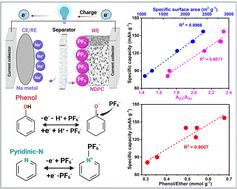
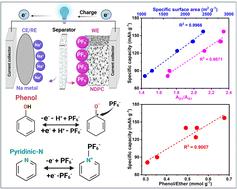
Sodium-ion capacitors are increasingly gaining momentum thanks to their high energy and power densities. However, there is still a lack of understanding of porous carbon positive electrode properties that affect their electrochemical performance. To address this challenge, carbon materials with controlled porosity, structure and surface functionalities are strongly required. Herein, we report the synthesis of nitrogen-doped porous carbons (NDPCs) by a combined soft-salt templating approach, that allows to achieve various nitrogen doping levels (up to 8 at%) via precursor amount modification. This results in materials with ultrahigh specific surface area (up to 2412 m2 g−1) and finely tuned pore size (up to 0.92 nm) matching the desolvated PF6− anion sorption requirement of 0.8 nm, along with controlled graphitization induced by the salt type. The materials exhibit specific capacities ranging from 83 to 159 mA h g−1vs. Na/Na+, higher than that of commercial carbons. From positive linear correlations, it was identified that the improved capacity is driven by the large specific surface area, substantial microporous volume with appropriate pore size, and structural defects, which enhance ion adsorption and promote enhanced specific capacity. However, the capacity retention is improved by the mesoporous volume and graphitic domains. Moreover, the surface pseudocapacitive interactions involving Na+ and PF6− ions could be associated with specific oxygen-containing groups (phenol/ethers and anhydride) and nitrogen species (pyridinic-N/pyrrolic-N). The dual carbon full-cell configuration consisting of a hard carbon and N-doped carbon achieves a high energy density of 209 W h kg−1 and a maximum power density of 5040 W kg−1 with ∼100% coulombic efficiency.
钠离子电容器由于其高能量和功率密度而日益获得动力。然而,对多孔碳正极性能影响其电化学性能的研究仍缺乏深入的认识。为了应对这一挑战,迫切需要具有可控孔隙度、结构和表面功能的碳材料。在此,我们报道了通过结合软盐模板法合成氮掺杂多孔碳(NDPCs)的方法,该方法可以通过前驱体量修饰实现各种氮掺杂水平(高达8% at%)。这使得材料具有超高的比表面积(高达2412 m2 g−1)和精细调节的孔径(高达0.92 nm),符合脱溶的PF6−阴离子吸附0.8 nm的要求,以及由盐类型引起的可控石墨化。与Na/Na+相比,材料的比容量为83 ~ 159 mA h g−1,高于商业碳。从正线性关系可知,大的比表面积、适当孔径的大量微孔体积和结构缺陷是提高比容量的主要原因,这些因素增强了离子吸附,促进了比容量的提高。然而,介孔体积和石墨畴改善了容量保持。此外,涉及Na+和PF6 -离子的表面赝电容相互作用可能与特定的含氧基团(苯酚/醚和酸酐)和氮种(吡啶- n /吡咯烷- n)有关。由硬碳和n掺杂碳组成的双碳全电池结构实现了209 W h kg−1的高能量密度和5040 W kg−1的最大功率密度,库仑效率为100%。
期刊介绍:
The Journal of Materials Chemistry A, B & C covers a wide range of high-quality studies in the field of materials chemistry, with each section focusing on specific applications of the materials studied. Journal of Materials Chemistry A emphasizes applications in energy and sustainability, including topics such as artificial photosynthesis, batteries, and fuel cells. Journal of Materials Chemistry B focuses on applications in biology and medicine, while Journal of Materials Chemistry C covers applications in optical, magnetic, and electronic devices. Example topic areas within the scope of Journal of Materials Chemistry A include catalysis, green/sustainable materials, sensors, and water treatment, among others.




 京公网安备 11010802042870号
京ICP备2023020795号-1
京公网安备 11010802042870号
京ICP备2023020795号-1

 分享
分享
 求助内容:
求助内容: 应助结果提醒方式:
 扫码关注我们
