Mengni Liu, Yuxiao Liu, Xia Zhang, Linfeng Li, Xinying Xue, Muhammad Humayun, Haowei Yang, Libo Sun, Mohamed Bououdina, Jianrong Zeng, Deli Wang, Rony Snyders, Dingsheng Wang, Xin Wang, Chundong Wang
{"title":"Altering the Symmetry of Fe–N–C by Axial Cl-Mediation for High-Performance Zinc–Air Batteries","authors":"Mengni Liu, Yuxiao Liu, Xia Zhang, Linfeng Li, Xinying Xue, Muhammad Humayun, Haowei Yang, Libo Sun, Mohamed Bououdina, Jianrong Zeng, Deli Wang, Rony Snyders, Dingsheng Wang, Xin Wang, Chundong Wang","doi":"10.1002/anie.202504923","DOIUrl":null,"url":null,"abstract":"<p>Fe–N–C catalyst is acknowledged as a promising alternative for the state-of-the-art Pt/C in oxygen reduction reaction (ORR) toward cutting-edge electrochemical energy conversion/storage applications. Herein, a “Cl-mediation” strategy is proposed on Fe–N–C for modulating the catalyst's electronic structure toward achieving remarkable ORR activity. By coordinating axial Cl atoms to iron phthalocyanine (FePc) molecules on carbon nanotubes (CNTs) matrix, a Cl-modulated Fe–N–C (FePc-Cl-CNTs) catalyst is synthesized. The as-prepared FePc-Cl-CNTs exhibit an improved ORR activity with a half-wave potential of 0.91 V versus RHE in alkaline solution, significantly outperforming the parent FePc-CNTs (0.88 V versus RHE). The advanced nature of the as-prepared FePc-Cl-CNTs is evidenced by a configured high-performance rechargeable Zn–air battery, which operates stably for over 150 h. The experiments and density functional theory calculations unveil that axial Cl atoms induce the transformation of FePc from its original D<sub>4h</sub> to C<sub>4v</sub> symmetry, effectively altering the electrons distribution around the Fe-center, by which it optimizes *OH desorption and subsequently boosts the reaction kinetics. This work paves ways for resolving the dilemma of Fe–N–C catalysts’ exploration via engineering Fe–N–C configuration.</p>","PeriodicalId":125,"journal":{"name":"Angewandte Chemie International Edition","volume":"64 26","pages":""},"PeriodicalIF":16.9000,"publicationDate":"2025-04-15","publicationTypes":"Journal Article","fieldsOfStudy":null,"isOpenAccess":false,"openAccessPdf":"","citationCount":"0","resultStr":null,"platform":"Semanticscholar","paperid":null,"PeriodicalName":"Angewandte Chemie International Edition","FirstCategoryId":"92","ListUrlMain":"https://onlinelibrary.wiley.com/doi/10.1002/anie.202504923","RegionNum":1,"RegionCategory":"化学","ArticlePicture":[],"TitleCN":null,"AbstractTextCN":null,"PMCID":null,"EPubDate":"","PubModel":"","JCR":"Q1","JCRName":"CHEMISTRY, MULTIDISCIPLINARY","Score":null,"Total":0}
引用次数: 0
Abstract
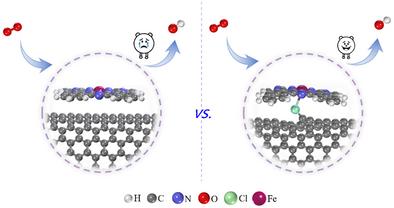
Fe–N–C catalyst is acknowledged as a promising alternative for the state-of-the-art Pt/C in oxygen reduction reaction (ORR) toward cutting-edge electrochemical energy conversion/storage applications. Herein, a “Cl-mediation” strategy is proposed on Fe–N–C for modulating the catalyst's electronic structure toward achieving remarkable ORR activity. By coordinating axial Cl atoms to iron phthalocyanine (FePc) molecules on carbon nanotubes (CNTs) matrix, a Cl-modulated Fe–N–C (FePc-Cl-CNTs) catalyst is synthesized. The as-prepared FePc-Cl-CNTs exhibit an improved ORR activity with a half-wave potential of 0.91 V versus RHE in alkaline solution, significantly outperforming the parent FePc-CNTs (0.88 V versus RHE). The advanced nature of the as-prepared FePc-Cl-CNTs is evidenced by a configured high-performance rechargeable Zn–air battery, which operates stably for over 150 h. The experiments and density functional theory calculations unveil that axial Cl atoms induce the transformation of FePc from its original D4h to C4v symmetry, effectively altering the electrons distribution around the Fe-center, by which it optimizes *OH desorption and subsequently boosts the reaction kinetics. This work paves ways for resolving the dilemma of Fe–N–C catalysts’ exploration via engineering Fe–N–C configuration.
期刊介绍:
Angewandte Chemie, a journal of the German Chemical Society (GDCh), maintains a leading position among scholarly journals in general chemistry with an impressive Impact Factor of 16.6 (2022 Journal Citation Reports, Clarivate, 2023). Published weekly in a reader-friendly format, it features new articles almost every day. Established in 1887, Angewandte Chemie is a prominent chemistry journal, offering a dynamic blend of Review-type articles, Highlights, Communications, and Research Articles on a weekly basis, making it unique in the field.



 京公网安备 11010802042870号
京ICP备2023020795号-1
京公网安备 11010802042870号
京ICP备2023020795号-1

 分享
分享
 求助内容:
求助内容: 应助结果提醒方式:
 扫码关注我们
