Erna K. Wieduwilt, Marlisa M. Hagemann, Ulf Ryde and Erik D. Hedegård
{"title":"The mechanism behind the oxidase activity of cellulose-active AA10 lytic polysaccharide monooxygenases†","authors":"Erna K. Wieduwilt, Marlisa M. Hagemann, Ulf Ryde and Erik D. Hedegård","doi":"10.1039/D5QI00796H","DOIUrl":null,"url":null,"abstract":"<p >Lytic polysaccharide monooxygenases (LPMOs) are copper enzymes that boost the degradation of different polysaccharides and play important roles in the sustainable production of biofuels, in human and plant pathogens, and potentially also in plastic degradation. Their activity depends on a co-substrate, where recent results show that hydrogen peroxide is the preferred co-substrate. Under typical experimental conditions, no hydrogen peroxide is added and it is instead produced <em>in situ</em> by LPMOs themselves, which could be the rate-limiting step. Previous theoretical investigations of the oxidase reaction have been highly inhomogeneous and focused on different aspects of LPMO reactivity. In this paper, we systematically investigate how LPMOs generate hydrogen peroxide using accurate quantum mechanics/molecular mechanics (QM/MM) hybrid methods with extended QM regions. We find that the reaction of the reduced LPMO active site with O<small><sub>2</sub></small> yields a superoxide coordinated to Cu(<small>II</small>), from which [Cu(<small>II</small>)−OOH<small><sup>−</sup></small>]<small><sup>+</sup></small> can be formed <em>via</em> a proton-coupled electron transfer, using a second-coordination-sphere histidine as the proton donor. Either OOH<small><sup>−</sup></small> dissociates from this species (while abstracting a proton from a water molecule) or [Cu(<small>II</small>)−OOH<small><sup>−</sup></small>]<small><sup>+</sup></small> reacts in a second protonation from the second-sphere histidine, yielding [Cu(<small>II</small>) − H<small><sub>2</sub></small>O<small><sub>2</sub></small>]<small><sup>2+</sup></small>, followed by dissociation of H<small><sub>2</sub></small>O<small><sub>2</sub></small>. Energetically, all three oxygen species can dissociate into solution, but the dissociation of H<small><sub>2</sub></small>O<small><sub>2</sub></small> from the Cu(<small>II</small>) active site is the most favorable while the dissociation of O<small><sub>2</sub></small>˙<small><sup>−</sup></small> is least favorable.</p>","PeriodicalId":79,"journal":{"name":"Inorganic Chemistry Frontiers","volume":" 18","pages":" 5344-5359"},"PeriodicalIF":6.4000,"publicationDate":"2025-04-15","publicationTypes":"Journal Article","fieldsOfStudy":null,"isOpenAccess":false,"openAccessPdf":"","citationCount":"0","resultStr":null,"platform":"Semanticscholar","paperid":null,"PeriodicalName":"Inorganic Chemistry Frontiers","FirstCategoryId":"92","ListUrlMain":"https://pubs.rsc.org/en/content/articlelanding/2025/qi/d5qi00796h","RegionNum":1,"RegionCategory":"化学","ArticlePicture":[],"TitleCN":null,"AbstractTextCN":null,"PMCID":null,"EPubDate":"","PubModel":"","JCR":"Q1","JCRName":"CHEMISTRY, INORGANIC & NUCLEAR","Score":null,"Total":0}
引用次数: 0
Abstract
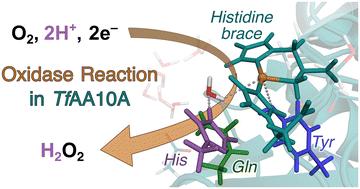
Lytic polysaccharide monooxygenases (LPMOs) are copper enzymes that boost the degradation of different polysaccharides and play important roles in the sustainable production of biofuels, in human and plant pathogens, and potentially also in plastic degradation. Their activity depends on a co-substrate, where recent results show that hydrogen peroxide is the preferred co-substrate. Under typical experimental conditions, no hydrogen peroxide is added and it is instead produced in situ by LPMOs themselves, which could be the rate-limiting step. Previous theoretical investigations of the oxidase reaction have been highly inhomogeneous and focused on different aspects of LPMO reactivity. In this paper, we systematically investigate how LPMOs generate hydrogen peroxide using accurate quantum mechanics/molecular mechanics (QM/MM) hybrid methods with extended QM regions. We find that the reaction of the reduced LPMO active site with O2 yields a superoxide coordinated to Cu(II), from which [Cu(II)−OOH−]+ can be formed via a proton-coupled electron transfer, using a second-coordination-sphere histidine as the proton donor. Either OOH− dissociates from this species (while abstracting a proton from a water molecule) or [Cu(II)−OOH−]+ reacts in a second protonation from the second-sphere histidine, yielding [Cu(II) − H2O2]2+, followed by dissociation of H2O2. Energetically, all three oxygen species can dissociate into solution, but the dissociation of H2O2 from the Cu(II) active site is the most favorable while the dissociation of O2˙− is least favorable.



 京公网安备 11010802042870号
京ICP备2023020795号-1
京公网安备 11010802042870号
京ICP备2023020795号-1

 分享
分享
 求助内容:
求助内容: 应助结果提醒方式:
 扫码关注我们
