Rapid Screening of Illicit Drugs from Biofluid via Dried Blood/Urine Spot and Ultrasonic Desorption-Assisted Low-Temperature Arc Plasma Ionization Mass Spectrometry
{"title":"Rapid Screening of Illicit Drugs from Biofluid via Dried Blood/Urine Spot and Ultrasonic Desorption-Assisted Low-Temperature Arc Plasma Ionization Mass Spectrometry","authors":"Zhongbao Han, Zhongyu Zhao, Meiyun Pan, Yimeng Qi, Liyan Liu, Dan Wang, Zhan Yu","doi":"10.1021/acs.analchem.5c00232","DOIUrl":null,"url":null,"abstract":"A novel method for rapid and sensitive illicit drug screening in biofluids has been developed by employing a paper-based sample collection coupled with ultrasonic desorption-assisted low-temperature plasma ionization mass spectrometry (PBS-LTPI-MS). For optimization, key experimental parameters, such as geometry coordinates, angle, and plasma intensity, were fine-tuned using ketamine as the representative analyte. The redissolution process, which encompasses the use of organic solvents and sample collection paper, underwent an evaluation to establish conditions conducive to efficient ionization. The proposed method demonstrated excellent analytical performance, with linear ranges exceeding <i>R</i><sup>2</sup> > 0.99, limits of detection ranging from 10 to 20 ng mL<sup>–1</sup>, and impressive recovery rates exceeding 91.16% in complex biofluid matrixes. Spiked recovery experiments revealed strong matrix tolerance and reliable performance, even in the presence of illicit drug mixtures. The robustness of the sampling device under varying storage temperatures and durations further confirmed the method’s suitability for point-of-care testing and large-scale sample collection. With the ability to analyze samples within a mere 3 s, high-throughput potential, and environmental robustness, this method stands out as an invaluable instrument for rapid illicit drug screening and forensic analysis.","PeriodicalId":27,"journal":{"name":"Analytical Chemistry","volume":"40 1","pages":""},"PeriodicalIF":6.7000,"publicationDate":"2025-04-15","publicationTypes":"Journal Article","fieldsOfStudy":null,"isOpenAccess":false,"openAccessPdf":"","citationCount":"0","resultStr":null,"platform":"Semanticscholar","paperid":null,"PeriodicalName":"Analytical Chemistry","FirstCategoryId":"92","ListUrlMain":"https://doi.org/10.1021/acs.analchem.5c00232","RegionNum":1,"RegionCategory":"化学","ArticlePicture":[],"TitleCN":null,"AbstractTextCN":null,"PMCID":null,"EPubDate":"","PubModel":"","JCR":"Q1","JCRName":"CHEMISTRY, ANALYTICAL","Score":null,"Total":0}
引用次数: 0
Abstract
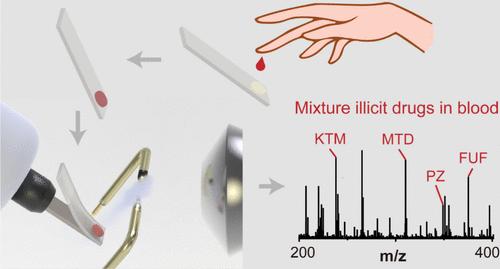
A novel method for rapid and sensitive illicit drug screening in biofluids has been developed by employing a paper-based sample collection coupled with ultrasonic desorption-assisted low-temperature plasma ionization mass spectrometry (PBS-LTPI-MS). For optimization, key experimental parameters, such as geometry coordinates, angle, and plasma intensity, were fine-tuned using ketamine as the representative analyte. The redissolution process, which encompasses the use of organic solvents and sample collection paper, underwent an evaluation to establish conditions conducive to efficient ionization. The proposed method demonstrated excellent analytical performance, with linear ranges exceeding R2 > 0.99, limits of detection ranging from 10 to 20 ng mL–1, and impressive recovery rates exceeding 91.16% in complex biofluid matrixes. Spiked recovery experiments revealed strong matrix tolerance and reliable performance, even in the presence of illicit drug mixtures. The robustness of the sampling device under varying storage temperatures and durations further confirmed the method’s suitability for point-of-care testing and large-scale sample collection. With the ability to analyze samples within a mere 3 s, high-throughput potential, and environmental robustness, this method stands out as an invaluable instrument for rapid illicit drug screening and forensic analysis.
期刊介绍:
Analytical Chemistry, a peer-reviewed research journal, focuses on disseminating new and original knowledge across all branches of analytical chemistry. Fundamental articles may explore general principles of chemical measurement science and need not directly address existing or potential analytical methodology. They can be entirely theoretical or report experimental results. Contributions may cover various phases of analytical operations, including sampling, bioanalysis, electrochemistry, mass spectrometry, microscale and nanoscale systems, environmental analysis, separations, spectroscopy, chemical reactions and selectivity, instrumentation, imaging, surface analysis, and data processing. Papers discussing known analytical methods should present a significant, original application of the method, a notable improvement, or results on an important analyte.



 京公网安备 11010802042870号
京ICP备2023020795号-1
京公网安备 11010802042870号
京ICP备2023020795号-1

 分享
分享
 求助内容:
求助内容: 应助结果提醒方式:
 扫码关注我们
