Abhishek Narayanan, Pavan T., Narad Barman, Nagaraj S. Naik, Ranjit Thapa, Chandra Sekhar Rout and Mahesh Padaki
{"title":"Architecture of imidazolium-based poly(ionic liquid)s–cobalt hexagonal thin nanosheets for high-energy density, using membrane electrolytes†","authors":"Abhishek Narayanan, Pavan T., Narad Barman, Nagaraj S. Naik, Ranjit Thapa, Chandra Sekhar Rout and Mahesh Padaki","doi":"10.1039/D4TA06914E","DOIUrl":null,"url":null,"abstract":"<p >Transition-metal hydroxides have attracted significant interest as electrode materials for supercapacitors due to their abundant redox activity and excellent electrical conductivity. Herein, we present a novel design and engineering of a hexagonal thin nanosheet of cobalt hydroxide (Co(OH)<small><sub>2</sub></small>) with enveloped imidazolium-based poly(ionic liquid)s (PIL-Br, poly(1-butyl-3-vinylimidazolium bromide)). The presence of PILs in Co(OH)<small><sub>2</sub></small> influenced morphogenesis control and a high capacitance of 1758 F g<small><sup>−1</sup></small> at a current density of 2 A g<small><sup>−1</sup></small> in a three-electrode system. A solid-state free-standing device was developed with a unique electrolyte configuration comprising EMIM-TFSI/PVDF-HFP, which further enhanced device performance. Achieving a high energy density of 212 W h kg<small><sup>−1</sup></small> at a power density of 1499 W kg<small><sup>−1</sup></small> underscored its capability to deliver stored energy effectively. Most notably, the device demonstrated exceptional durability, maintaining a capacity retention of 97% even after undergoing 10 000 cycles at 5 A g<small><sup>−1</sup></small>. Density functional theory also indicated the presence of PILs active sites in the composites, thereby promising a new <em>in situ</em> strategy for energy-storage applications.</p>","PeriodicalId":82,"journal":{"name":"Journal of Materials Chemistry A","volume":" 21","pages":" 15989-15998"},"PeriodicalIF":9.5000,"publicationDate":"2025-04-15","publicationTypes":"Journal Article","fieldsOfStudy":null,"isOpenAccess":false,"openAccessPdf":"","citationCount":"0","resultStr":null,"platform":"Semanticscholar","paperid":null,"PeriodicalName":"Journal of Materials Chemistry A","FirstCategoryId":"88","ListUrlMain":"https://pubs.rsc.org/en/content/articlelanding/2025/ta/d4ta06914e","RegionNum":2,"RegionCategory":"材料科学","ArticlePicture":[],"TitleCN":null,"AbstractTextCN":null,"PMCID":null,"EPubDate":"","PubModel":"","JCR":"Q1","JCRName":"CHEMISTRY, PHYSICAL","Score":null,"Total":0}
引用次数: 0
Abstract
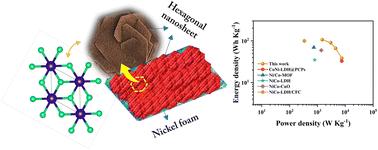
Transition-metal hydroxides have attracted significant interest as electrode materials for supercapacitors due to their abundant redox activity and excellent electrical conductivity. Herein, we present a novel design and engineering of a hexagonal thin nanosheet of cobalt hydroxide (Co(OH)2) with enveloped imidazolium-based poly(ionic liquid)s (PIL-Br, poly(1-butyl-3-vinylimidazolium bromide)). The presence of PILs in Co(OH)2 influenced morphogenesis control and a high capacitance of 1758 F g−1 at a current density of 2 A g−1 in a three-electrode system. A solid-state free-standing device was developed with a unique electrolyte configuration comprising EMIM-TFSI/PVDF-HFP, which further enhanced device performance. Achieving a high energy density of 212 W h kg−1 at a power density of 1499 W kg−1 underscored its capability to deliver stored energy effectively. Most notably, the device demonstrated exceptional durability, maintaining a capacity retention of 97% even after undergoing 10 000 cycles at 5 A g−1. Density functional theory also indicated the presence of PILs active sites in the composites, thereby promising a new in situ strategy for energy-storage applications.
过渡金属氢氧化物因其丰富的氧化还原活性和优异的导电性而成为超级电容器的电极材料。在这里,我们提出了一种新颖的设计和构建的六方薄纳米片工程的氢氧化钴(Co(OH)2)包裹咪唑基聚离子液体(PIL-Br,聚(1-丁基-3-乙烯基咪唑溴)。在2 a g-1电流密度下,Co(OH)2中的PILs的存在影响了三电极体系的形态发生控制和1758 F -1的高电容。在深入研究中,一种固态独立器件已经开发出来,其独特的电解质结构包括EMIM-TFSI/PVDF-HFP,进一步提高了器件的性能。在1499 W kg-1的功率密度下实现212 Wh kg-1的高能量密度,强调了其有效传递存储能量的能力。最值得注意的是,该设备具有出色的耐用性,即使在5a g-1下进行10,000次循环后,其容量保持率仍为97%。密度泛函理论还表明,复合材料中存在pil活性位点,为储能应用提供了新的原位策略。
期刊介绍:
The Journal of Materials Chemistry A, B & C covers a wide range of high-quality studies in the field of materials chemistry, with each section focusing on specific applications of the materials studied. Journal of Materials Chemistry A emphasizes applications in energy and sustainability, including topics such as artificial photosynthesis, batteries, and fuel cells. Journal of Materials Chemistry B focuses on applications in biology and medicine, while Journal of Materials Chemistry C covers applications in optical, magnetic, and electronic devices. Example topic areas within the scope of Journal of Materials Chemistry A include catalysis, green/sustainable materials, sensors, and water treatment, among others.



 京公网安备 11010802042870号
京ICP备2023020795号-1
京公网安备 11010802042870号
京ICP备2023020795号-1

 分享
分享
 求助内容:
求助内容: 应助结果提醒方式:
 扫码关注我们
