Meiting Guo, Zhishan Li, Lang Tang, Jingwei Li, Zehua Wang, Bo Wang, Zongping Shao, San Ping Jiang and Zhongwei Yue
{"title":"Chromium deposition and poisoning of the proton-conducting BaZr0.1Ce0.7Y0.1Yb0.1O3−δ electrolyte of protonic ceramic cells†","authors":"Meiting Guo, Zhishan Li, Lang Tang, Jingwei Li, Zehua Wang, Bo Wang, Zongping Shao, San Ping Jiang and Zhongwei Yue","doi":"10.1039/D5TA01090J","DOIUrl":null,"url":null,"abstract":"<p >Due to their low activation energy and high mobility of proton transfer, protonic ceramic cells (PCCs), including protonic ceramic fuel cells (PCFCs) and protonic ceramic electrolysis cells (PCECs), working at relatively low temperatures (400–700 °C) have gained increasing attention as promising and highly efficient energy conversion and storage technologies to replace the oxide ion-conducting, high-temperature solid oxide cells (SOCs). However, similar to SOCs, Fe–Cr based alloys are also commonly used as metallic interconnects in PCCs. Thus, the practical applicability of Ba-containing proton conducting electrolytes in PCCs is fundamentally related to their tolerance and resistance towards the deposition and poisoning of the volatile chromium species from the Fe–Cr based interconnect. This study focuses on the interaction between the Cr species and the most widely used proton conducting electrolyte BaZr<small><sub>0.1</sub></small>Ce<small><sub>0.7</sub></small>Y<small><sub>0.1</sub></small>Yb<small><sub>0.1</sub></small>O<small><sub>3−<em>δ</em></sub></small> (BZCYYb1711) within a temperature range from 400 °C to 700 °C. Results indicated that barium oxide and the BZCYYb1711 powder reacted with the Cr<small><sub>2</sub></small>O<small><sub>3</sub></small> powder at 250 °C and 400 °C, respectively, while the deposition of Cr species on the BZCYYb1711 electrolyte surface occurred at temperatures as low as 500 °C. Ba segregated from the BZCYYb1711 electrolyte and reacted with gaseous Cr species, forming BaCrO<small><sub>4</sub></small> and causing a significant depreciation in Ba content in the electrolyte. The Cr species also diffused into the inner layer of BZCYYb1711, leading to the segregation of CeO<small><sub>2</sub></small> and degrading the conductivity of the electrolyte. This study demonstrates that the deposition and poisoning of the Cr species from the Fe–Cr based metallic interconnect are serious issues for the practical and long-term applicability of Ba-containing protonic ceramic materials in PCCs.</p>","PeriodicalId":82,"journal":{"name":"Journal of Materials Chemistry A","volume":" 21","pages":" 15892-15906"},"PeriodicalIF":9.5000,"publicationDate":"2025-04-15","publicationTypes":"Journal Article","fieldsOfStudy":null,"isOpenAccess":false,"openAccessPdf":"","citationCount":"0","resultStr":null,"platform":"Semanticscholar","paperid":null,"PeriodicalName":"Journal of Materials Chemistry A","FirstCategoryId":"88","ListUrlMain":"https://pubs.rsc.org/en/content/articlelanding/2025/ta/d5ta01090j","RegionNum":2,"RegionCategory":"材料科学","ArticlePicture":[],"TitleCN":null,"AbstractTextCN":null,"PMCID":null,"EPubDate":"","PubModel":"","JCR":"Q1","JCRName":"CHEMISTRY, PHYSICAL","Score":null,"Total":0}
引用次数: 0
Abstract
Due to their low activation energy and high mobility of proton transfer, protonic ceramic cells (PCCs), including protonic ceramic fuel cells (PCFCs) and protonic ceramic electrolysis cells (PCECs), working at relatively low temperatures (400–700 °C) have gained increasing attention as promising and highly efficient energy conversion and storage technologies to replace the oxide ion-conducting, high-temperature solid oxide cells (SOCs). However, similar to SOCs, Fe–Cr based alloys are also commonly used as metallic interconnects in PCCs. Thus, the practical applicability of Ba-containing proton conducting electrolytes in PCCs is fundamentally related to their tolerance and resistance towards the deposition and poisoning of the volatile chromium species from the Fe–Cr based interconnect. This study focuses on the interaction between the Cr species and the most widely used proton conducting electrolyte BaZr0.1Ce0.7Y0.1Yb0.1O3−δ (BZCYYb1711) within a temperature range from 400 °C to 700 °C. Results indicated that barium oxide and the BZCYYb1711 powder reacted with the Cr2O3 powder at 250 °C and 400 °C, respectively, while the deposition of Cr species on the BZCYYb1711 electrolyte surface occurred at temperatures as low as 500 °C. Ba segregated from the BZCYYb1711 electrolyte and reacted with gaseous Cr species, forming BaCrO4 and causing a significant depreciation in Ba content in the electrolyte. The Cr species also diffused into the inner layer of BZCYYb1711, leading to the segregation of CeO2 and degrading the conductivity of the electrolyte. This study demonstrates that the deposition and poisoning of the Cr species from the Fe–Cr based metallic interconnect are serious issues for the practical and long-term applicability of Ba-containing protonic ceramic materials in PCCs.
期刊介绍:
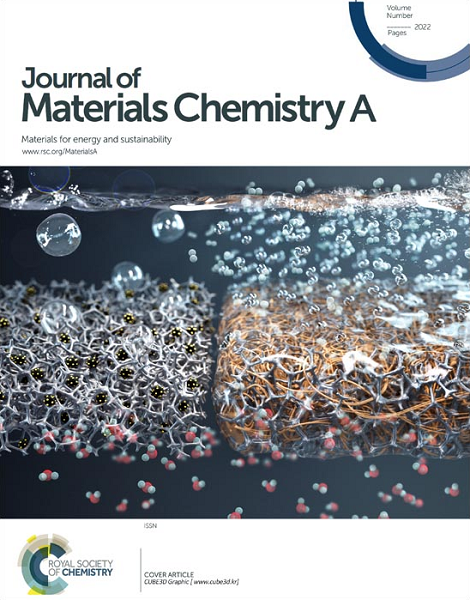
The Journal of Materials Chemistry A, B & C covers a wide range of high-quality studies in the field of materials chemistry, with each section focusing on specific applications of the materials studied. Journal of Materials Chemistry A emphasizes applications in energy and sustainability, including topics such as artificial photosynthesis, batteries, and fuel cells. Journal of Materials Chemistry B focuses on applications in biology and medicine, while Journal of Materials Chemistry C covers applications in optical, magnetic, and electronic devices. Example topic areas within the scope of Journal of Materials Chemistry A include catalysis, green/sustainable materials, sensors, and water treatment, among others.




 京公网安备 11010802042870号
京ICP备2023020795号-1
京公网安备 11010802042870号
京ICP备2023020795号-1

 分享
分享
 求助内容:
求助内容: 应助结果提醒方式:
 扫码关注我们
