Jie Liu, Peng Wang, Xiaoyu Yang, Zinan Wang, Hangyu Miao, Zhe Li, Wei Duan, Ying Yue, Yunpeng Liu and Yang Ju
{"title":"A thiol-modified solid electrolyte interphase enhances the stability of zinc anodes under high depths of discharge†","authors":"Jie Liu, Peng Wang, Xiaoyu Yang, Zinan Wang, Hangyu Miao, Zhe Li, Wei Duan, Ying Yue, Yunpeng Liu and Yang Ju","doi":"10.1039/D5TA01051A","DOIUrl":null,"url":null,"abstract":"<p >Aqueous zinc-ion batteries (AZIBs) have gained considerable attention within the growing energy storage sector. However, dendritic growth and side reactions on zinc anodes significantly degrade battery stability, especially at high depths of discharge (DODs). These issues present a substantial challenge in attaining long-term cycling performance. In this study, a new electrolyte additive, tris[2-(3-mercaptopropionyloxy)ethyl] isocyanurate (TMPEI), was employed to optimize the interface between the zinc electrode and electrolyte, effectively addressing these issues. The thiol groups in TMPEI strongly interact with zinc metal, forming stable Zn–S bonds through coordination interactions. This interaction results in the formation of a reliable and durable solid electrolyte interphase (SEI) layer on the zinc surface. This SEI layer not only controls zinc-ion deposition and inhibits dendrite growth but also decreases the energy barrier for zinc deposition. Furthermore, the hydrophobic properties of TMPEI help repel water molecules from the zinc anode, significantly limiting the hydrogen evolution reaction (HER) and corrosion processes. This effective interfacial protection enables Zn‖Zn symmetric cells to achieve stable cycling for up to 2000 h at 5 mA cm<small><sup>−2</sup></small> and 5 mA h cm<small><sup>−2</sup></small>. Even under a high current density of 10 mA cm<small><sup>−2</sup></small> and a high DOD of 56.93%, the battery still demonstrates a cycling lifespan of 500 h. This research provides an efficient design strategy to enhance the cycling stability of zinc anodes in AZIBs under extreme conditions.</p>","PeriodicalId":82,"journal":{"name":"Journal of Materials Chemistry A","volume":" 30","pages":" 24483-24494"},"PeriodicalIF":9.5000,"publicationDate":"2025-04-15","publicationTypes":"Journal Article","fieldsOfStudy":null,"isOpenAccess":false,"openAccessPdf":"","citationCount":"0","resultStr":null,"platform":"Semanticscholar","paperid":null,"PeriodicalName":"Journal of Materials Chemistry A","FirstCategoryId":"88","ListUrlMain":"https://pubs.rsc.org/en/content/articlelanding/2025/ta/d5ta01051a","RegionNum":2,"RegionCategory":"材料科学","ArticlePicture":[],"TitleCN":null,"AbstractTextCN":null,"PMCID":null,"EPubDate":"","PubModel":"","JCR":"Q1","JCRName":"CHEMISTRY, PHYSICAL","Score":null,"Total":0}
引用次数: 0
Abstract
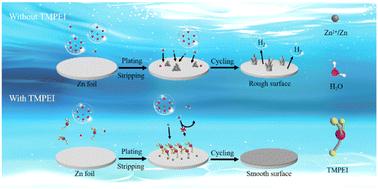
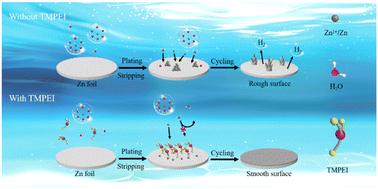
Aqueous zinc-ion batteries (AZIBs) have gained considerable attention within the growing energy storage sector. However, dendritic growth and side reactions on zinc anodes significantly degrade battery stability, especially at high depths of discharge (DODs). These issues present a substantial challenge in attaining long-term cycling performance. In this study, a new electrolyte additive, tris[2-(3-mercaptopropionyloxy)ethyl] isocyanurate (TMPEI), was employed to optimize the interface between the zinc electrode and electrolyte, effectively addressing these issues. The thiol groups in TMPEI strongly interact with zinc metal, forming stable Zn–S bonds through coordination interactions. This interaction results in the formation of a reliable and durable solid electrolyte interphase (SEI) layer on the zinc surface. This SEI layer not only controls zinc-ion deposition and inhibits dendrite growth but also decreases the energy barrier for zinc deposition. Furthermore, the hydrophobic properties of TMPEI help repel water molecules from the zinc anode, significantly limiting the hydrogen evolution reaction (HER) and corrosion processes. This effective interfacial protection enables Zn‖Zn symmetric cells to achieve stable cycling for up to 2000 h at 5 mA cm−2 and 5 mA h cm−2. Even under a high current density of 10 mA cm−2 and a high DOD of 56.93%, the battery still demonstrates a cycling lifespan of 500 h. This research provides an efficient design strategy to enhance the cycling stability of zinc anodes in AZIBs under extreme conditions.
水性锌离子电池(azib)在日益增长的能源存储领域得到了相当大的关注。然而,锌阳极上的枝晶生长和副反应显著降低了电池的稳定性,特别是在高放电深度(DODs)下。这些问题对实现长期循环性能提出了重大挑战。本研究采用一种新的电解质添加剂三[2-(3-巯基丙酰氧基)乙基]异氰尿酸酯(TMPEI)来优化锌电极与电解质之间的界面,有效地解决了这些问题。TMPEI中的巯基与锌金属相互作用强烈,通过配位相互作用形成稳定的Zn-S键。这种相互作用导致锌表面形成可靠耐用的固体电解质界面层(SEI)。该SEI层不仅控制了锌离子的沉积,抑制了枝晶的生长,而且降低了锌沉积的能垒。此外,TMPEI的疏水性有助于排斥锌阳极的水分子,显著限制析氢反应(HER)和腐蚀过程。这种有效的界面保护使Zn‖Zn对称电池能够在5ma cm - 2和5ma h cm - 2下实现高达2000小时的稳定循环。即使在10 mA cm−2的高电流密度和56.93%的高DOD下,电池仍然具有500 h的循环寿命。该研究为提高AZIBs中锌阳极在极端条件下的循环稳定性提供了一种有效的设计策略。
期刊介绍:
The Journal of Materials Chemistry A, B & C covers a wide range of high-quality studies in the field of materials chemistry, with each section focusing on specific applications of the materials studied. Journal of Materials Chemistry A emphasizes applications in energy and sustainability, including topics such as artificial photosynthesis, batteries, and fuel cells. Journal of Materials Chemistry B focuses on applications in biology and medicine, while Journal of Materials Chemistry C covers applications in optical, magnetic, and electronic devices. Example topic areas within the scope of Journal of Materials Chemistry A include catalysis, green/sustainable materials, sensors, and water treatment, among others.



 京公网安备 11010802042870号
京ICP备2023020795号-1
京公网安备 11010802042870号
京ICP备2023020795号-1

 分享
分享
 求助内容:
求助内容: 应助结果提醒方式:
 扫码关注我们
